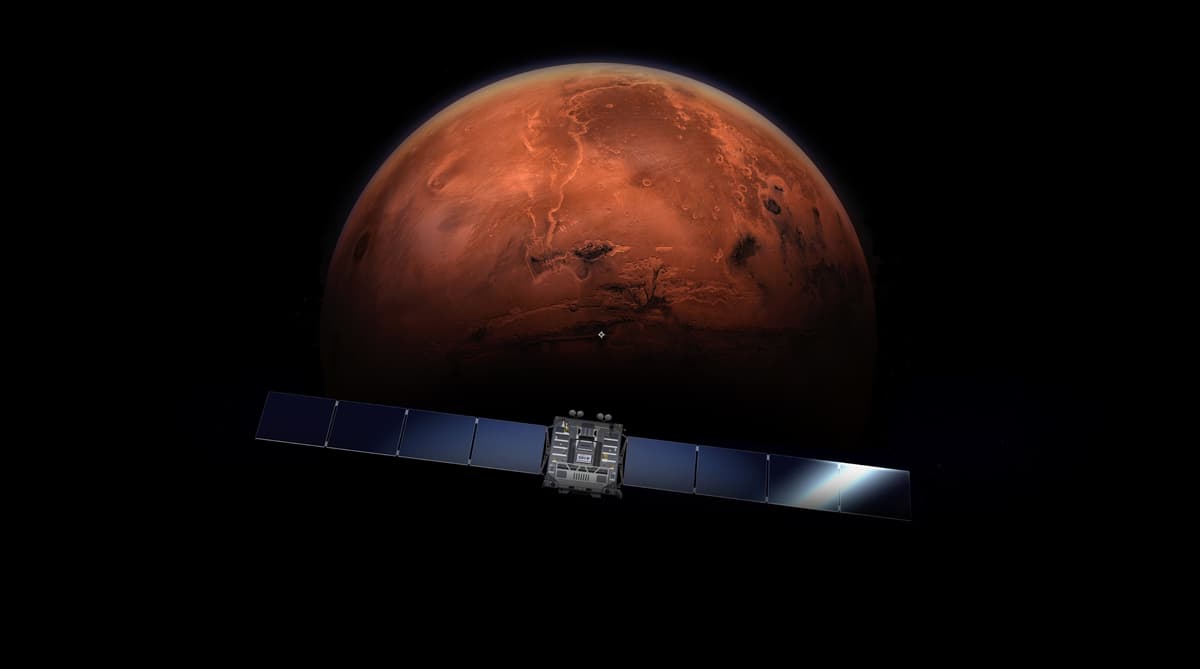
Relativity Space to Privately Develop Mars Orbiter Mission
Companies Mentioned

Why It Matters
The orbiter demonstrates that private firms can field end‑to‑end planetary missions, potentially lowering costs and accelerating scientific return. Success could reshape the commercial space market by adding data services and AI processing as new revenue streams.
Key Takeaways
- •Relativity aims to launch Mars orbiter in late 2028
- •Orbiter will carry NASA atmospheric profiler and subsurface radar
- •Mission will test high‑bandwidth laser links and on‑board AI compute
- •Funding includes undisclosed philanthropic partner; cost not disclosed
- •Terran R reusable rocket slated for first launch 2027, supporting mission
Pulse Analysis
Relativity Space’s new Interplanetary Sciences Program marks a strategic pivot from pure launch services to full‑scale planetary exploration. By committing to a 2028 Mars orbiter, the company joins a small but growing cohort of private actors seeking to deliver scientific payloads traditionally reserved for national agencies. The initiative leverages Relativity’s 3D‑printed, reusable Terran R rocket, promising lower launch costs and faster turnaround, while the partnership model—mixing industry, academia, and philanthropy—signals a broader shift toward diversified funding for deep‑space research.
The orbiter’s payload suite blends classic science with next‑generation communications. NASA’s Ames Research Center will supply an atmospheric profiling instrument, while a radar payload will map subsurface ice and geology, offering fresh insights into Martian climate history. More notable are the high‑bandwidth laser and RF links that will serve as a data conduit between Earth and surface assets, coupled with massive on‑board storage and server‑class compute. This architecture enables real‑time AI processing and autonomous decision‑making, potentially reducing latency and expanding the scope of future surface missions that rely on rapid data exchange.
From a business perspective, the mission illustrates how private capital can underwrite ambitious science while opening new commercial avenues. The undisclosed philanthropic backer suggests a model where wealthy donors fund high‑impact research in exchange for data access or branding, reducing reliance on government contracts. If successful, Relativity could monetize the orbiter’s communications node, offering bandwidth services to other Mars missions and establishing a recurring revenue stream. The move also pressures traditional aerospace firms to integrate advanced data services, accelerating competition and innovation across the commercial space ecosystem.
Relativity Space to privately develop Mars orbiter mission
Comments
Want to join the conversation?
Loading comments...