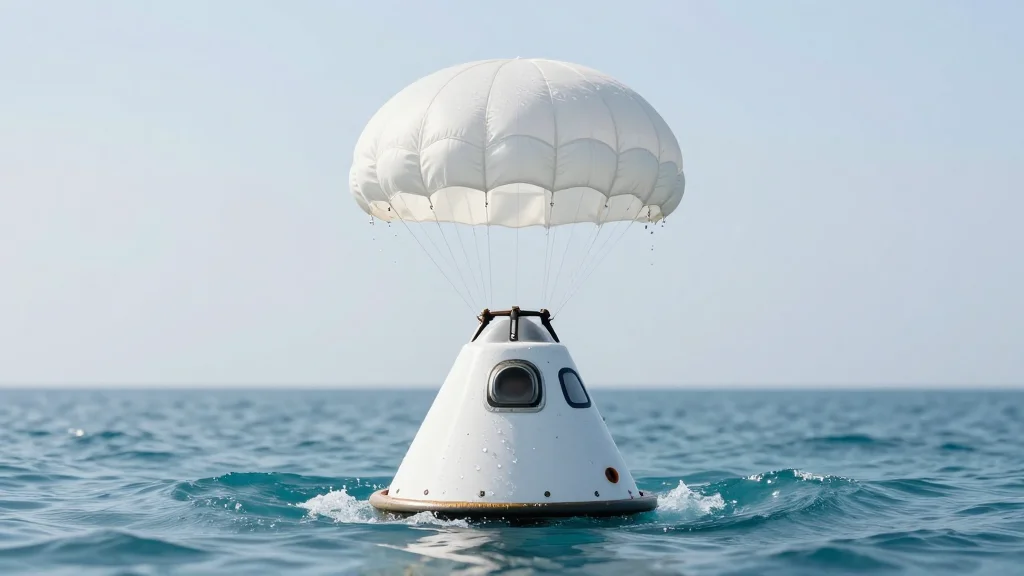
Research Helps Power Safe Return of Astronauts in Historic Orion Splashdown
Why It Matters
The Rice‑led FSI work cut development time and expenses while ensuring a stable, human‑rated parachute, a critical safety component for future deep‑space missions. It demonstrates how high‑fidelity academic research can de‑risk NASA’s hardware and accelerate exploration timelines.
Key Takeaways
- •Rice's FSI simulations cut Orion parachute testing costs.
- •Simulations identified shape instability, leading to stable canopy design.
- •Virtual testing accelerated development timeline by months.
- •Only academic team providing full parachute FSI analysis for Orion.
- •Work showcases high‑fidelity CFD‑structure coupling for large aerospace systems.
Pulse Analysis
The Artemis II mission marked a historic milestone when NASA’s Orion capsule touched down in the Pacific on April 10, 2026. While the crew’s safe return captured headlines, the unheralded three‑parachute system was the linchpin that slowed the 26‑ton vehicle to a gentle splash. Designing a parachute large enough to generate sufficient drag yet stable enough to avoid oscillations is a classic aerospace dilemma, especially for human‑rated spacecraft where even minor speed variations can jeopardize crew safety.
Rice University’s mechanical‑engineering team, led by Professor Tayfun E. Tezduyar and collaborator Kenji Takizawa, supplied the only full‑scale fluid‑structure interaction (FSI) analysis for Orion’s parachutes, a project that began in 2013. Their high‑fidelity simulations captured the two‑way coupling between aerodynamic forces and fabric deformation, revealing that early Apollo‑derived designs suffered from canopy diameter fluctuations. By iterating virtually over canopy shapes and suspension‑line layouts, the researchers pinpointed a configuration that eliminated instability, allowing NASA to validate the design with fewer costly drop tests.
The success of Orion’s splashdown underscores how advanced computational tools can shrink development cycles and budgets for high‑risk space hardware. By replacing dozens of physical drop tests with virtual experiments, NASA saved millions of dollars and accelerated the schedule for subsequent Artemis missions. Moreover, the collaboration illustrates the growing value of university‑industry partnerships in tackling complex multiphysics problems, a trend likely to expand as private firms and NASA pursue larger payloads and lunar‑surface operations. Rice’s FSI framework now serves as a template for future parachute and inflatable‑structure designs across the aerospace sector. Its adoption promises safer, more cost‑effective missions to the Moon and beyond.
Research helps power safe return of astronauts in historic Orion splashdown
Comments
Want to join the conversation?
Loading comments...