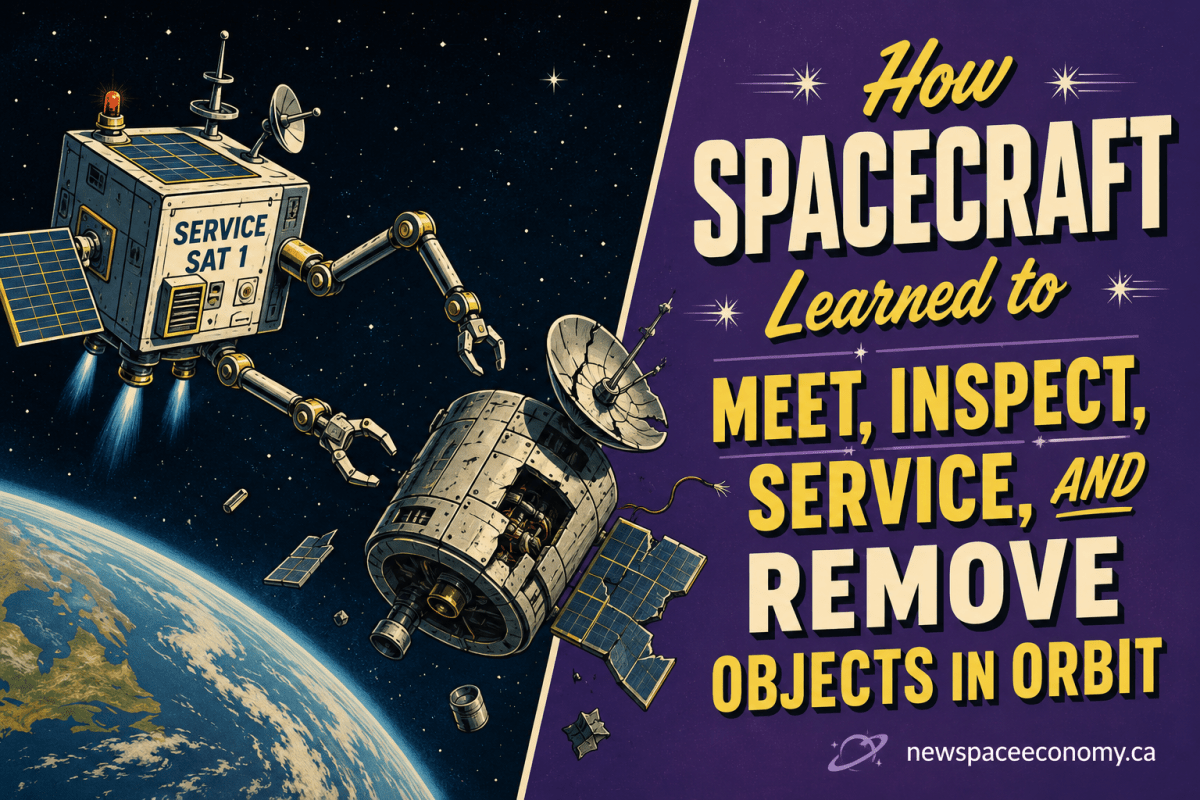
RPO Past, Present, and Future: How Spacecraft Learned to Meet, Inspect, Service, and Remove Objects in Orbit
Companies Mentioned
Why It Matters
RPO transforms the traditional build‑launch‑replace model, unlocking new revenue streams, enhancing space sustainability, and providing strategic defense tools, making it a pivotal capability for the emerging space economy.
Key Takeaways
- •Gemini missions pioneered rendezvous, enabling modern RPO capabilities
- •MEV-1 extended Intelsat 901, proving profitable GEO life‑extension
- •ClearSpace‑1 will be first active debris removal of an uncooperative satellite
- •Industry standards like CONFERS and ISO 24330 aim to build trust
- •Autonomy and standardized interfaces are critical for scaling commercial RPO services
Pulse Analysis
On‑orbit servicing has moved from a series of historic crewed rendezvous to a robust commercial ecosystem. Early milestones—Gemini’s docking, Soviet automated Kurs, and Europe’s ATV—established the navigation, propulsion, and safety fundamentals that today’s autonomous servicers rely on. Modern missions such as Northrop Grumman’s Mission Extension Vehicles demonstrate that extending a geostationary satellite’s life can preserve hundreds of millions of dollars in revenue, while Japan’s Astroscale and ESA’s ClearSpace‑1 illustrate how precise proximity operations can turn debris from a liability into a serviceable asset. These successes are reshaping satellite economics, turning what was once a one‑off demonstration into a repeatable, revenue‑generating service.
The commercial viability of RPO hinges on two technical pillars: standardized docking or grapple interfaces and high‑level autonomy. Operators that embed docking ports, fiducial markers, or refueling adapters enable servicers to perform repeatable missions with lower risk and cost. At the same time, onboard AI‑driven navigation and collision‑avoidance reduce reliance on ground‑segment approvals, making low‑value LEO satellites economically serviceable. Companies like Starfish Space and Impulse Space are proving that fully autonomous rendezvous can be achieved in under‑hour timelines, a crucial step toward scaling life‑extension and de‑orbit services for megaconstellations.
Regulatory and trust frameworks are the final piece of the puzzle. The CONFERS consortium and ISO 24330 provide best‑practice guidelines that address liability, safety zones, and data sharing, while UN sustainability guidelines push for responsible debris mitigation. Insurance underwriters are beginning to price RPO missions based on these standards, giving investors confidence to fund larger service contracts. As governments continue to fund defense‑oriented inspection and as commercial operators seek cost‑effective end‑of‑life solutions, the market is poised to expand across GEO life‑extension, LEO de‑orbit, and future on‑orbit assembly, cementing RPO as a cornerstone of the next‑generation space economy.
RPO Past, Present, and Future: How Spacecraft Learned to Meet, Inspect, Service, and Remove Objects in Orbit
Comments
Want to join the conversation?
Loading comments...