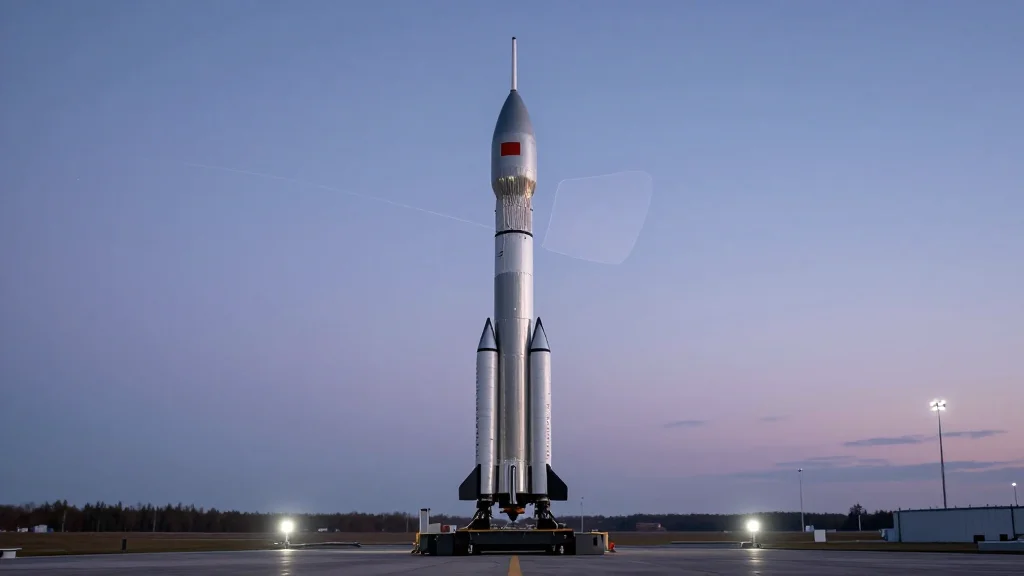
Russia Launches the Smallest Version of Its Angara Rocket
Companies Mentioned
Why It Matters
The flight proves Russia can field a low‑cost small‑sat launcher, yet the limited launch cadence and security risks at Plesetsk expose hurdles in competing for the booming commercial market.
Key Takeaways
- •Angara‑1.2 successfully reached orbit, confirming smallest Angara variant.
- •Launch carried classified payloads, likely reinforcing Russia’s military satellite fleet.
- •Plesetsk’s exposure to Ukrainian drones threatens future Russian launch reliability.
- •Russia logged only six launches in 2026, far behind SpaceX’s 49.
- •Angara‑1.2 could open niche commercial market if cost‑effective.
Pulse Analysis
The Angara‑1.2 represents the latest evolution of Russia’s modular launch architecture, designed to serve payloads under 2,500 kilograms. By scaling down the core booster and using a single RD‑191 engine, the vehicle offers a cheaper, more flexible alternative to the larger Angara‑5. Analysts see this as a strategic move to capture the growing small‑sat segment, where launch frequency and price per kilogram are decisive factors. While the technical success validates the design, the real test will be whether Russia can sustain production and secure a steady stream of customers.
Beyond the engineering milestone, the mission’s classified payloads hint at a renewed emphasis on military satellite capabilities. Russia has been modernizing its communications, navigation, and reconnaissance constellations, and a dedicated small‑launch vehicle enables rapid deployment of niche assets. However, the Plesetsk launch complex’s vulnerability to Ukrainian drone incursions raises operational concerns. A recent drone strike forced a scrubbed launch, prompting officials to limit public disclosure and reconsider site security protocols. This security calculus could affect launch scheduling, insurance costs, and ultimately the reliability perception among prospective commercial users.
In the broader launch ecosystem, Russia’s six launches in 2026 starkly contrast with SpaceX’s 49, highlighting a widening gap in launch cadence and market share. While the Angara‑1.2 could carve out a niche for small, government‑grade missions, competing against the cost efficiencies of SpaceX’s Falcon 9 and the agility of Rocket Lab’s Electron will be challenging. To remain relevant, Russian launch providers may need to streamline operations, improve cost structures, and address the geopolitical risks that threaten their launch infrastructure. The Angara‑1.2’s success is a step forward, but sustained competitiveness will depend on how quickly these broader issues are resolved.
Russia launches the smallest version of its Angara rocket
Comments
Want to join the conversation?
Loading comments...