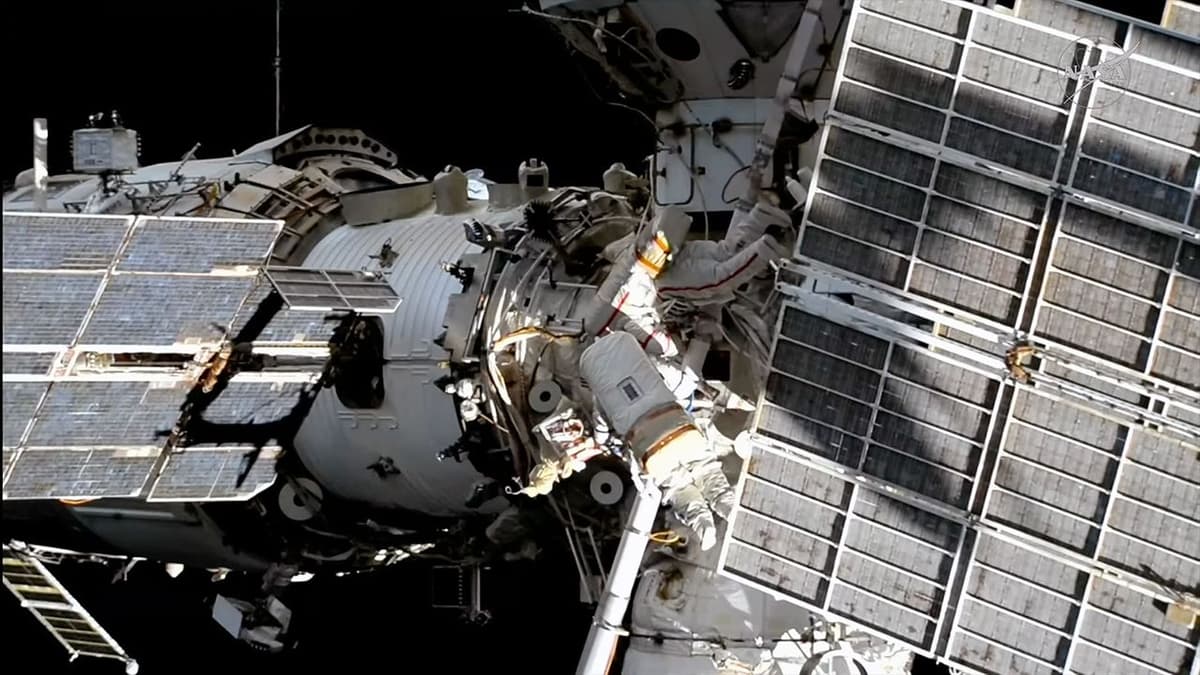
Russian Cosmonauts Install Sun-Watching Telescope on ISS During 6-Hour Spacewalk
Why It Matters
The solar‑flare telescope strengthens space‑weather forecasting, safeguarding satellites and power grids, while the EVA underscores Russia’s ongoing role in ISS upkeep and cutting‑edge microgravity research.
Key Takeaways
- •Solntse‑Teragerts telescope installed to monitor solar flares until 2028
- •EVA lasted 6 hours 5 minutes, marking cosmonaut Kud‑Sverchkov’s second spacewalk
- •Ekran‑M experiment retrieved gallium arsenide films despite tool loss
- •Progress MS‑33 antenna inspected after failed deployment during March launch
Pulse Analysis
The International Space Station’s 279th spacewalk highlighted the strategic value of solar‑weather monitoring. By mounting the Solntse‑Teragerts telescope on Zvezda, Russian engineers aim to capture high‑frequency solar‑flare data that feeds into global forecasting models. Accurate predictions help satellite operators and power‑grid managers mitigate the disruptive effects of geomagnetic storms, a growing concern as reliance on space‑based services expands.
Beyond the telescope, the EVA showcased the unique science possible in microgravity. The Ekran‑M molecular‑beam epitaxy experiment produced ultra‑pure gallium arsenide films, a material critical for next‑generation high‑speed electronics and photonics. Recovering the sample despite a lost pair of pliers demonstrated crew ingenuity and the robustness of on‑orbit manufacturing pipelines, reinforcing the ISS’s role as a testbed for commercial space‑industry technologies.
Finally, the mission reinforced international collaboration and Russia’s continued investment in orbital infrastructure. Inspecting the Progress MS‑33 antenna and retrieving a biorisk container ensured the station’s operational safety and supported biological research on Earth‑origin organisms in space. As the ISS transitions toward commercial management, such EVAs provide essential experience for future lunar gateway and deep‑space habitats, where on‑site maintenance and scientific payloads will be indispensable.
Russian cosmonauts install sun-watching telescope on ISS during 6-hour spacewalk
Comments
Want to join the conversation?
Loading comments...