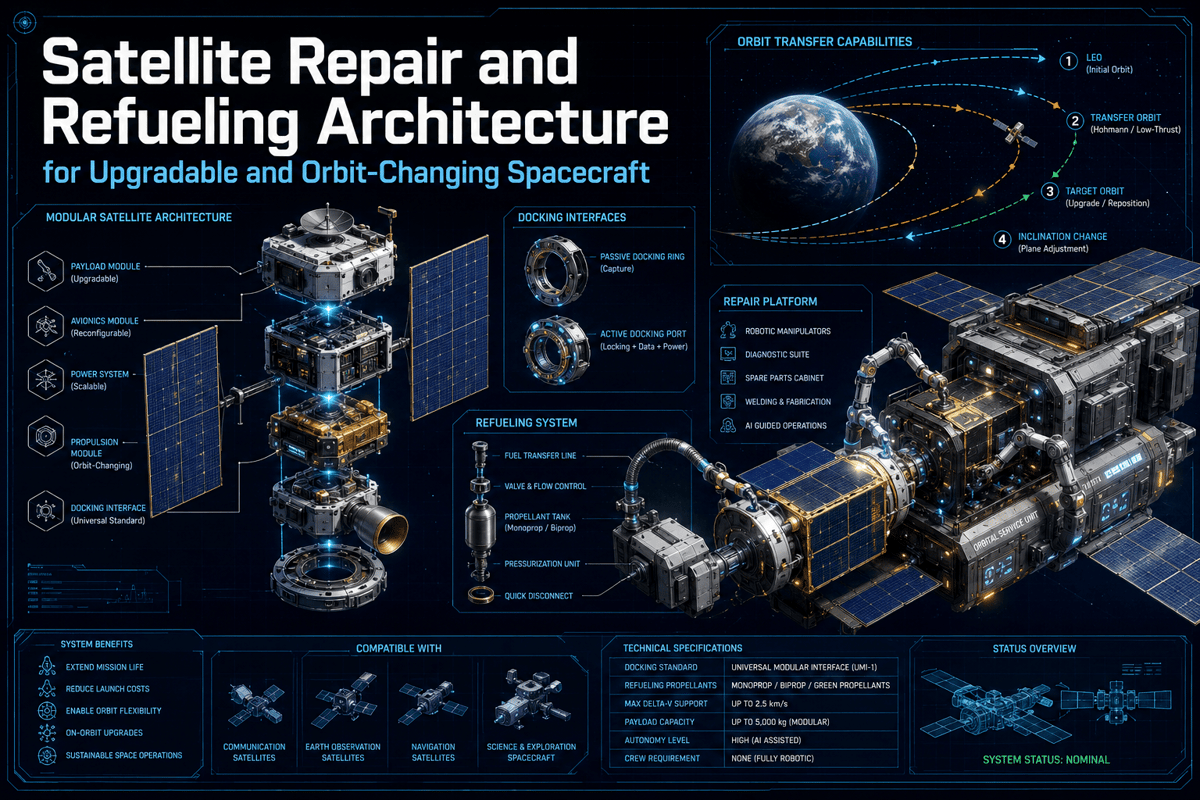
Satellite Repair and Refueling Architecture for Upgradable and Orbit-Changing Spacecraft
Why It Matters
Serviceable satellites extend operational life, lower total ownership cost, and create a new market for on‑orbit servicing, reshaping satellite economics and regulatory planning.
Key Takeaways
- •Standardized docking ports enable robotic capture and refueling
- •Modular bus units allow payload swaps and on‑orbit upgrades
- •Service models dictate mass, cost, and insurance implications
- •Refueling extends life only if propulsion is primary limitation
- •Software openness is essential for safe, authenticated servicing
Pulse Analysis
The emergence of on‑orbit servicing is moving satellites from disposable hardware to maintainable platforms. The 2020 docking of Northrop Grumman’s Mission Extension Vehicle with Intelsat IS‑901 proved that a vehicle can safely attach to a client that was built with service points, confirming that repairable architecture is no longer theoretical. Lessons from the Hubble Space Telescope—modular bays, handholds, and open connectors—show how standardized access points simplify robotic manipulation. Designers now embed grapple fixtures, blind‑mate fluid ports, and cooperative navigation beacons into the bus, turning the spacecraft into a machine that can be inspected, refueled, or upgraded years after launch.
Technical standards are coalescing around a common service interface. ISO 24330:2022 defines rendezvous geometry and proximity‑operation protocols, while the draft AIAA S‑159 outlines power‑and‑data blind‑mate connectors that prevent mis‑mating in vacuum. By adopting these open specifications, satellite manufacturers reduce one‑off negotiations with each servicer and enable a market of interchangeable refueling depots, orbital tugs, and upgrade modules. The trade‑off is additional mass for docking hardware, isolation valves, and captive fasteners, which must be balanced against the revenue gained from extending station‑keeping life or swapping out obsolete payloads.
From a business perspective, serviceable satellites reshape the economics of the space industry. Operators can launch a heavier, longer‑lasting bus and amortize the cost over multiple mission phases, or they can opt for a lighter baseline platform and purchase life‑extension services on demand. This flexibility influences insurance premiums, licensing, and debris‑mitigation compliance, because a refueled or relocated satellite can meet end‑of‑life disposal requirements more reliably. However, the model hinges on secure software interfaces; authenticated servicing modes and robust cyber‑risk controls are now as critical as the mechanical docking hardware for ensuring safe, repeatable on‑orbit operations.
Satellite Repair and Refueling Architecture for Upgradable and Orbit-Changing Spacecraft
Comments
Want to join the conversation?
Loading comments...