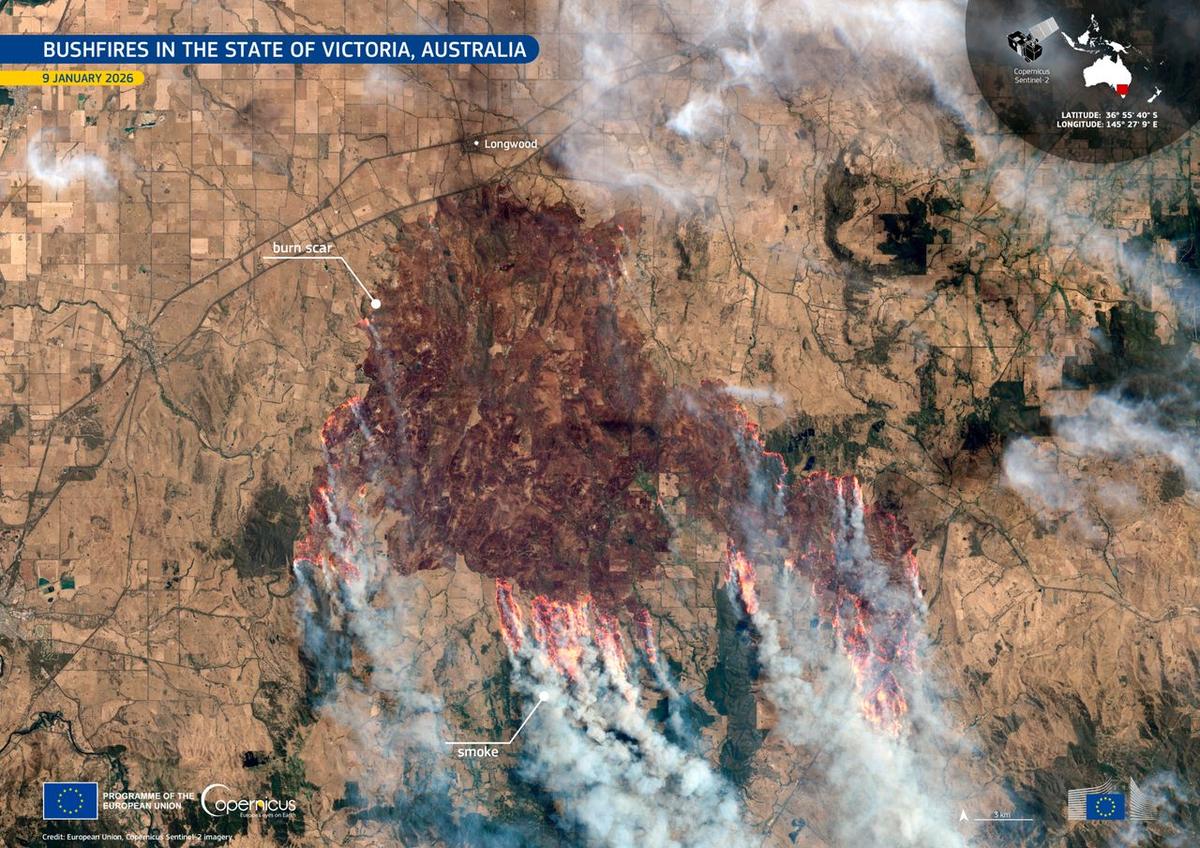
Satellites Spy Raging Bushfires in Australia | Space Photo of the Day for Jan. 15, 2026
•January 15, 2026
0
Why It Matters
Accurate, near‑real‑time satellite data improves firefighting coordination and informs recovery strategies, reducing economic and environmental losses. It also demonstrates how Copernicus can influence climate‑resilience policies worldwide.
Key Takeaways
- •Sentinel‑2 captured Australian bushfires on Jan 9, 2026.
- •Imagery maps burn scars, aiding emergency response.
- •Infrared bands differentiate smoke, soil, and charred vegetation.
- •Repeated scans monitor post‑fire ecosystem recovery.
- •Copernicus data supports policy and recovery planning.
Pulse Analysis
Satellite‑based Earth observation has become a cornerstone of modern disaster response, and Sentinel‑2 exemplifies that shift. Equipped with 13 spectral bands—including visible, near‑infrared, and short‑wave infrared—the constellation delivers sub‑10‑meter resolution imagery every five days. These bands allow analysts to isolate active flames, differentiate smoke from clouds, and quantify vegetation stress, providing a level of detail that ground teams cannot match. As climate change fuels hotter, drier conditions, the frequency of large‑scale wildfires is rising, making such timely data indispensable for governments and insurers alike.
The January 2026 Australian bushfires illustrate the practical impact of this technology. The Sentinel‑2 snapshot of Victoria showed dark burn scars and thick smoke corridors, enabling authorities to delineate affected zones within hours. Emergency managers used the data to prioritize evacuations, allocate firefighting resources, and coordinate power restoration for thousands of households. Moreover, the precise mapping fed into Copernicus’ fire‑severity indices, informing state‑level recovery budgets and guiding reforestation efforts. By integrating satellite feeds with local sensor networks, responders achieved a more coordinated, data‑driven approach than ever before.
Beyond immediate response, Sentinel‑2’s frequent revisits support long‑term ecological monitoring. Researchers can track soil moisture recovery, vegetation regrowth, and carbon sequestration over months and years, generating insights into ecosystem resilience. Coupled with AI‑driven change detection, the platform can predict high‑risk zones before the next fire season. This continuous feedback loop not only aids Australia but also serves as a template for global fire‑prone regions, reinforcing Copernicus’ role as a strategic asset for climate adaptation and disaster risk reduction.
Satellites spy raging bushfires in Australia | Space photo of the day for Jan. 15, 2026
0
Comments
Want to join the conversation?
Loading comments...