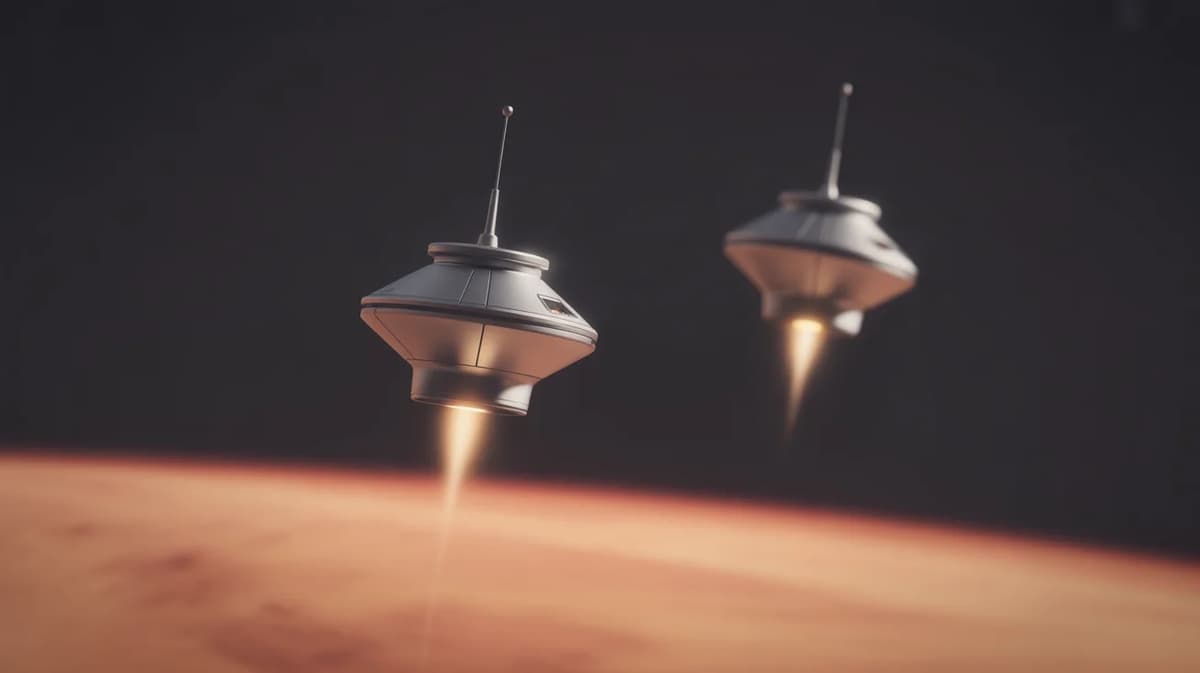
Second Escapade Mars Orbiter Completes a Delayed Engine Burn
•January 8, 2026
0
Why It Matters
Resolving the thrust issue keeps the Escapade mission on schedule, preserving its role in delivering high‑resolution data for Mars science. Timely execution of the November 2026 burn ensures the orbiters can meet their science objectives before competing missions.
Key Takeaways
- •Second Escapade orbiter finished delayed trajectory correction burn.
- •Telemetry showed lower-than-expected thrust during earlier maneuver.
- •NASA resolved thrust issue without public technical details.
- •Both orbiters slated for November 2026 Mars injection burn.
- •Mission remains on schedule for Mars orbit insertion.
Pulse Analysis
The Escapade program, a joint NASA‑industry effort, aims to place two small, cost‑effective orbiters around Mars to capture high‑resolution imagery and atmospheric data. By leveraging commercial launch services and miniaturized instruments, the mission promises to augment the scientific return of larger flagship missions while demonstrating scalable deep‑space operations. Successful placement of both spacecraft in a stable parking orbit marks a critical milestone, confirming that the platform’s navigation and communications subsystems are functioning as designed.
Mid‑course correction burns are routine but demand precise thrust performance to maintain the narrow trajectory windows required for interplanetary travel. The unexpected telemetry indicating reduced thrust raised concerns about propellant consumption, burn duration, and overall mission timeline. While NASA has not disclosed the engineering solution, typical remedies include software re‑calibration, valve adjustments, or redundancy activation. The swift resolution underscores the robustness of the orbiter’s propulsion architecture and the agency’s ability to troubleshoot anomalies without jeopardizing downstream events.
Looking ahead, the November 2026 engine firings will propel the orbiters onto a Mars‑bound trajectory, positioning them for arrival in early 2027. This timing aligns with a busy period of Mars exploration, offering opportunities for coordinated observations with other orbiters and landers. Maintaining schedule fidelity not only safeguards the scientific payloads but also reinforces confidence in low‑cost, rapid‑development spacecraft—a model that could reshape future planetary missions and commercial deep‑space ventures.
Second Escapade Mars orbiter completes a delayed engine burn
0
Comments
Want to join the conversation?
Loading comments...