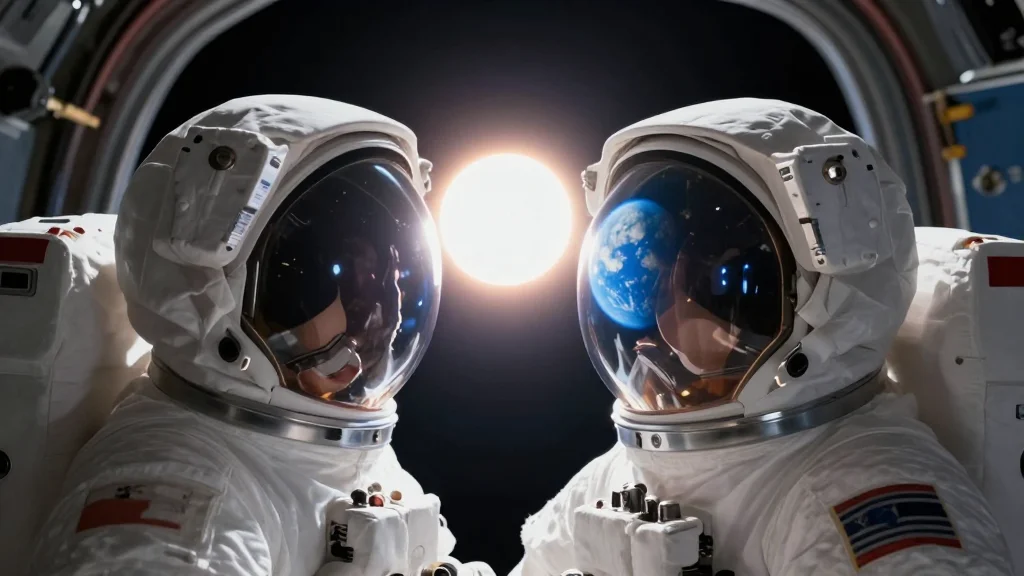
Seeing an Eclipse From Earth Is Awe‑inspiring—For Astronauts in Space, the Scene Was Even More Grand
Companies Mentioned

NASA
Why It Matters
The space‑based eclipse provides unique data on the solar corona and Earthshine, enhancing heliophysics research, while the emotional impact reinforces public interest and support for future lunar missions.
Key Takeaways
- •Artemis II crew witnessed first total solar eclipse from lunar vicinity
- •Eclipse view lasted roughly 54 minutes, longer than Earth‑bound totalities
- •Earthshine illuminated Moon’s surface, revealing craters in dim twilight
- •Astronauts reported profound awe, influencing their perspective on Earth
- •Space‑based eclipse offers unique data on solar corona dynamics
Pulse Analysis
The Artemis II crew became the first humans to witness a total solar eclipse from beyond Earth’s atmosphere on 6 April 2026. While looping around the Moon, the spacecraft aligned so that the Moon completely obscured the Sun, creating a 54‑minute period of darkness that dwarfed any ground‑based totality. The view differed dramatically: the lunar silhouette appeared larger than the Sun, and the faint glow of Earthshine bathed the Moon’s rugged terrain. Astronauts Victor Glover and Reid Wiseman described the scene as “sci‑fi” and a moment of pure awe.
From a scientific standpoint the space‑borne eclipse offered a rare perspective on the Sun’s corona. With the bright photosphere blocked, the corona’s fine structures could be recorded by Orion’s high‑resolution cameras for longer than the typical 2‑minute Earth totalities, improving models of solar wind acceleration. The simultaneous presence of Earthshine also provided a natural illumination experiment, allowing researchers to map lunar topography under low‑angle lighting. These observations complement ground‑based eclipse expeditions and could refine predictions of space‑weather events that affect satellite operations and power grids.
The psychological impact of witnessing an eclipse from lunar orbit underscores the broader value of human spaceflight. Astronauts reported a heightened sense of planetary fragility that often translates into stronger advocacy for Earth stewardship and scientific research. Public broadcasts of the event captured worldwide attention, reinforcing NASA’s outreach goals and fueling interest in upcoming commercial lunar missions and space‑tourism packages that promise similar awe‑inducing experiences. As agencies plan Artemis III and beyond, leveraging such unique visual phenomena could become a strategic tool for securing funding and inspiring the next generation of explorers.
Seeing an eclipse from Earth is awe‑inspiring—for astronauts in space, the scene was even more grand
Comments
Want to join the conversation?
Loading comments...