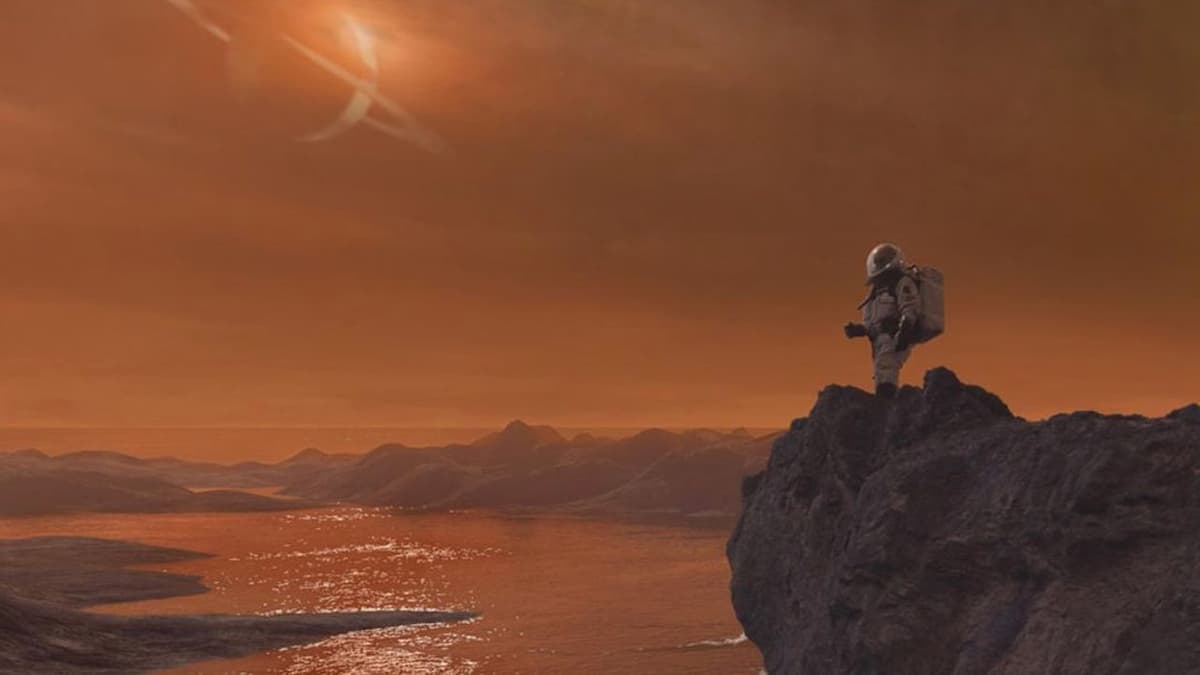
Should Saturn's Huge Moon Titan Be Humanity's Next Destination, After the Moon and Mars?
Why It Matters
Establishing Titan as the next human destination extends deep‑space exploration beyond Mars, driving new technologies and sustaining the commercial space economy. Success would demonstrate humanity’s ability to live and work on a distant, alien world, reshaping scientific and strategic priorities.
Key Takeaways
- •Humans to Titan Summit scheduled June 11‑12, 2026, Boulder, Colorado
- •Dragonfly mission launches 2028, will scout Titan for habitability
- •Titan’s dense atmosphere enables winged or jet‑pack mobility for astronauts
- •Surface pressure exceeds lunar levels; extreme cold demands advanced thermal systems
- •Robotic orbiters could map resources before crewed landings
Pulse Analysis
Titan, Saturn’s largest moon, has moved from a distant curiosity to a plausible target for human exploration. Its thick nitrogen‑rich atmosphere, surface lakes of liquid methane, and active geology resemble a primordial Earth, offering a unique laboratory for astrobiology and in‑situ resource utilization. After NASA’s Artemis program re‑establishes a lunar foothold and the agency plans crewed missions to Mars, planners are already looking farther out to keep momentum and justify the multibillion‑dollar investment in deep‑space infrastructure.
The upcoming Dragonfly mission, slated for launch no earlier than 2028, will spend three years flying across Titan’s surface, sampling dunes, cryovolcanoes and hydrocarbon lakes. Its suite of mass spectrometers, radar and infrared imagers will deliver high‑resolution maps of terrain, composition and seasonal weather patterns—data essential for designing habitats, power systems and propulsion concepts. By demonstrating autonomous aerial navigation in a dense, cold atmosphere, Dragonfly also de‑riskes the wing‑or‑jet‑pack mobility concepts that could allow astronauts to traverse the moon without traditional rovers.
Human missions to Titan face formidable engineering hurdles: surface temperatures hover near –179 °C, requiring advanced insulation and heat‑recycling life‑support; the 1.5‑bar pressure eliminates the need for bulky pressure suits but demands reliable thermal control; and the moon’s low gravity (0.14 g) changes fluid dynamics and muscle loading. Solutions may involve nuclear or solar‑thermal power, in‑situ oxygen extraction from nitrogen‑methane mixtures, and modular habitats that can be assembled by robotic precursors. The Humans to Titan Summit in June 2026 aims to align academia, industry and government around these challenges, turning speculative concepts into actionable roadmaps.
Should Saturn's huge moon Titan be humanity's next destination, after the moon and Mars?
Comments
Want to join the conversation?
Loading comments...