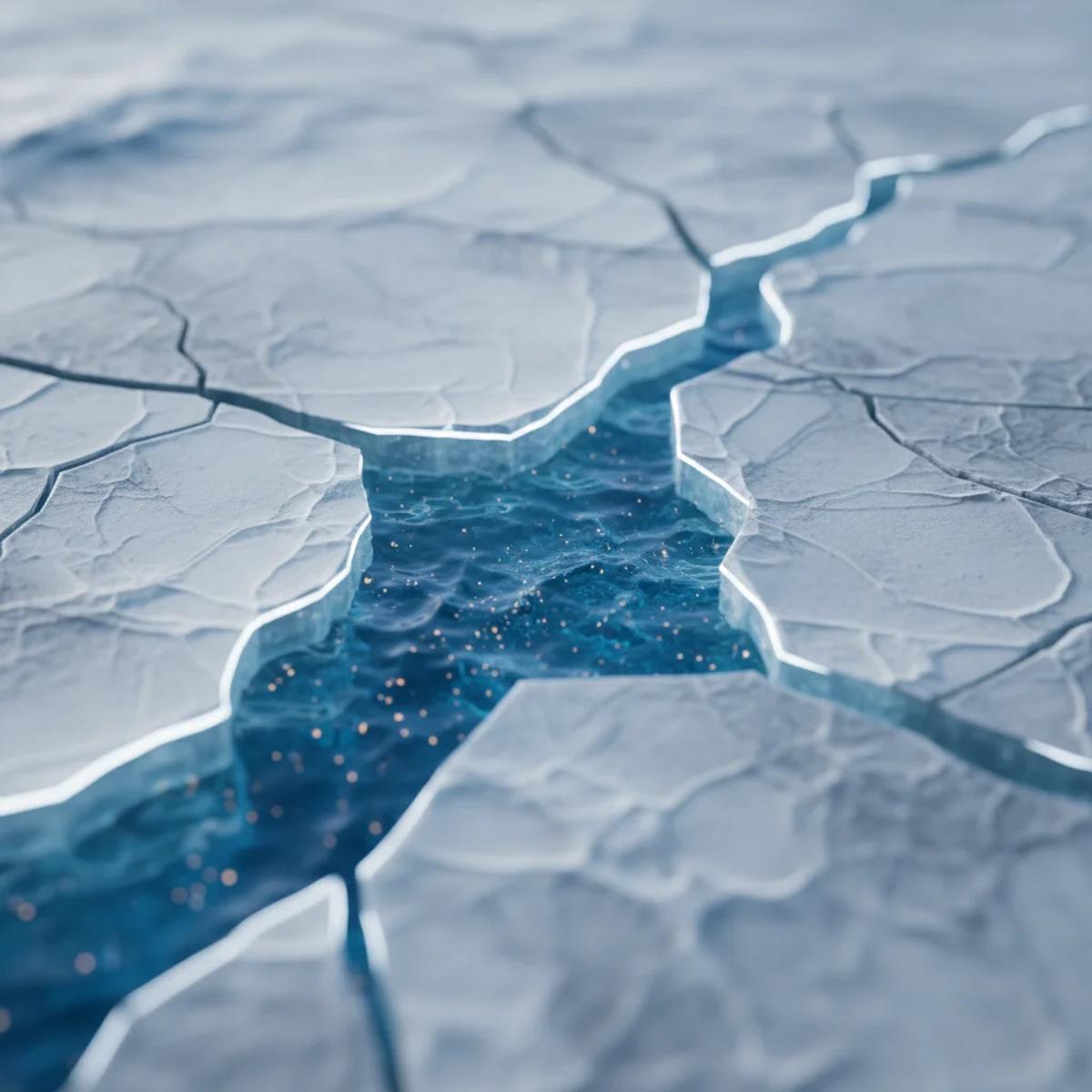
Sinking Salty Ice Suggests Pathway for Life-Sustaining Conditions in Europa's Ocean
•January 20, 2026
0
Companies Mentioned

NASA
Why It Matters
Delivering surface nutrients to Europa’s ocean dramatically raises the moon’s potential for supporting microbial life and informs target selection for upcoming missions. The mechanism also offers a testable hypothesis for interpreting Clipper’s ice‑shell observations.
Key Takeaways
- •Dense salty ice can sink through Europa's ice shell
- •Modeling shows sinking occurs for most salt concentrations
- •Process could deliver nutrients to subsurface ocean
- •Findings support Europa Clipper mission’s habitability goals
Pulse Analysis
Europa, Jupiter’s third‑largest moon, hides a global ocean that dwarfs Earth’s combined seas, sealed beneath a thick ice shell. Without sunlight, any life must rely on chemical energy and nutrients generated at the surface, where intense Jovian radiation converts salts and organics into bio‑available compounds. The key challenge is how these surface‑derived materials cross the tens of kilometers of ice to reach the liquid water below. Traditional models emphasize lateral ice motion, but they cannot explain a sustained vertical flux sufficient for a biosphere.
The study adapts Earth’s crustal delamination—where a dense, chemically altered layer detaches and sinks— to Europa’s ice shell. Thermomechanical simulations reveal that salt‑laden ice becomes heavy enough to overcome the buoyancy of surrounding pure ice, especially when micro‑fractures weaken the crystal lattice. Even modest salinity combined with slight weakening triggers a rapid plunge that can transport nutrient‑rich parcels from the surface to the ocean‑ice interface in geologically short timescales. This vertical transport offers a continuous, self‑reinforcing cycle that could replenish the ocean with essential elements.
For the Europa Clipper, slated to orbit the moon in the mid‑2020s, the delamination hypothesis offers a testable signature. Ice‑Penetrating Radar and the Mass Spectrometer could detect anomalous salt layers or temperature gradients indicating descending slabs. Validating this process would sharpen habitability assessments and guide landing‑site selection for future Europa landers. Moreover, the concept reshapes expectations for other icy ocean worlds, suggesting nutrient delivery may be common rather than exceptional. Ongoing modeling and forthcoming mission data will be crucial to confirm this promising pathway for extraterrestrial life.
Sinking salty ice suggests pathway for life-sustaining conditions in Europa's ocean
0
Comments
Want to join the conversation?
Loading comments...