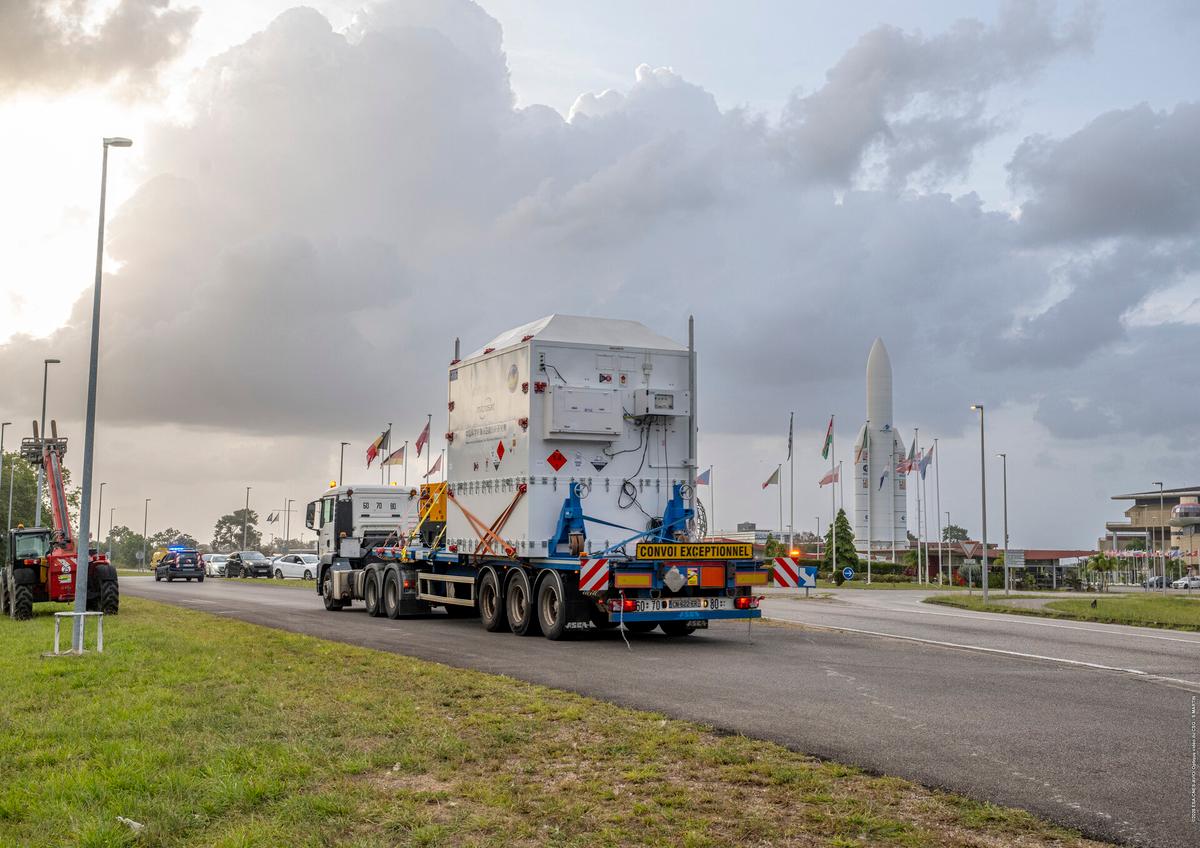
Smile Arrives at Europe’s Spaceport
•March 9, 2026
0
Why It Matters
Smile will deliver critical space‑weather data, improving forecasts that protect satellites and power grids, while Vega‑C demonstrates Europe’s autonomous access to high‑energy scientific missions.
Key Takeaways
- •Smile arrived via cargo ship Colibri on 26 Feb
- •Vega‑C integration begins, targeting April‑May launch window
- •Mission studies solar wind impacts on Earth’s magnetosphere
- •ESA provides launcher, payload module; CAS supplies instruments
- •Elliptical orbit reaches 121 000 km over North Pole
Pulse Analysis
The arrival of the Smile spacecraft in Kourou marks a pivotal step for Europe’s space science agenda. By transporting the probe on the maritime vessel Colibri, ESA minimized vibration and thermal stresses, preserving instrument integrity for the demanding solar‑wind measurements ahead. This logistical choice underscores the growing sophistication of ESA’s supply chain, which now blends sea, road, and ground handling to support high‑value payloads. The upcoming health‑check and propellant loading phases will verify that the spacecraft’s delicate sensors remain calibrated after the transatlantic crossing, a prerequisite for the mission’s scientific success.
Vega‑C, Europe’s newest small‑launch vehicle, is being assembled on the Kourou pad to carry Smile into a low‑Earth orbit before the upper stage delivers it to a 121 000‑km elliptical trajectory. The rocket’s three solid‑propellant stages provide robust thrust, while the liquid‑fuel upper stage ensures the precise insertion required for the mission’s polar passes. Vega‑C’s payload capacity of up to 2 300 kg positions it as a versatile complement to Ariane, offering cost‑effective access for scientific and Earth‑observation satellites. Its successful integration with Smile will validate the vehicle’s reliability for future ESA and commercial customers.
Beyond the technical milestones, Smile’s science goals address a critical gap in space‑weather forecasting. By measuring how solar wind interacts with Earth’s magnetosphere and ionosphere, the mission will refine models of geomagnetic storms that can disrupt communications, navigation, and power grids. The joint ESA‑CAS collaboration also exemplifies international cooperation, pooling European launch expertise with Chinese instrument development. As solar activity ramps up in the coming solar cycle, data from Smile could become essential for protecting the increasingly satellite‑dependent global economy.
Smile arrives at Europe’s Spaceport
0
Comments
Want to join the conversation?
Loading comments...