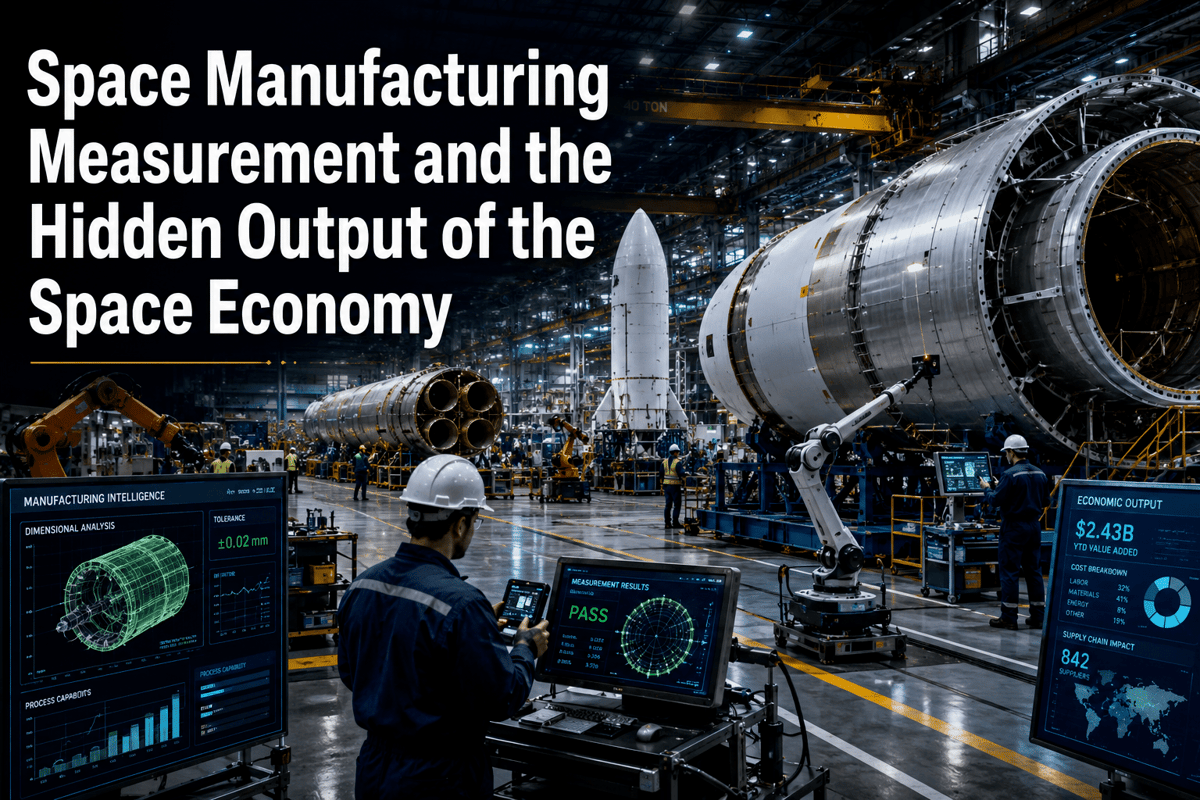
Space Manufacturing Measurement and the Hidden Output of the Space Economy
Companies Mentioned
Why It Matters
Accurate plant‑utilization data reveals hidden capacity constraints and investment, enabling investors, suppliers, and policymakers to anticipate bottlenecks and allocate resources more effectively in the space economy.
Key Takeaways
- •Space manufacturing accounts for 25.2% of U.S. space‑economy GDP (2022)
- •SEMPI shows average plant utilization of 67.2% from 2012‑2021
- •Own‑account production hides investment when firms build assets for internal use
- •Utilization drops can signal capacity expansion, not just demand weakness
- •Better utilization data helps investors, suppliers, and policymakers plan capacity
Pulse Analysis
Understanding how much of a factory’s capacity is actually being used has become a critical lens for the space industry, which blends defense, commercial, and scientific activities. Traditional GDP and sales figures capture revenue but miss the nuance of whether plants are operating near their limits or sitting idle. The newly proposed Space Economy Manufacturing Plant Utilization Index (SEMPI) bridges this gap by linking public plant‑capacity surveys with BEA’s space‑economy satellite accounts, offering a clearer picture of real‑time pressure on satellite, electronics, and launch‑vehicle production lines. This granular view helps differentiate between genuine demand shortfalls and temporary lulls caused by new capacity coming online.
A second, often overlooked, challenge is own‑account production—when vertically integrated firms such as SpaceX manufacture rockets or satellites for their own services rather than selling them on the open market. Standard revenue‑based metrics understate the economic contribution of these internal assets, leading to an incomplete assessment of capital formation and workforce needs. By applying cost‑based estimation methods—accounting for labor, materials, and capital services—analysts can capture the true scale of these investments, providing a more accurate gauge of the sector’s growth trajectory and its impact on broader manufacturing statistics.
For investors, suppliers, and government agencies, the implications are profound. High utilization rates flagged by SEMPI can signal impending bottlenecks, prompting proactive sourcing strategies or capital infusion to expand capacity. Conversely, a dip in utilization may indicate that firms are scaling up infrastructure, a positive sign for long‑term supply‑chain resilience. Policymakers can leverage these insights to fine‑tune procurement schedules, workforce development programs, and export‑control policies, ensuring the U.S. maintains a competitive edge in the burgeoning space economy. As data collection methods evolve, combining public indicators with confidential industry surveys will further sharpen the accuracy of space‑manufacturing metrics.
Space Manufacturing Measurement and the Hidden Output of the Space Economy
Comments
Want to join the conversation?
Loading comments...