Space Observatories and the Quest to Understand the Universe
•January 17, 2026
0
Why It Matters
By delivering unobstructed, multi‑spectral observations, space observatories drive fundamental discoveries that shape cosmology, particle physics, and planetary science, influencing both scientific knowledge and high‑technology sectors.
Key Takeaways
- •Space telescopes bypass atmospheric distortion, enabling clear observations
- •Multi‑wavelength data reveals cosmic evolution across epochs
- •Future interferometers like LISA will detect low‑frequency gravitational waves
- •Roman Telescope will survey dark energy and exoplanets efficiently
Pulse Analysis
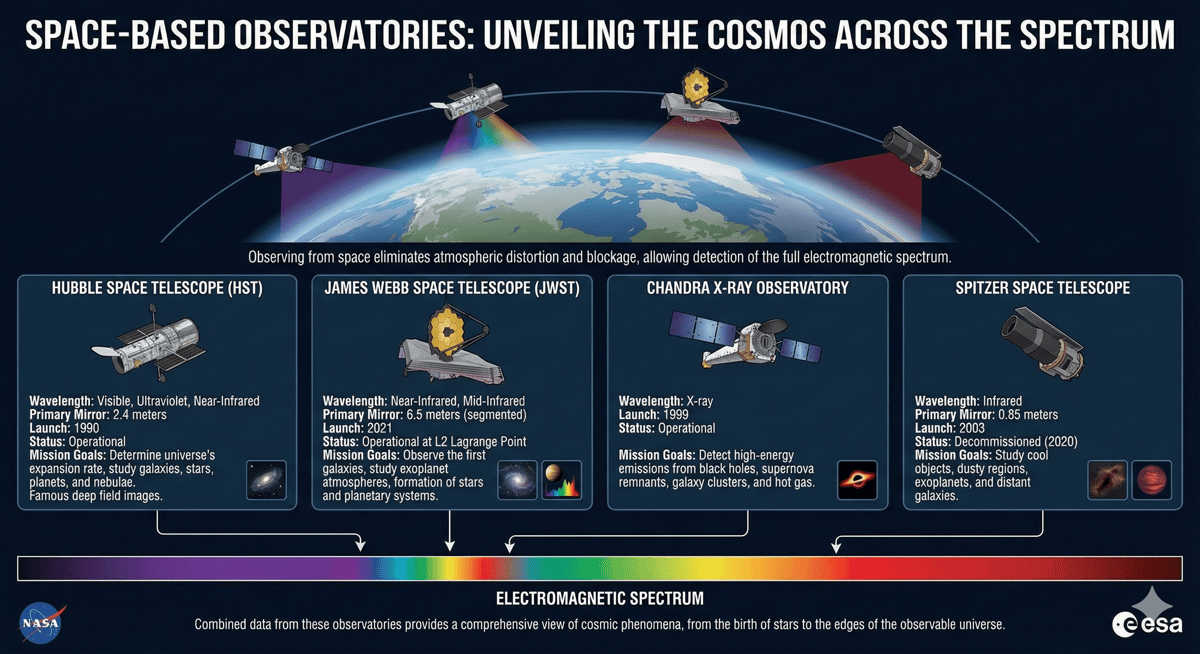
The atmosphere, while vital for life, acts as a filter that blocks most of the electromagnetic spectrum, forcing ground‑based astronomers to contend with turbulence and absorption. Deploying telescopes in orbit removes these constraints, allowing direct access to gamma‑ray bursts, X‑ray halos, ultraviolet star‑forming regions, infrared dust clouds, and the microwave afterglow of the Big Bang. This capability has turned astronomy from a primarily optical discipline into a true multi‑wavelength science, where each band uncovers distinct physical processes and together they construct a coherent narrative of cosmic evolution.
Decades of space‑based observations have reshaped our understanding of the universe. Hubble’s deep‑field images exposed the sheer abundance of distant galaxies, while Chandra’s high‑resolution X‑ray maps traced the distribution of dark matter in colliding clusters. The James Webb Space Telescope’s infrared sensitivity has already identified complex molecules in exoplanet atmospheres and captured galaxies formed within the first few hundred million years after the Big Bang. Meanwhile, missions such as Planck refined the cosmological parameters that define the universe’s age, composition, and geometry, anchoring theoretical models across physics.
The next generation of observatories promises even broader horizons. The Nancy Grace Roman Space Telescope will conduct wide‑field surveys to probe dark energy’s influence on cosmic acceleration and to discover thousands of new exoplanets. Proposed interferometers like LISA will listen to low‑frequency gravitational waves, opening a new messenger that complements electromagnetic data. As private firms enter the launch market and detector technologies become more compact, the pace of mission development accelerates, delivering faster data cycles that benefit both academic research and commercial sectors such as satellite communications and advanced materials.
Space Observatories and the Quest to Understand the Universe
0
Comments
Want to join the conversation?
Loading comments...