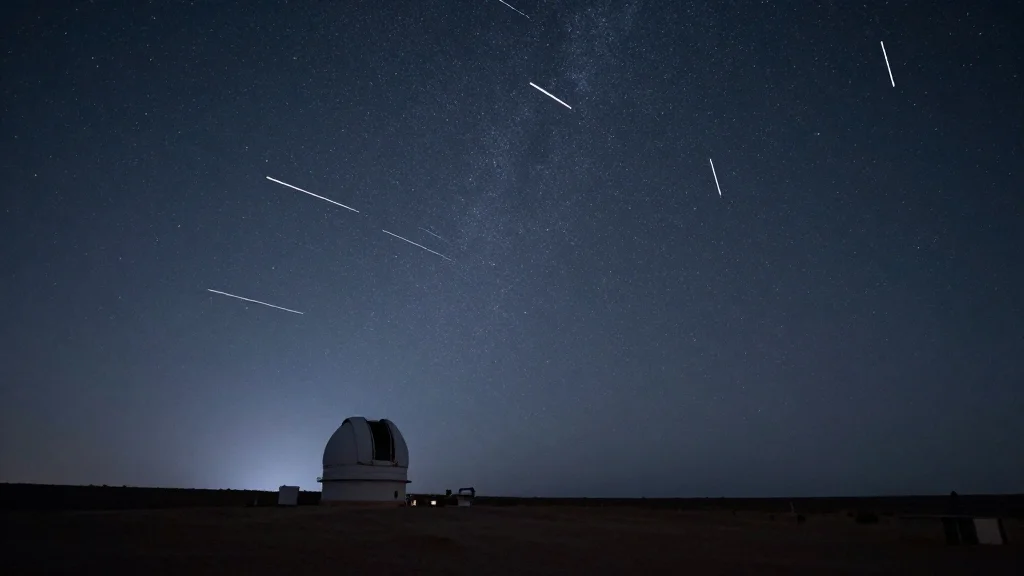
Space Telescopes Are Now Overwhelmed by Satellite Trails
Why It Matters
Satellite glare threatens the scientific return of space‑based observatories, jeopardizing near‑infrared surveys and long‑term cosmology data. The escalation could force costly redesigns or limit future missions.
Key Takeaways
- •73.3% of SPHEREx images contain at least one satellite trail
- •Average exposure sees 2.18 trails, forming an “X” pattern
- •Hubble’s trail contamination rose from 2.8% to 5.9% by 2021
- •FCC may allow 2 million LEO satellites, causing total image loss
- •Current mitigation like dark coatings cannot offset bright megaconstellations
Pulse Analysis
The rapid deployment of satellite megaconstellations has transformed the night sky, turning a once‑clear canvas into a crowded highway of reflective objects. While ground‑based observatories have long battled light pollution, space‑borne platforms like NASA’s SPHEREx—designed to map the entire sky in near‑infrared—are now facing comparable, if not greater, interference. Long exposure times and wide‑field imaging make SPHEREx especially vulnerable, resulting in an average of more than two artificial trails per frame and a 73.3% overall contamination rate.
Technical safeguards that once protected instruments from cosmic rays are being triggered by the intense brightness of modern satellites. SPHEREx’s “sample up‑the‑ramp” algorithm halts pixel readout when sudden energy spikes occur, but bright satellite reflections mimic these spikes, corrupting data before any post‑processing can recover it. The resulting “railroad” artifacts erase photometric information, undermining the mission’s core science goals of probing cosmic history, reionization, and icy bodies across the universe. Dark coatings and visors, while helpful for smaller satellites, cannot compensate for the larger, more reflective designs now dominating low‑Earth orbit.
Policy and industry responses lag behind the accelerating threat. Recent FCC filings propose authorizing up to two million low‑Earth‑orbit satellites—a tenfold increase over the current fleet—projecting that SPHEREx could see 100% image contamination with roughly 189 trails per exposure. Without coordinated international regulation or innovative engineering solutions, the scientific community risks losing critical observational capabilities. Stakeholders are calling for stricter brightness standards, active debris removal, and collaborative frameworks to preserve the utility of both existing and future space telescopes.
Space telescopes are now overwhelmed by satellite trails
Comments
Want to join the conversation?
Loading comments...