Space Telescopes Capture Breathtaking Galactic Hug | Space Photo of the Day for Jan. 8, 2026
•January 8, 2026
0
Companies Mentioned


Why It Matters
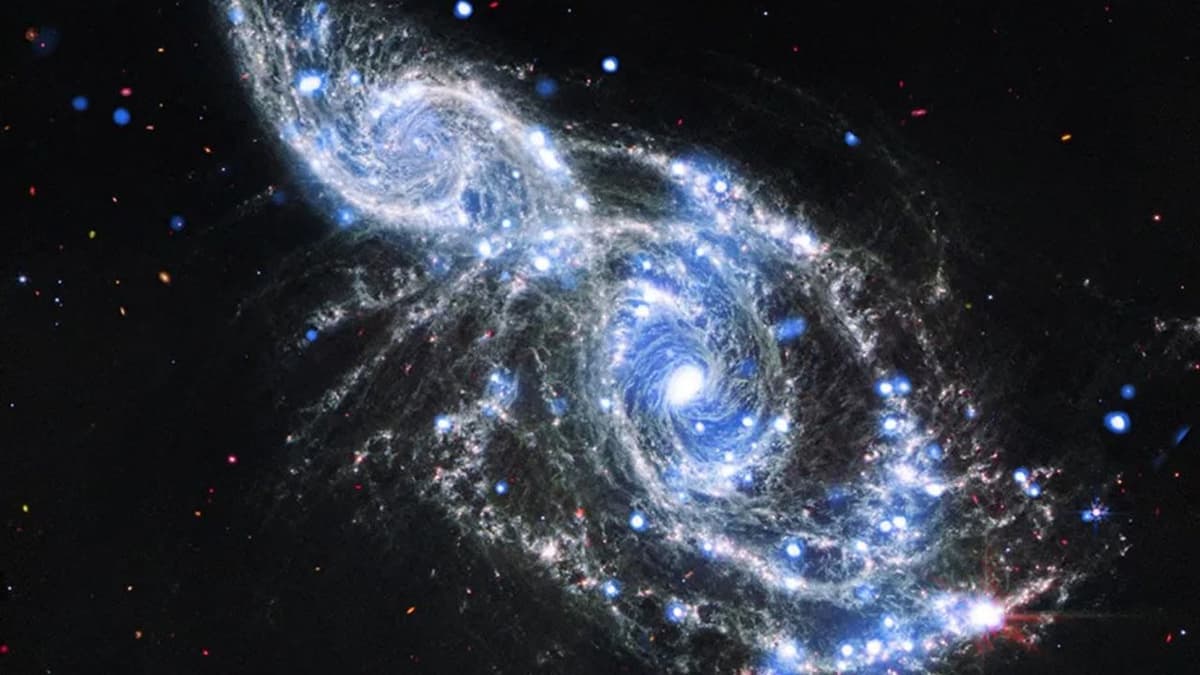
The image provides a unique, multi‑spectral perspective on how galaxy collisions drive star formation and structural change, informing models of cosmic growth. It underscores the value of coordinated space‑telescope observations for unraveling complex astrophysical processes.
Key Takeaways
- •Webb captures infrared dust and star formation.
- •Chandra reveals hot gas and X‑ray emissions.
- •Collision illustrates galaxy growth via mergers.
- •Composite image offers multi‑wavelength physical insight.
Pulse Analysis
Multi‑wavelength astronomy has become a cornerstone of modern astrophysics, and the recent Webb‑Chandra composite exemplifies its power. Infrared observations from Webb penetrate dust clouds, exposing hidden star‑forming knots, while Chandra’s X‑ray vision maps plasma heated to millions of degrees. By overlaying these datasets, scientists obtain a holistic physical map that bridges cool gas dynamics with energetic processes, enabling more accurate simulations of how galaxies interact and evolve over billions of years.
The colliding pair IC 2163 and NGC 2207 offers a textbook case for studying merger‑driven galaxy evolution. Their spiral arms are being stretched and twisted, compressing gas and triggering bursts of star formation observable in infrared, whereas shock‑heated regions glow in X‑rays. Analyzing the distribution of these emissions helps researchers quantify how much gas is funneled toward galactic centers, a key factor in feeding supermassive black holes and shaping future stellar populations. Such detailed, face‑on observations are rare, making this snapshot a valuable benchmark for testing theoretical models of tidal forces and gas inflow during mergers.
Beyond its scientific merit, the image showcases NASA’s strategic use of complementary space assets to deliver compelling, data‑rich visuals that engage both the scientific community and the public. As next‑generation observatories like the Nancy Grace Roman Space Telescope and Athena X‑ray mission come online, coordinated campaigns will further refine our understanding of cosmic structure formation. The Webb‑Chandra collaboration sets a precedent for future joint observations, highlighting how integrated datasets can unlock insights that single‑wavelength studies would miss, ultimately advancing the frontier of galaxy‑formation research.
Space telescopes capture breathtaking galactic hug | Space photo of the day for Jan. 8, 2026
0
Comments
Want to join the conversation?
Loading comments...