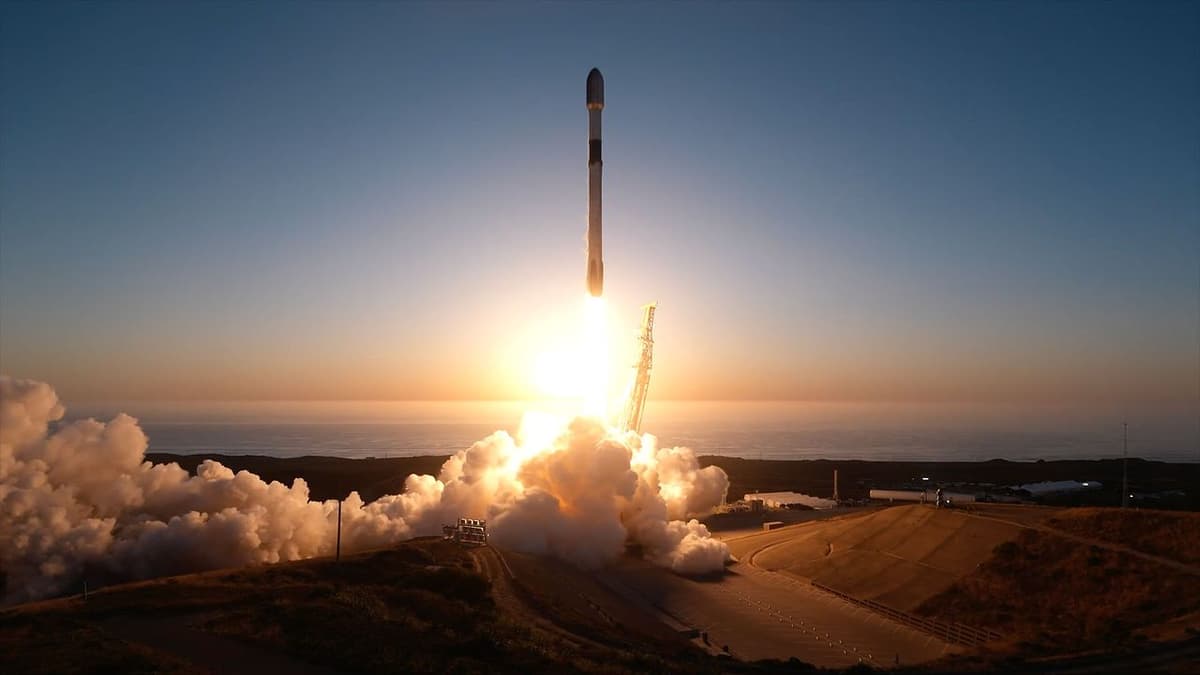
SpaceX Launches 24 Starlink Satellites on Falcon 9 Launch From California
Why It Matters
The added satellites extend global broadband coverage while the reusable booster lowers launch costs, strengthening SpaceX’s market dominance and accelerating the megaconstellation’s growth amid rising competition and regulatory scrutiny.
Key Takeaways
- •24 Starlink satellites added, total near 10,500 operational
- •Falcon 9 booster B1103 landed on droneship after second flight
- •Launch marks SpaceX's 58th mission of 2026, 651st overall
- •Reusable rockets cut launch costs, boosting broadband expansion
- •Starlink growth pressures satellite‑debris mitigation and regulatory scrutiny
Pulse Analysis
The latest Falcon 9 flight from Vandenberg lifted 24 new Starlink satellites into low‑Earth orbit, nudging the constellation to just under 10,500 active units. The mission, designated Group 17‑42, demonstrated SpaceX’s continued reliance on its reusable booster B1103, which safely touched down on the droneship “Of Course I Still Love You” for a second flight. By maintaining a rapid cadence—its 58th launch of 2026 and the 651st successful ascent since 2010—SpaceX reinforces its position as the world’s most prolific launch provider.
Beyond the headline numbers, each additional satellite expands the broadband footprint that Starlink offers to underserved regions, from rural America to remote islands. Analysts estimate the service now supports millions of subscribers, generating upwards of $2 billion in annual revenue. The incremental capacity also strengthens SpaceX’s bargaining power with telecom partners and governments seeking resilient connectivity. However, the swelling constellation intensifies concerns over orbital congestion and debris, prompting regulators in the U.S. and Europe to tighten licensing and collision‑avoidance standards.
The reusable architecture that underpins this launch is reshaping the economics of space access. By refurbishing boosters like B1103 for multiple flights, SpaceX drives launch costs down to roughly $30 million per Falcon 9 mission, a fraction of legacy expendable prices. This cost advantage fuels both commercial satellite deployments and the company’s own Starlink rollout, creating a feedback loop that funds further R&D in next‑generation Starship vehicles. As competition from rivals such as Amazon’s Project Kuiper and OneWeb accelerates, SpaceX’s launch cadence and reuse record will remain critical differentiators.
SpaceX launches 24 Starlink satellites on Falcon 9 launch from California
Comments
Want to join the conversation?
Loading comments...