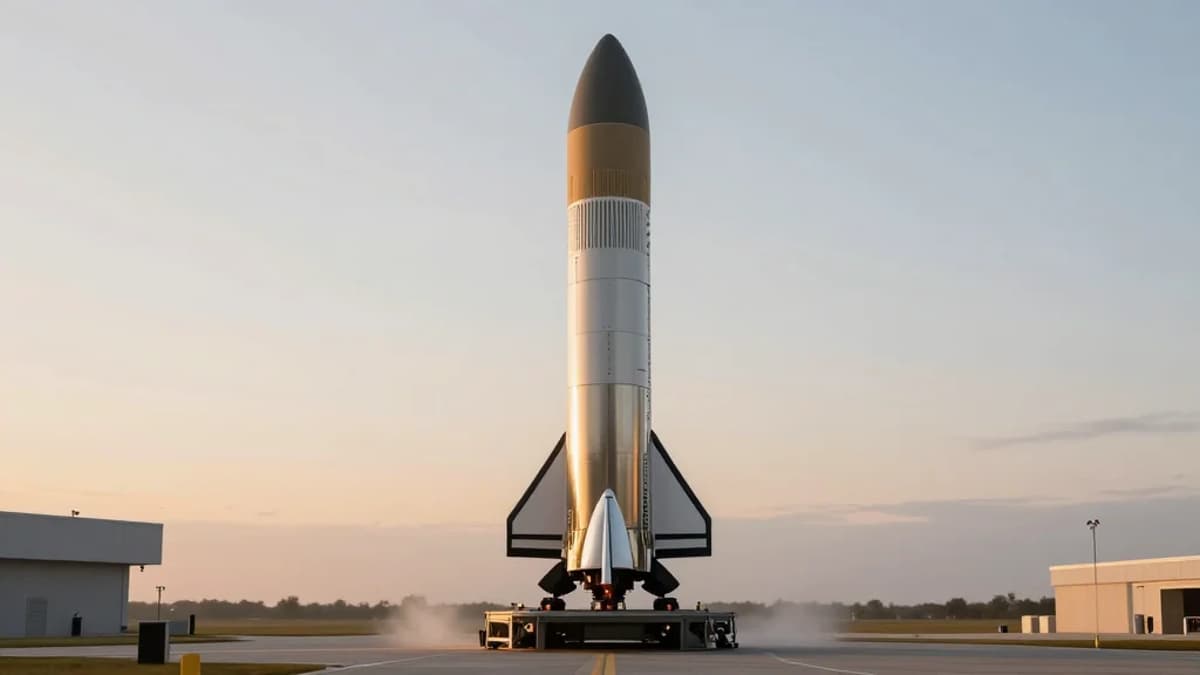
SpaceX Now Targeting Early April for Next Starship/Superheavy Test Flight
•March 10, 2026
0
Why It Matters
The early‑April test moves SpaceX closer to an operational launch system, potentially reshaping commercial heavy‑lift markets and pressuring legacy programs like NASA’s SLS to accelerate their timelines.
Key Takeaways
- •Booster 19 on Pad 2 for early April launch.
- •Starship prototype 39 undergoing final assembly.
- •SpaceX aims 12th orbital test flight in early April.
- •Testing includes LOX/LCH4 tanking, static fires, limited engines.
- •SpaceX's rapid prototype cadence outpaces NASA's SLS program.
Pulse Analysis
SpaceX’s push for an early‑April Starship/Superheavy launch underscores the company’s relentless pace of hardware turnover. Booster 19, the 19th Superheavy prototype and the inaugural Block 3 version, arrived at Pad 2 in early March and is now subject to a suite of ground‑system validations, including LOX and methane tanking, spin‑prime checks, and multiple static‑fire events. By deliberately installing only a subset of its 33 Raptor engines, SpaceX can verify pad fueling infrastructure while preserving engine life for later flights. Simultaneously, Starship 39 is completing its own assembly and pre‑flight checks, positioning both stages for a coordinated orbital attempt.
The iterative approach contrasts sharply with NASA’s decades‑long SLS program, which has produced only two hardware units and a single test launch since its inception. SpaceX’s strategy of building, testing, and often discarding prototypes accelerates learning cycles and drives down per‑flight costs. This methodology enables rapid design refinements—such as the transition to Block 3 engines—without the bureaucratic overhead that typically slows government‑run projects. As a result, SpaceX can promise near‑term operational capability, while NASA must contend with budgetary constraints and a reliance on high‑fidelity simulations rather than frequent physical flights.
For the commercial launch market, an operational Starship could redefine payload economics, offering a fully reusable vehicle capable of delivering over 100 tonnes to low‑Earth orbit at a fraction of current prices. Government customers, including the Department of Defense and NASA itself, may increasingly view SpaceX as the preferred partner for deep‑space missions, lunar lander deliveries, and Mars architecture studies. The early‑April test therefore serves as a critical milestone, signaling that SpaceX is on track to capture a dominant share of heavy‑lift contracts and to set new industry standards for speed, cost, and reliability.
SpaceX now targeting early April for next Starship/Superheavy test flight
0
Comments
Want to join the conversation?
Loading comments...