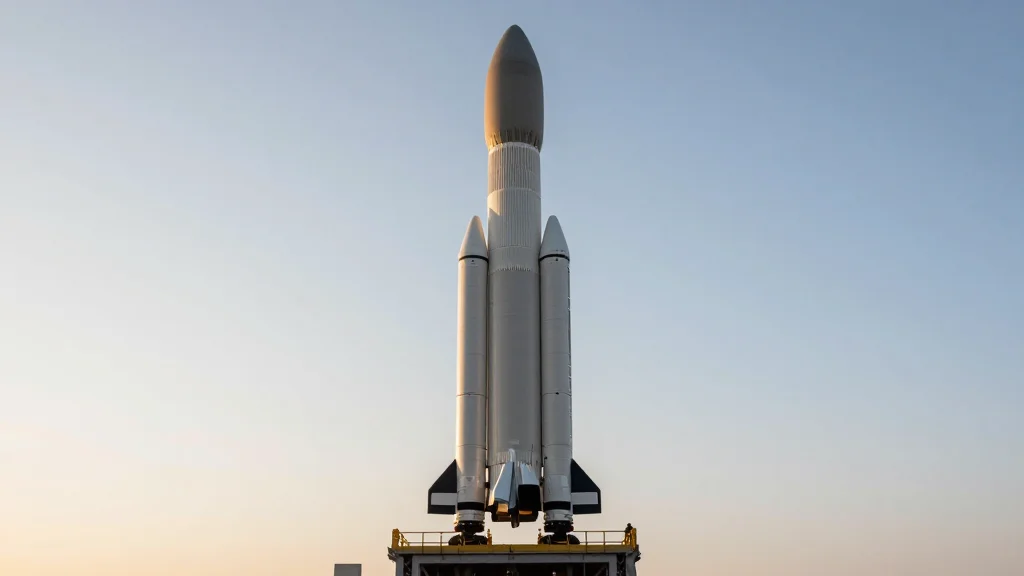
SpaceX Plans Falcon Heavy Return Featuring Side Booster Landings
Companies Mentioned
Why It Matters
Successful side‑booster recovery lowers launch costs and re‑affirms SpaceX’s dominance in the heavy‑lift market, opening new revenue streams for high‑value payloads.
Key Takeaways
- •Falcon Heavy’s first launch in 1.5 years targets Viasat‑3 satellite
- •Side boosters slated for controlled landing at Cape Canaveral
- •Recovery reduces per‑launch cost, boosting commercial competitiveness
- •Re‑entry demonstrates maturing reusable heavy‑lift technology
- •Launch revives demand for high‑mass, high‑value payloads
Pulse Analysis
SpaceX’s upcoming Falcon Heavy launch signals a pivotal return for the company’s most powerful rocket. After a 19‑month hiatus, the mission will loft a Viasat‑3 communications satellite, a contract that underscores the platform’s relevance for high‑capacity broadband services. The launch from Kennedy’s historic Launch Complex 39 also highlights NASA’s continued partnership with commercial providers, leveraging existing infrastructure to support next‑generation payloads.
The mission’s headline feature is the planned recovery of both side boosters at Cape Canaveral Space Force Station. By executing a synchronized landing sequence, SpaceX aims to demonstrate that even the heaviest payloads can benefit from its reusable architecture. Booster refurbishment cycles have already cut costs for Falcon 9; extending that model to Falcon Heavy could shave millions off each launch, making the vehicle more attractive to both defense and commercial customers seeking cost‑effective heavy‑lift solutions.
Industry analysts view the launch as a bellwether for the competitive landscape of large‑scale rockets. Blue Origin’s New Glenn and United Launch Alliance’s Vulcan are also vying for heavy‑payload contracts, but SpaceX’s proven reusability and rapid turnaround give it a strategic edge. As satellite constellations expand and deep‑space missions demand greater lift capacity, Falcon Heavy’s successful return could cement its role as a workhorse for missions that exceed Falcon 9’s payload envelope, reinforcing SpaceX’s market leadership through 2020s and beyond.
SpaceX Plans Falcon Heavy Return Featuring Side Booster Landings
Comments
Want to join the conversation?
Loading comments...