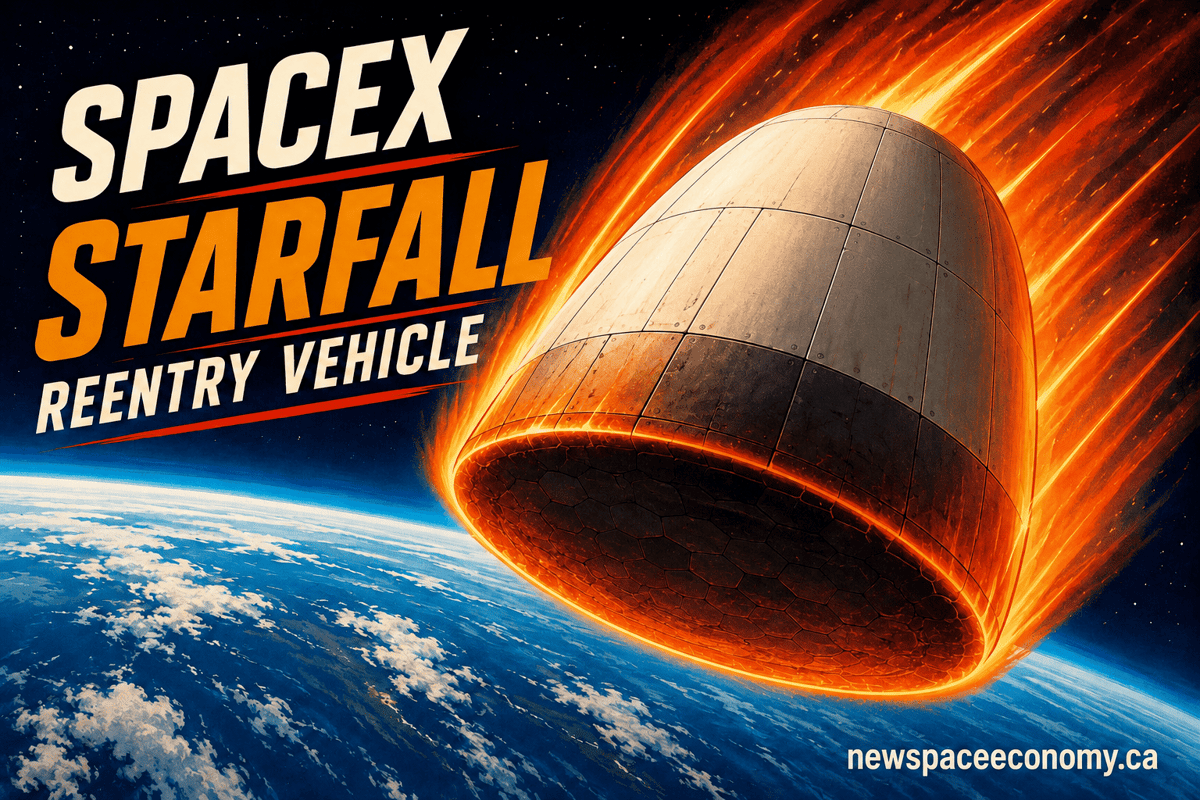
SpaceX Starfall Reentry Vehicle and the Emerging Return Path for In-Space Manufacturing
Companies Mentioned
Why It Matters
Starfall could close the critical down‑mass gap for orbital manufacturing, turning micro‑gravity research into a repeatable commercial service and reshaping the space‑logistics value chain.
Key Takeaways
- •Starfall can return up to 1,000 kg from orbit to Pacific splash‑down
- •FAA environmental review cleared, but final re‑entry license still pending
- •Capsule targets high‑value in‑space manufacturing like pharma and advanced materials
- •Vertical integration gives SpaceX advantage over independent return‑capsule firms
Pulse Analysis
The FAA’s environmental assessment marks a pivotal regulatory milestone for SpaceX’s Starfall program, but it is only one piece of a broader licensing puzzle. Under 14 CFR Part 450, the agency must still grant a vehicle‑operator license that satisfies safety, risk and financial‑responsibility criteria. By separating the environmental review from the safety approval, the FAA signals that repeatable commercial re‑entry services are moving from ad‑hoc missions to a standardized operational category, a shift that could streamline future approvals for similar payload‑return vehicles.
In‑space manufacturing hinges on a reliable down‑mass pathway, and Starfall is designed to fill that niche. Its compact 2.5 m × 1.5 m × 0.5 m payload bay is optimized for high‑value, low‑volume goods such as pharmaceuticals, crystal growth experiments, and advanced composites that benefit from micro‑gravity processing. By offering a dedicated return capsule that can be launched on Falcon 9 or Starship‑Super Heavy, SpaceX creates a vertically integrated service that reduces coordination complexity for customers, potentially lowering overall mission costs and accelerating time‑to‑market for orbit‑produced products.
The competitive landscape is already populated by firms like Varda, Inversion Space and Europe’s Atmos Space Cargo, all of which rely on external launch providers. SpaceX’s control of both launch and return infrastructure could reshape market dynamics, forcing independent capsule developers to differentiate on payload environment, cadence or cost. If Starfall proves reliable through its two test flights, it may become the preferred option for defense logistics, biotech firms, and semiconductor researchers, driving a new ecosystem of ancillary services—from clean‑room payload integration to maritime recovery logistics—while reinforcing SpaceX’s dominance across the entire space‑flight value chain.
SpaceX Starfall Reentry Vehicle and the Emerging Return Path for In-Space Manufacturing
Comments
Want to join the conversation?
Loading comments...