Why It Matters
The evolution demonstrates SpaceX’s path to a fully reusable, high‑capacity launch system that could reshape satellite deployment, NASA’s Artemis logistics, and commercial heavy‑lift markets.
Key Takeaways
- •V3 flight on May 22 2026 introduced Raptor 3 engines and docking hardware
- •V4 planned for 2027, featuring a longer Ship and nine upper‑stage Raptors
- •Super Heavy retains 33 Raptor engines across V1‑V4, focusing on booster reuse
- •V2 added higher propellant capacity and revised forward flaps for hotter re‑entry
- •FAA cleared up to 25 Starship launches per year from Boca Chica
Pulse Analysis
SpaceX’s iterative Starship development reflects a classic aerospace maturation curve, where each vehicle block tackles a specific technical barrier. V1 proved that a full‑stack launch could be achieved, delivering critical data on ascent dynamics, hot‑staging, and re‑entry heating. V2 built on that foundation by expanding propellant tanks, refining flap geometry, and testing early booster reuse, thereby increasing payload relevance for Starlink and other commercial missions. The transition to V3 marks a decisive step toward operational reuse: Raptor 3 engines offer higher thrust and better packaging, while new docking ports and propellant‑transfer connections lay the groundwork for in‑space refueling—a prerequisite for lunar and Mars architectures.
The planned V4 configuration pushes the system’s scalability further, introducing a longer upper stage with three additional vacuum‑optimized Raptors. This design promises higher thrust-to-weight ratios, enabling payloads exceeding 100 metric tons to low‑Earth orbit in a fully reusable configuration. Although V4 remains unflown, its specifications signal SpaceX’s intent to capture a broader market segment, from massive satellite constellations to deep‑space cargo. The 42‑engine full stack also aligns with NASA’s Artemis program, where increased thrust margins could improve crewed lunar lander performance and reduce launch‑window constraints.
Regulatory and infrastructure considerations are equally pivotal. The FAA’s recent environmental clearance for up to 25 annual launches from Boca Chica reduces a major bottleneck, while the rollout of Pad 2 and anticipated upgrades at Kennedy Space Center position SpaceX to support higher launch cadences. As the hardware matures, commercial operators will evaluate cost per kilogram, turnaround time, and reliability metrics, all of which hinge on demonstrated booster recovery and rapid refurbishment. In sum, the V1‑V4 progression not only showcases engineering milestones but also reshapes the economics of heavy‑lift launch services, with far‑reaching implications for satellite operators, government agencies, and the emerging space‑based economy.
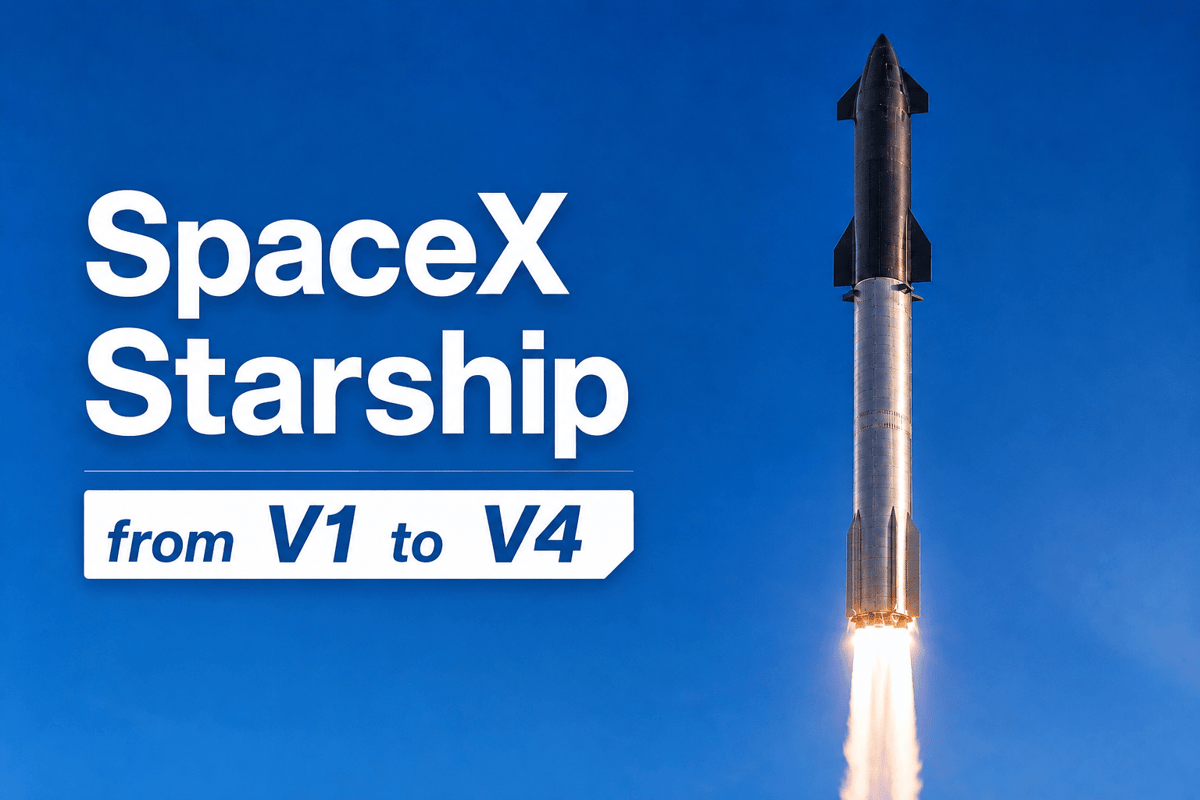
SpaceX Starship from V1 to V4
Comments
Want to join the conversation?
Loading comments...