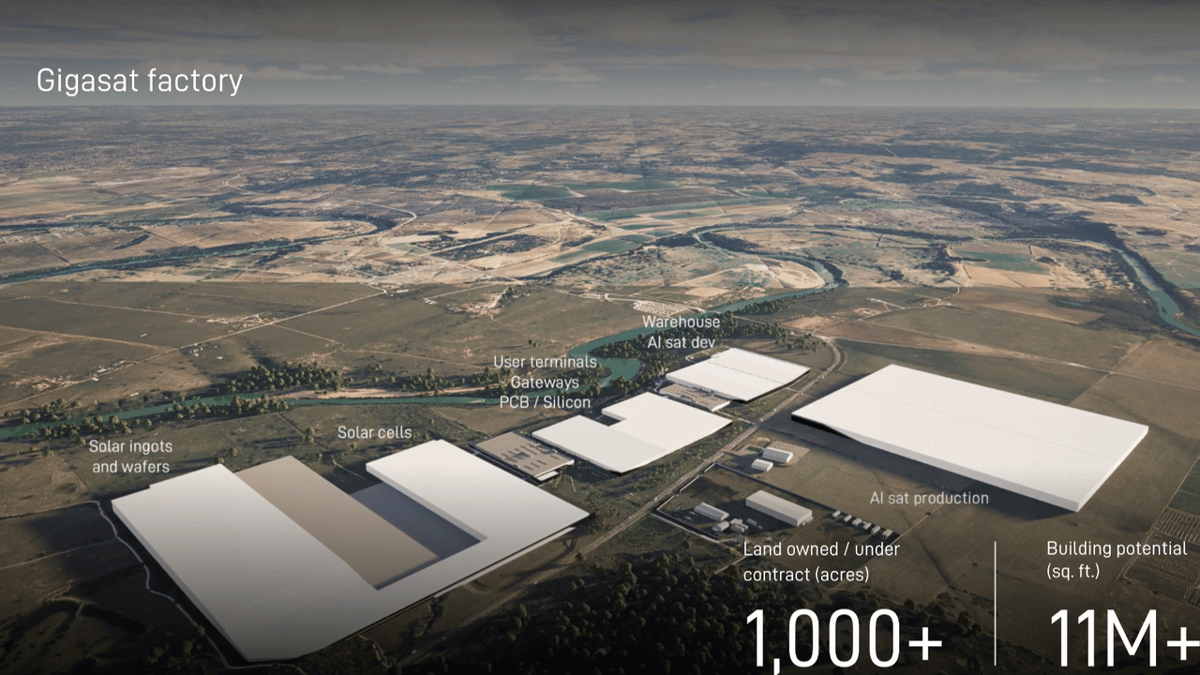
SpaceX Unveils 11-Million-Square-Foot Gigasat Factory, a New Manufacturing Facility for Space-Based Data Centers — Aims for 1 GW/Year of Space AI Compute by Late 2027 From Its Satellites

Why It Matters
By moving AI compute to orbit, SpaceX could alleviate terrestrial data‑center power constraints and reshape the high‑performance computing market. The scale of production positions the company as a potential leader in next‑generation cloud infrastructure.
Key Takeaways
- •SpaceX's 11‑million‑sq‑ft Gigasat factory will start AI satellite production by 2027.
- •AI1 satellite carries 150 kW compute, targeting 1 GW of orbital AI power annually.
- •Launch plan requires over 6,000 AI1 satellites per year by 2027.
- •SpaceX aims for 100 GW of space AI compute per year by 2030.
- •Terafab joint venture plans to fab 1 TW of chips annually in Austin.
Pulse Analysis
SpaceX’s Gigasat factory marks a decisive shift from traditional satellite assembly to a vertically integrated production line for orbital data centers. Spanning 11 million square feet—ten times larger than the Starfactory—the campus will house solar wafer fabrication, PCB manufacturing, and final satellite integration under one roof. This scale‑up mirrors the company’s broader ambition to transition AI workloads from power‑hungry ground facilities to solar‑powered platforms, promising lower latency for edge applications and a new frontier for cloud services.
The AI1 satellite, roughly the length of a football field, embeds a 150 kW compute module surrounded by expansive solar arrays delivering 250 W per square meter. At the projected 1 GW annual compute output, SpaceX would need to launch more than 6,000 such satellites each year, a figure that dwarfs the current 10,500‑satellite Starlink constellation. Compared with terrestrial megacenters—Meta’s $100 billion Hyperion (5 GW) and xAI’s $18 billion Colossus 2 (2 GW)—SpaceX’s orbital goal of 100 GW by 2030 represents a tenfold increase in capacity, potentially redefining the economics of AI training and inference.
Achieving these numbers hinges on the unproven Terafab venture, which aims to produce 1 TW of chips annually at a 2 nm node—a scale no single company has attempted. Skeptics point to the lack of chip‑fabrication experience across SpaceX, Tesla and xAI, as well as the massive supply‑chain and thermal‑management challenges of operating data centers in space. If successful, however, the convergence of satellite manufacturing and advanced semiconductor production could unlock terawatt‑level compute at a fraction of Earth‑based energy costs, accelerating AI development and giving SpaceX a strategic foothold in the emerging space‑AI ecosystem.
SpaceX unveils 11-million-square-foot Gigasat factory, a new manufacturing facility for space-based data centers — aims for 1 GW/year of space AI compute by late 2027 from its satellites
Comments
Want to join the conversation?
Loading comments...