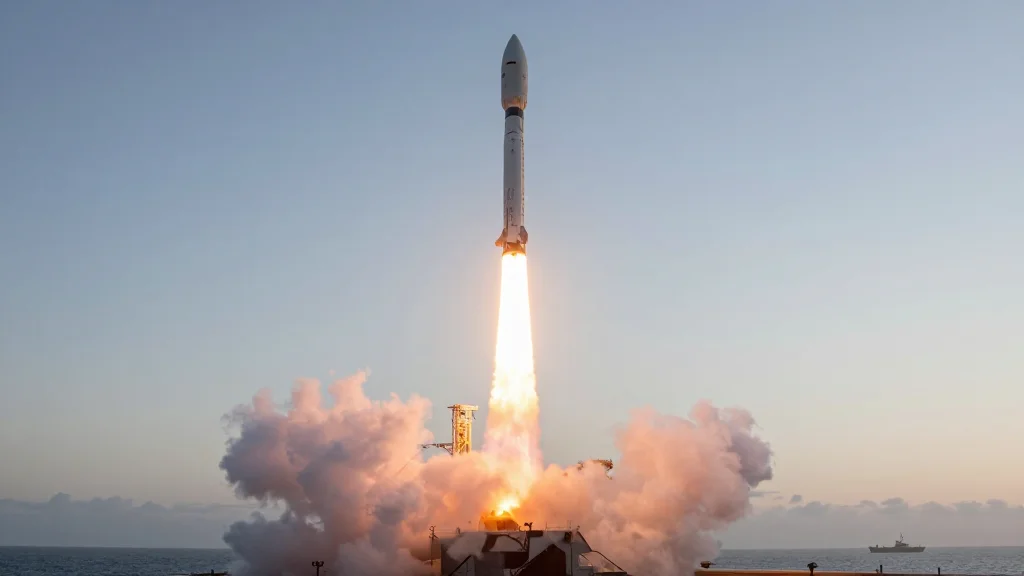
SpaceX’s Sunrise Starlink Launch Adds 29 Satellites to Low Earth Orbit Megaconstellation
Companies Mentioned
Why It Matters
The added satellites expand global broadband coverage and reinforce SpaceX’s cost advantage through booster reuse, intensifying competition in the satellite‑internet market.
Key Takeaways
- •29 Starlink V2 Mini satellites launched, raising constellation to >10,000
- •Falcon 9 booster B1077 completed its 28th flight, landing on drone ship
- •Launch occurred at 6:04 a.m. EDT, visible sunrise “jellyfish” plume
- •Mission marked SpaceX’s 46th Starlink deployment and 150th drone‑ship landing
- •Favorable weather forecast enabled launch despite minor cumulus cloud risk
Pulse Analysis
The latest Starlink 10‑31 mission adds 29 V2 Mini Optimized satellites to SpaceX’s low‑Earth‑orbit broadband network, nudging the total beyond the 10,000‑satellite milestone. The V2 Mini design, a smaller, cost‑efficient variant of the second‑generation constellation, targets underserved regions while preserving the high‑throughput capabilities that differentiate Starlink from legacy satellite providers. By deploying these units before sunrise, SpaceX capitalized on clear atmospheric conditions, creating the striking “jellyfish” plume that captured public attention and underscored the company’s operational cadence.
The launch employed a Falcon 9 booster designated B1077, now on its 28th flight, illustrating SpaceX’s aggressive reuse strategy. After a 8.5‑minute coast, the first stage touched down on the autonomous drone ship ‘A Shortfall of Gravitas,’ marking the vessel’s 150th successful recovery and the 613th booster landing overall. Such turnaround rates reduce launch costs and free up launch windows for both commercial and government payloads. The mission also demonstrated SpaceX’s ability to meet stringent weather constraints, navigating a modest cumulus cloud risk with a 90 percent favorable forecast.
From a market perspective, the incremental capacity bolsters SpaceX’s bid to dominate global satellite internet, pressuring rivals like OneWeb and Amazon’s Project Kuiper. The expanded constellation improves latency and redundancy, essential for enterprise customers, maritime users, and remote education initiatives. Regulators continue to scrutinize orbital debris and spectrum allocation, but SpaceX’s track record of safe de‑orbiting and frequency coordination mitigates concerns. As the network approaches saturation, the next frontier will be integrating ground‑segment AI to optimize traffic routing and unlock new revenue streams.
SpaceX’s sunrise Starlink launch adds 29 satellites to low Earth orbit megaconstellation
Comments
Want to join the conversation?
Loading comments...