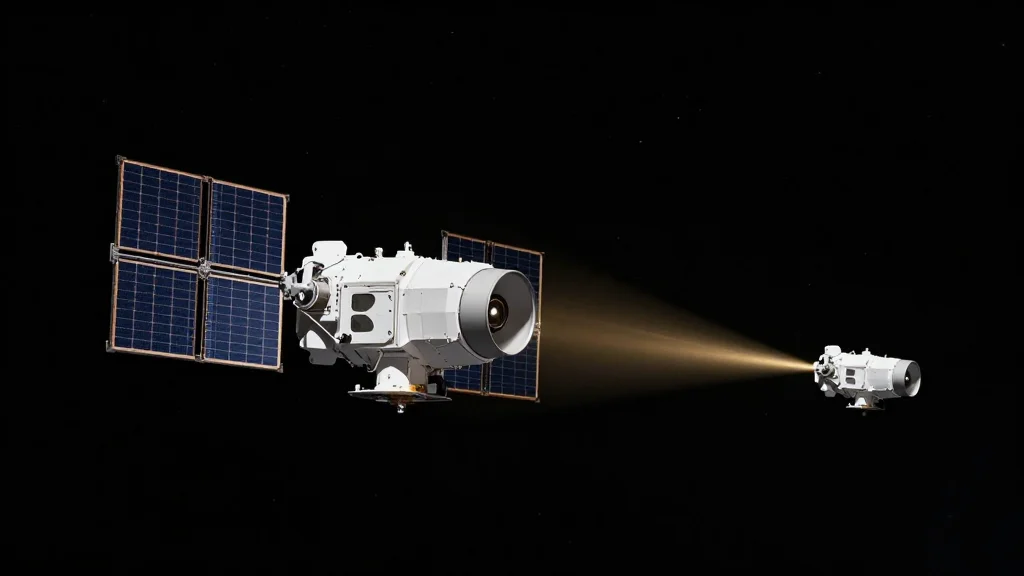
Star Catcher Raises $65 Million to Build Orbital Power‑Grid Satellite Network

Companies Mentioned
Why It Matters
Space‑based power beaming could unlock a new class of satellite services by decoupling mission endurance from onboard solar capacity. If Star Catcher’s technology scales, operators could extend satellite lifespans, reduce launch mass, and enable power‑intensive payloads such as orbital data centers that currently face strict energy limits. For national‑security missions, on‑demand power could improve maneuverability and resilience against anti‑satellite threats. The financing also signals investor confidence that the space‑energy market is moving from concept to commercial reality. With a $3 billion pipeline, Star Catcher is positioning itself at the nexus of emerging demand for high‑throughput communications, synthetic‑aperture‑radar imaging, and future space‑based computing platforms, potentially reshaping the economics of low‑Earth‑orbit (LEO) constellations.
Key Takeaways
- •Star Catcher closed a $65 million Series A round led by B Capital, with Shield Capital and Cerberus Ventures participating.
- •Total capital raised to date now stands at $88 million.
- •The company has $60 million in signed contracts and a $3 billion pipeline of prospective power‑beaming customers.
- •First in‑space power‑beaming demonstration scheduled for later in 2026, with a second mission planned for early 2027.
- •Retired Space Force Gen. Jay Raymond joins the board, highlighting defense interest in orbital power solutions.
Pulse Analysis
Star Catcher’s raise marks the most sizable single‑handed investment in space‑based power beaming to date, a niche that has lingered in the research phase for decades. The company’s hardware‑first strategy—ground‑testing mirrors in a football stadium and on a shuttle runway—mirrors the approach of early satellite manufacturers that proved concepts before scaling. By securing a mix of venture capital and strategic backers with defense ties, Star Catcher mitigates the classic ‘valley of death’ that has stalled many space‑energy projects.
Competitors such as SpaceX’s Starlink and OneWeb have focused on expanding bandwidth, but none have pursued external power delivery at scale. If Star Catcher can demonstrate reliable, high‑power laser or microwave beaming in orbit, it could create a new revenue stream that complements existing satellite services. However, technical hurdles remain: precise beam pointing, atmospheric attenuation for low‑orbit links, and regulatory clearance for high‑energy transmissions.
Market analysts estimate the global satellite services market will exceed $300 billion by 2030. Even a modest 1‑2 % capture of that spend on power‑beaming services would translate to multi‑billion‑dollar revenues, justifying the $3 billion pipeline claim. The next 12‑18 months will be critical; successful in‑space demos could unlock further institutional funding, while any failure could relegate power‑beaming to a long‑term research topic. Investors will watch closely for the outcomes of the upcoming missions and the company’s ability to convert signed contracts into recurring revenue.
Star Catcher Raises $65 Million to Build Orbital Power‑Grid Satellite Network
Comments
Want to join the conversation?
Loading comments...