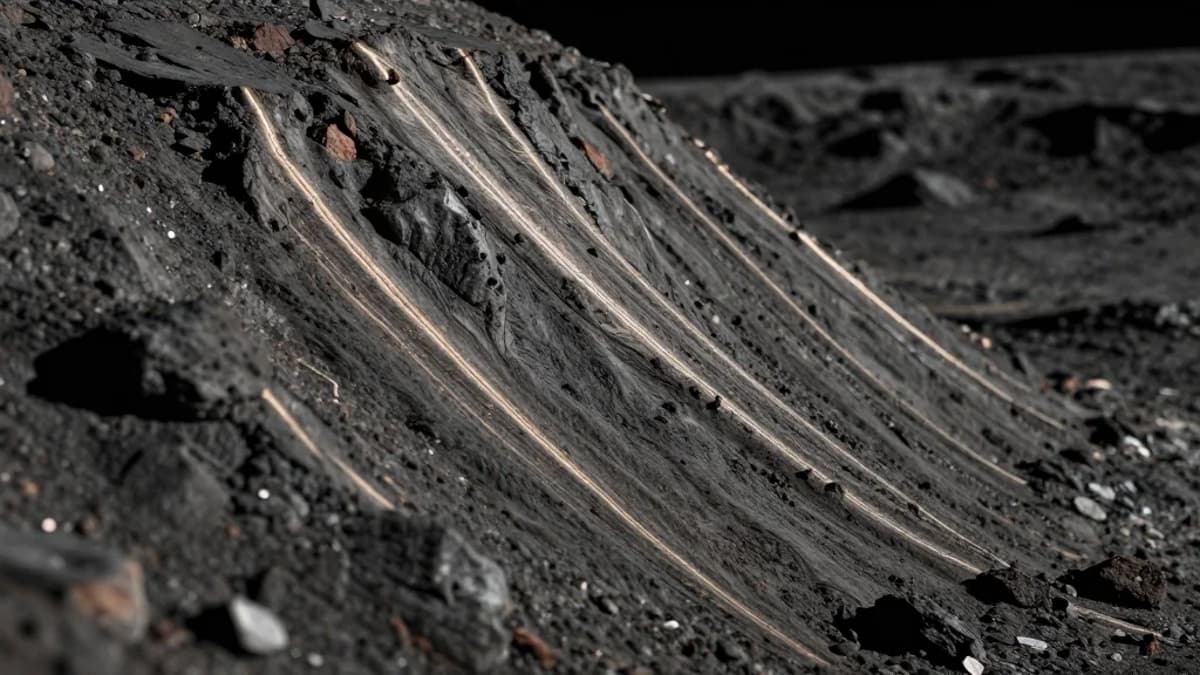
Streaks on Mercury Show that It Is Not a 'Dead Planet'
•January 27, 2026
0
Why It Matters
The evidence of active volatile release reshapes our understanding of Mercury’s interior dynamics and informs future mission strategies targeting the planet’s volatile budget.
Key Takeaways
- •Machine learning mapped ~400 Mercury slope lineae.
- •Streaks cluster on sun‑facing crater slopes.
- •Outgassing of sulfur‑rich volatiles drives lineae formation.
- •Findings reshape Mercury’s perceived geological inactivity.
- •BepiColombo instruments will monitor lineae evolution.
Pulse Analysis
Mercury has long been portrayed as a static, airless relic, its early volcanic vigor thought to have long since faded. The new study challenges that narrative by applying a deep‑learning pipeline to over 100,000 MESSENGER images, revealing a hidden network of bright, linear features. By systematically mapping these lineae, scientists have quantified their distribution and linked them to specific geological contexts, providing a fresh lens through which to view the planet’s surface processes.
The concentration of lineae on sun‑exposed crater slopes points to solar heating as a trigger for volatile release. Researchers propose that sulfur‑rich compounds trapped beneath impact‑fractured rock escape through micro‑cracks, forming transient bright streaks and associated hollows. This ongoing outgassing suggests Mercury retains a measurable volatile inventory, contrary to prior assumptions of a depleted interior. Quantifying this volatile loss is crucial for models of planetary differentiation, surface weathering, and the evolution of the innermost solar system.
Looking ahead, the European‑Japanese BepiColombo mission offers a timely opportunity to test these hypotheses. Instruments such as the BELA laser altimeter, the STROFIO mass spectrometer, and the ENA plasma analyzer will capture high‑resolution topography, compositional data, and particle environments around the identified lineae. Re‑imaging the same sites will reveal whether new streaks emerge, directly linking observed changes to active outgassing. These insights will refine hazard assessments for future landers and deepen our grasp of Mercury’s dynamic geology.
Streaks on Mercury show that it is not a 'dead planet'
0
Comments
Want to join the conversation?
Loading comments...