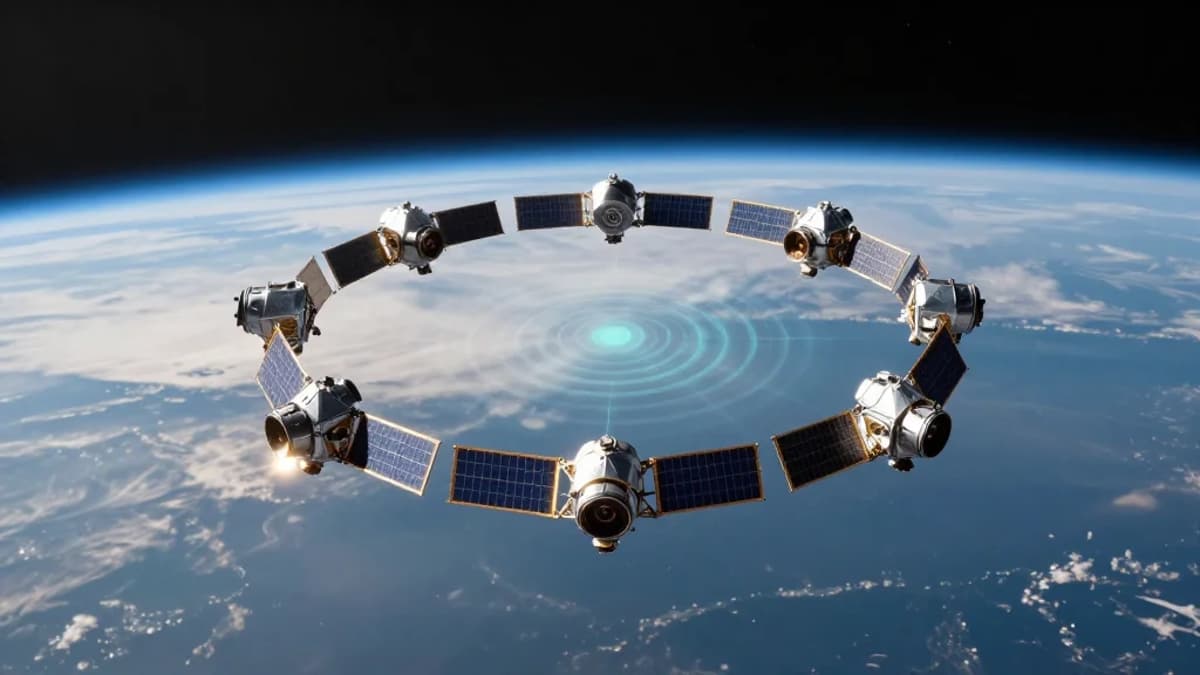
SunRISE SmallSats Ace Tests, Moving Closer to Launch
•January 20, 2026
0
Companies Mentioned

Why It Matters
The mission validates a novel formation‑flying radio interferometer that can deliver real‑time solar‑storm data, strengthening NASA’s space‑weather mitigation capabilities. Successful SmallSat testing also de‑ridges risk for future heliophysics constellations.
Key Takeaways
- •Six SunRISE SmallSats passed thermal, EMC, vibration tests.
- •Launch slated on ULA Vulcan Centaur rideshare this year.
- •Satellites will form a 10‑ft antenna X‑shape interferometer.
- •Mission aims to map solar radio bursts and magnetic fields.
- •Improves space weather forecasting, protecting astronauts and satellites.
Pulse Analysis
The SunRISE SmallSat constellation represents a shift toward distributed spacecraft architectures for heliophysics research. By subjecting each unit to thermal vacuum, EMC and launch‑profile vibration testing, engineers at Space Dynamics Laboratory have demonstrated that compact, low‑cost platforms can survive the rigors of launch and operate reliably in the harsh space environment. This rigorous validation reduces program risk and showcases the viability of rideshare launches, where multiple payloads share a single launch vehicle, optimizing cost and schedule for NASA and its partners.
Once in a slightly supersynchronous orbit, the six SmallSats will unfurl four 2.5‑meter antenna booms each, forming an X‑shaped array that functions as a synthetic aperture radio telescope. Using interferometric techniques, the array will combine signals to achieve the resolution of a much larger dish, enabling precise detection of solar radio bursts and mapping of the Sun’s magnetic field from the corona into interplanetary space. The mission’s design leverages the Deep Space Network for data downlink, ensuring high‑bandwidth communication despite the distributed nature of the fleet.
SunRISE’s data will complement existing heliophysics assets such as Parker Solar Probe, Solar Orbiter and STEREO, filling a critical observational gap in the near‑Earth environment. By delivering timely alerts on solar energetic particle events, the mission enhances space‑weather forecasting for both crewed missions and satellite operators. Its success could spur a new generation of SmallSat constellations targeting other astrophysical phenomena, driving innovation in formation‑flying technologies and expanding commercial opportunities in space‑based radio astronomy.
SunRISE SmallSats ace tests, moving closer to launch
0
Comments
Want to join the conversation?
Loading comments...