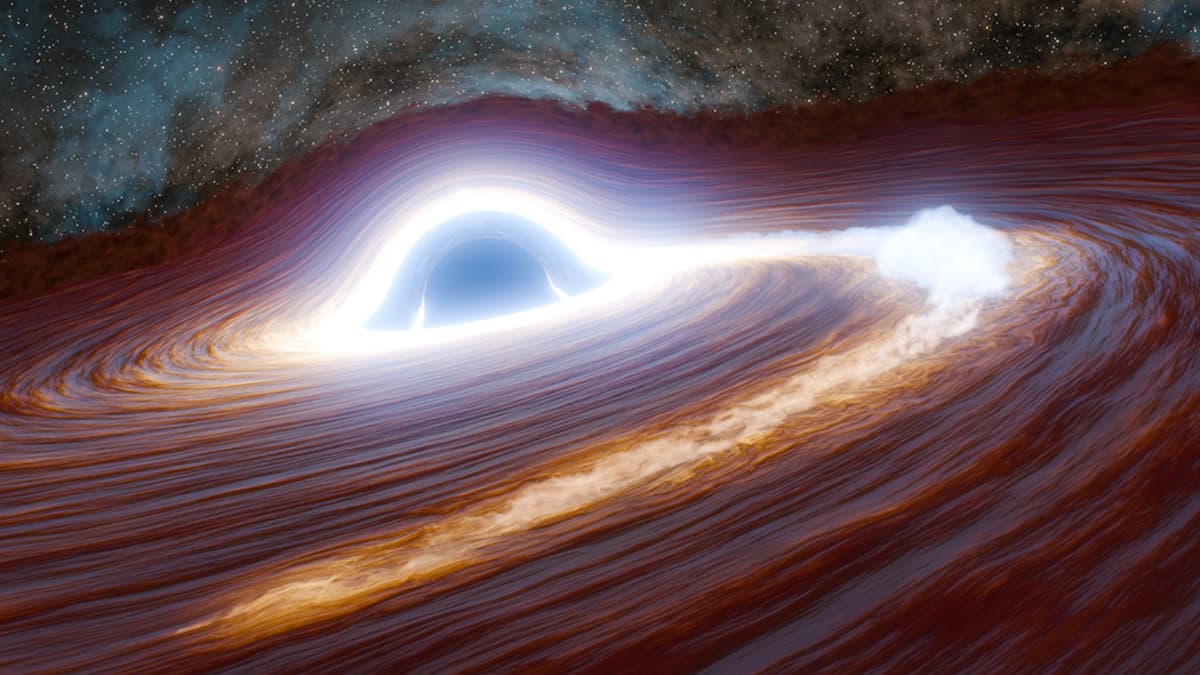
'Super Star' Being Shredded by Black Hole Releases as Much Energy as 400 Billion Suns
•January 8, 2026
0
Companies Mentioned

NASA
Why It Matters
This unprecedented energy release provides a new probe for locating and studying black holes, refining models of accretion physics and stellar disruption, and it helps clarify the nature of luminous fast blue optical transients.
Key Takeaways
- •TDE released energy equal to 400 billion suns.
- •Event named “Whippet” detected by ZTF and Swift.
- •Shockwave traveled at 0.2c, outshining typical supernovae.
- •Helium ejecta reached 13 million mph, indicating surviving core.
- •Findings aid black‑hole identification and growth models.
Pulse Analysis
The “Whippet” tidal disruption event stands out as one of the most energetic transients ever recorded, dwarfing ordinary supernovae by orders of magnitude. While TDEs have been observed before, the combination of a 400 billion‑sun energy output and a relativistic shock front traveling at 0.2c pushes the boundaries of current theoretical models. Such power suggests an unusually massive progenitor star and a rapidly spinning black hole, conditions that can generate extreme jets and luminous blue optical emission rarely seen in the night sky.
Detecting an event of this magnitude required coordinated effort across optical, ultraviolet and X‑ray facilities. The Zwicky Transient Facility’s wide‑field survey flagged the rapid brightening, prompting immediate follow‑up with NASA’s Swift satellite and the Liverpool Telescope. Multi‑wavelength data confirmed the characteristic blue spectrum and high‑energy X‑ray tail typical of luminous fast blue optical transients (LFBOTs). This case illustrates how modern time‑domain astronomy, powered by automated pipelines and rapid response networks, can capture fleeting phenomena that would otherwise vanish unnoticed.
The scientific payoff extends beyond a spectacular light show. By measuring the shock velocity, helium ejecta speed, and the evolution of the accretion disk, researchers gain direct insight into how black holes consume stellar material and convert it into radiation. These observations also help calibrate models that predict black‑hole growth rates across cosmic time, informing simulations of galaxy evolution. Moreover, the Whippet bridges the gap between classic TDEs and the enigmatic LFBOT class, suggesting a common physical mechanism that could unify disparate transient populations.
'Super star' being shredded by black hole releases as much energy as 400 billion suns
0
Comments
Want to join the conversation?
Loading comments...