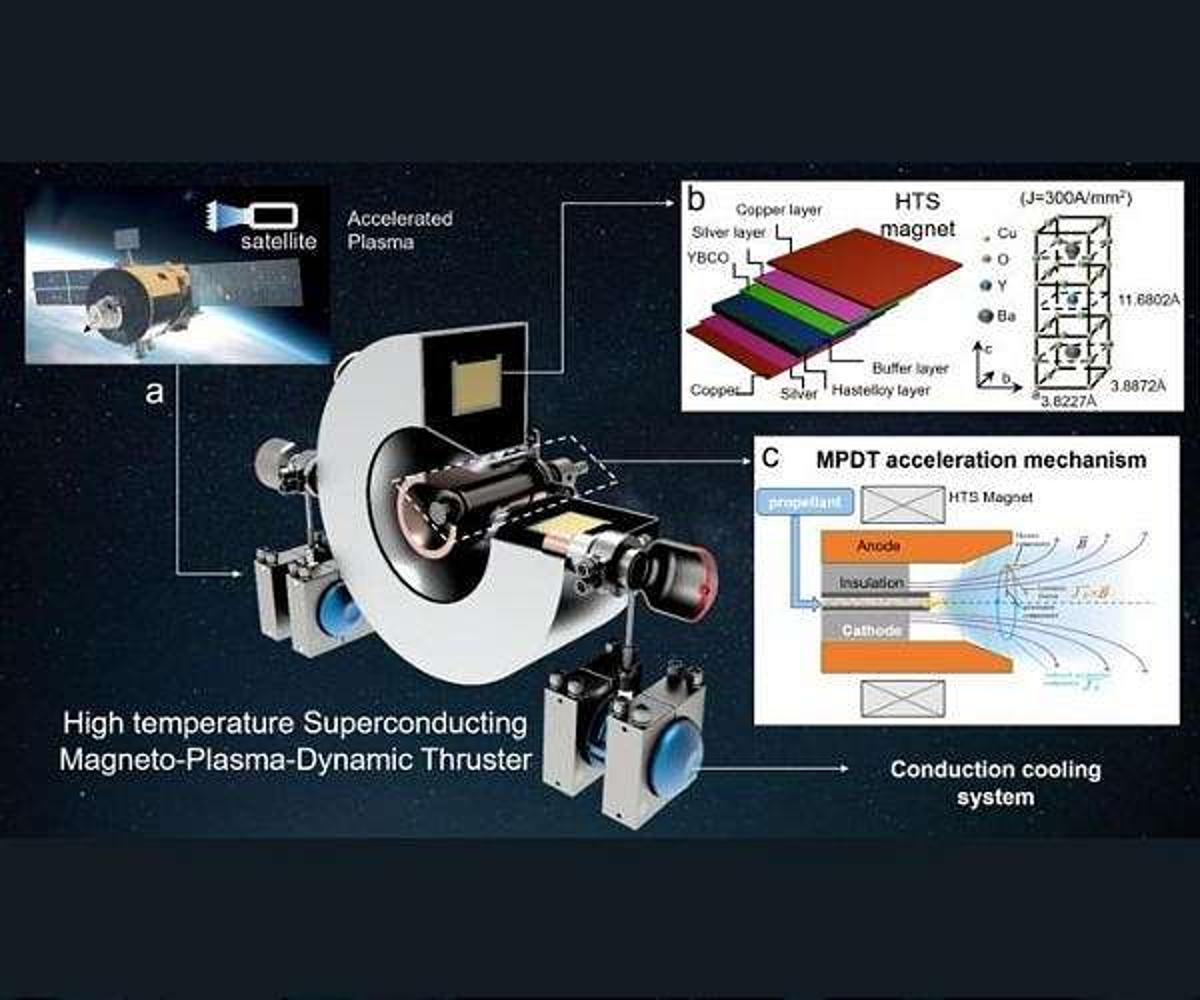
Superconducting Thruster Cuts Power and Mass for Space Propulsion
•February 26, 2026
0
Why It Matters
The breakthrough enables lightweight, low‑power propulsion for satellite constellations, reducing launch costs and expanding mission flexibility, and could accelerate electric‑propulsion adoption across commercial and deep‑space sectors.
Key Takeaways
- •Superconducting MPDT cuts power from 285 kW to <1 kW
- •Mass reduced from 220 kg to 60 kg
- •Specific impulse reaches 3,265 s at 12 kW
- •Efficiency eight to ten times higher than chemical rockets
- •Analytical MHD model guides thruster design optimization
Pulse Analysis
Small satellites have reshaped the economics of space, but their propulsion options remain constrained by the heavy, power‑hungry nature of traditional engines. Chemical rockets, while delivering high thrust, allocate over 90 % of launch mass to propellant, inflating costs and limiting payload capacity. Electric propulsion—using plasma accelerated by electromagnetic forces—offers far greater specific impulse, extending mission lifetimes and enabling precise orbit‑raising or station‑keeping. Among electric concepts, magnetoplasmadynamic thrusters stand out for their high thrust density, yet conventional designs rely on massive copper coils and megawatt‑scale power, precluding integration on nanosat platforms.
The breakthrough reported by Professor Jinxing Zheng’s team replaces those copper windings with high‑temperature YBCO superconductors cooled to liquid‑nitrogen temperatures. This substitution drives power draw down from 285 kW to less than 1 kW and cuts hardware mass to 60 kg, a three‑fold reduction that fits within the tight mass budgets of CubeSat and small‑bus architectures. In bench tests the superconducting MPDT delivered a specific impulse of 3,265 seconds at just 12 kW, delivering propulsion efficiency eight to ten times that of chemical rockets while easing thermal management and simplifying power‑system design.
The implications extend beyond individual missions. Lower‑mass, low‑power thrusters can democratize access to high‑performance propulsion, allowing emerging operators to field larger constellations or undertake deep‑space probes without prohibitive launch penalties. The accompanying analytical magnetohydrodynamic model gives engineers a predictive tool to tailor thrust, flow rate, and magnetic field strength to specific payload constraints, accelerating design cycles. As high‑temperature superconducting materials mature and cryogenic subsystems become more compact, the industry is poised to adopt superconducting MPDTs as a cornerstone of next‑generation, high‑efficiency space‑transport architectures.
Superconducting thruster cuts power and mass for space propulsion
0
Comments
Want to join the conversation?
Loading comments...