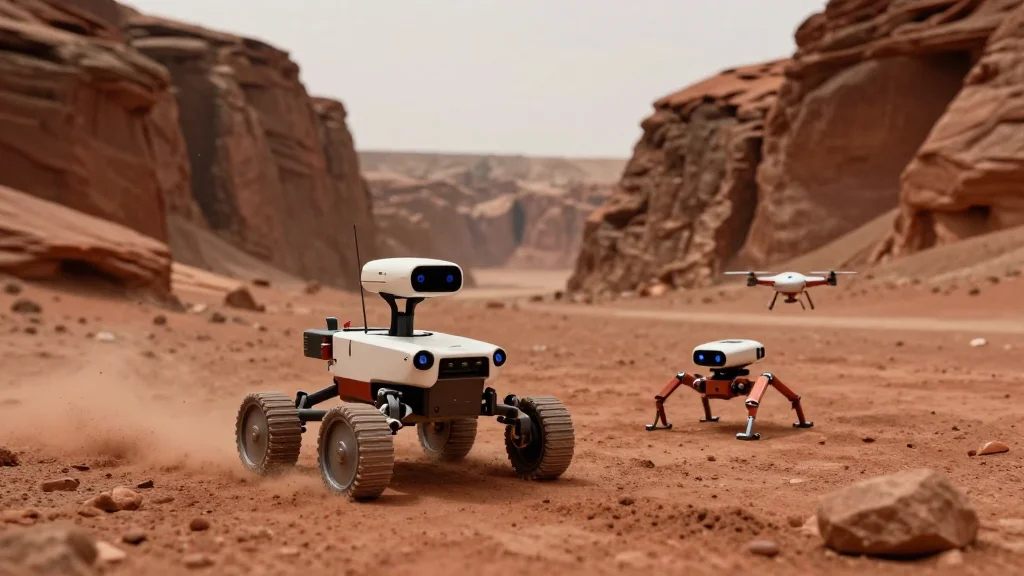
Take a Look at a Bio-Inspired Mars Robot
Why It Matters
Swarm‑based, multi‑modal rovers can cover more ground while lowering mission risk, accelerating scientific return from harsh Martian environments. The approach could redefine how agencies design future surface missions.
Key Takeaways
- •VaMEx aims to deploy heterogeneous swarm for Valles Marineris
- •Concept combines driving, walking, and aerial units for terrain adaptability
- •Curved wheels enable rover to 'swim' through loose sand
- •Swarm approach reduces single‑point failure risk on Mars missions
- •Project showcases bio‑inspired design influencing future planetary rovers
Pulse Analysis
Mars exploration has long been constrained by the planet’s extreme topography and the limited mobility of single‑purpose rovers. Valles Marineris, a canyon system over 4,000 km long and up to 7 km deep, presents steep walls, soft dunes, and sheer cliffs that challenge traditional wheel‑based platforms. Engineers are therefore turning to biologically inspired locomotion and distributed systems to increase resilience and coverage. By studying how desert organisms navigate shifting sands, researchers can translate those strategies into mechanical designs that maintain traction where conventional rovers would stall.
The VaMEx concept pushes this paradigm further by assembling a heterogeneous swarm that includes wheeled rovers, legged walkers, and micro‑drones. Its signature curved wheels act like a paddle, allowing the vehicle to generate lift and glide across granular media—a technique demonstrated in laboratory sand tanks. Meanwhile, legged units can climb over rocks and negotiate vertical faces, and aerial drones provide aerial mapping and relay communications. The autonomous coordination layer lets each unit share terrain data in real time, dynamically allocating tasks to the most suitable platform. This modularity not only expands the surveyed area but also creates redundancy; the loss of a single unit does not jeopardize the entire mission.
If successful, VaMEx could set a new benchmark for planetary surface missions, influencing both governmental and commercial ventures. Swarm robotics reduces launch mass by distributing payloads across smaller, cheaper units, and the bio‑inspired locomotion may be adapted for lunar regolith or asteroid surfaces. Moreover, the underlying algorithms for terrain‑aware task allocation have cross‑industry relevance, from disaster‑response robots on Earth to autonomous mining equipment. As agencies seek faster, more cost‑effective ways to explore the solar system, concepts like VaMEx illustrate how interdisciplinary engineering can unlock previously inaccessible regions.
Take a Look at a Bio-inspired Mars Robot
Comments
Want to join the conversation?
Loading comments...