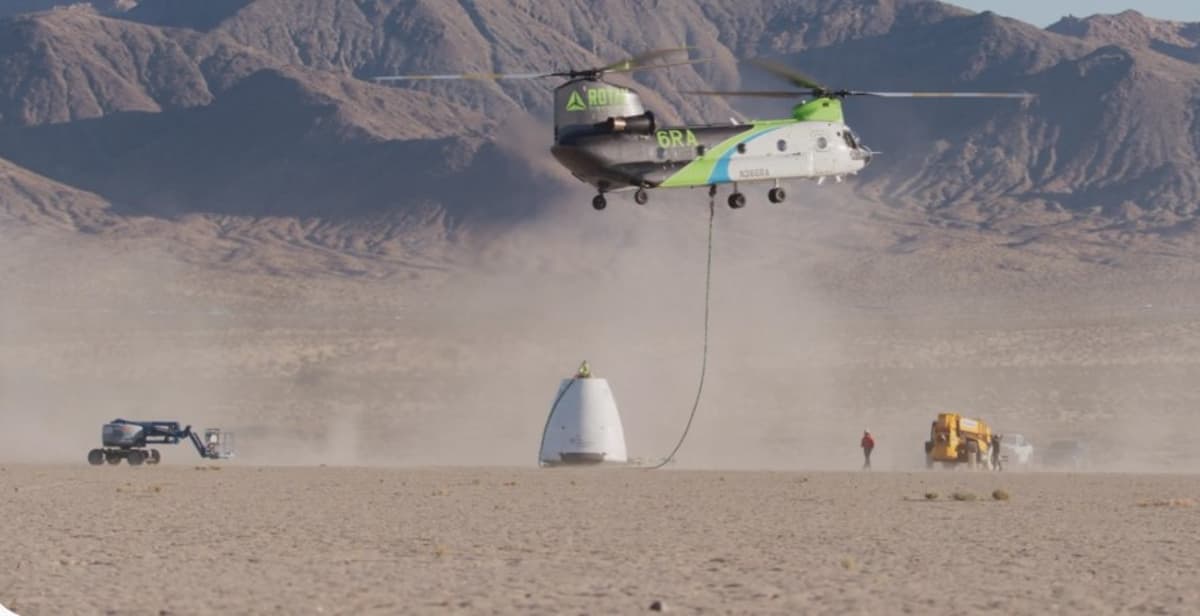
The Exploration Company Tests Nyx Recovery Vehicle
Companies Mentioned
Why It Matters
The successful parachute transition test de‑risks a key safety element for reusable capsules, bringing TEC closer to operational readiness. It signals Europe’s growing capability in autonomous re‑entry and recovery, potentially attracting commercial and government payload customers.
Key Takeaways
- •Nyx drop test validated parachute transition from drogue to main
- •Test conducted in Mojave desert using land‑impact mock‑up
- •Rapid iteration enabled by dedicated drop‑test vehicle and instrumentation
- •Demo launch targeted for 2028 after successful recovery milestones
Pulse Analysis
The Nyx recovery drop test marks a pivotal engineering milestone for The Exploration Company, a Munich‑based New Space venture. By demonstrating a reliable handoff from drogue to main parachutes, the company proves that its capsule can survive the most stressful phase of re‑entry—parachute deployment and final descent. The test employed a purpose‑built drop‑test vehicle equipped with high‑frequency sensors, allowing engineers to verify timing, load distribution, and structural integrity under real‑world conditions. Such data are essential for certifying the capsule’s safety envelope before any crewed or commercial missions.
Europe’s autonomous re‑entry sector has lagged behind the United States and China, but TEC’s progress narrows that gap. The 2028 demonstration flight, slated for a water landing, will build on the Mojave results and showcase a fully integrated recovery sequence. By leveraging rapid‑iteration design cycles and a modular mock‑up, TEC reduces development costs and shortens the path to market—a strategy that mirrors the lean approaches of SpaceX and Rocket Lab. Successful validation also positions the company to bid for government contracts and private payload services targeting low‑Earth orbit and beyond.
Investors and satellite operators are watching the Nyx program closely because a dependable, reusable return capsule can lower the total cost of missions that require on‑orbit servicing or sample return. If TEC meets its 2028 timeline, it could offer a European alternative to U.S. providers, diversifying the supply chain and enhancing resilience for critical communications or Earth‑observation constellations. Moreover, the desert‑based test demonstrates TEC’s ability to conduct low‑cost, high‑fidelity trials, a capability that may attract partnerships with aerospace firms seeking rapid prototyping and verification services.
The Exploration Company Tests Nyx Recovery Vehicle
Comments
Want to join the conversation?
Loading comments...