Companies Mentioned


Why It Matters
Understanding the value‑chain dynamics reveals where profit and risk reside, guiding investment, policy, and corporate strategy in a rapidly expanding sector.
Key Takeaways
- •Upstream activities carry high risk, low recurring revenue
- •Downstream services generate majority of space economy revenue
- •Midstream converts hardware into reliable data and connectivity
- •Government policy shapes spectrum, standards, and funding
- •Vertical integration boosts margins but requires significant capital
Pulse Analysis
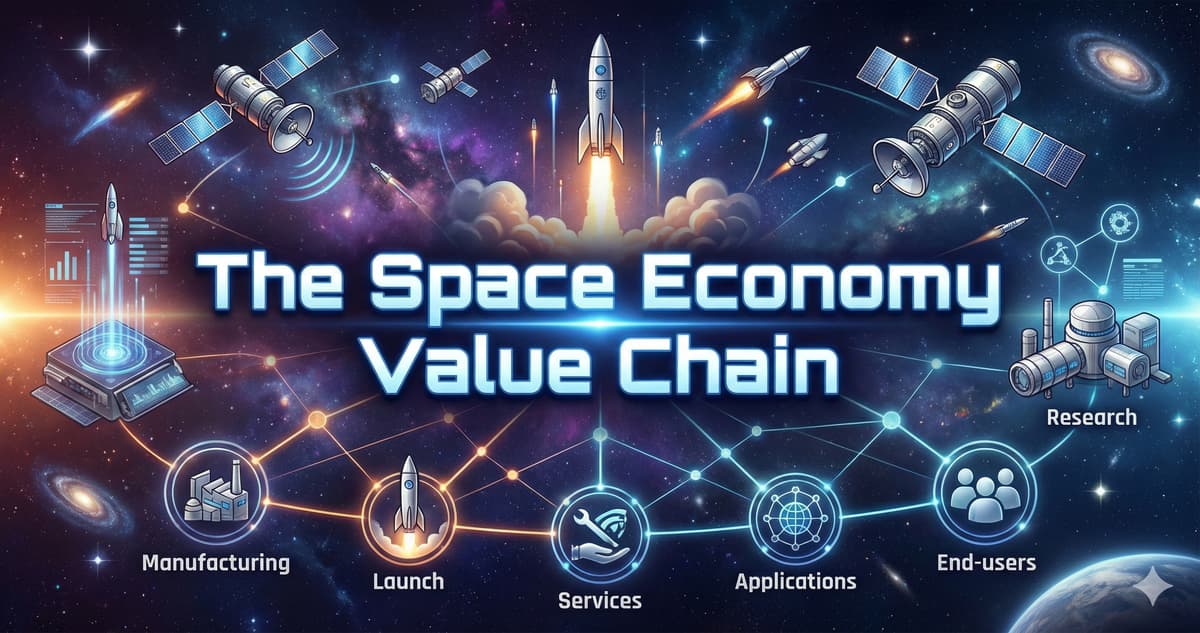
The space economy is no longer a niche sector; by early 2026 its total value sits in the high‑hundreds of billions of dollars, with many analysts forecasting a trillion‑dollar market by the 2030s. This valuation depends not only on rockets and satellites but on a multi‑layered value chain that transforms research, hardware, and launch services into data, connectivity, and downstream applications. Understanding how value is created, captured, and transferred across upstream, midstream, and downstream segments is essential for investors, policymakers, and corporations seeking to navigate the rapidly expanding orbital marketplace.
Upstream activities—research, component manufacturing, and launch—bear the greatest technical risk and capital intensity, yet they lay the foundation for downstream revenue streams that scale to millions of users. Midstream operations, including ground stations, mission control, and data‑processing pipelines, turn raw space assets into reliable services, with performance metrics such as latency, availability, and cybersecurity becoming competitive differentiators. Downstream firms capture the bulk of earnings through subscription‑based broadband, GNSS‑enabled logistics, and Earth‑observation analytics, leveraging APIs and platform ecosystems to embed space‑derived insights into everyday business processes. Government procurement and regulatory frameworks further shape each layer, influencing spectrum allocation, export controls, and liability insurance.
Emerging trends are reshaping the chain: automation in satellite assembly, software‑defined ground segments, and onboard AI reduce costs and latency, while direct‑to‑device connectivity expands consumer reach. At the same time, geopolitical competition drives sovereign capability programs and stricter debris‑mitigation rules, raising compliance costs but safeguarding long‑term orbital sustainability. Companies that balance vertical integration with strategic partnerships can capture higher margins, whereas pure‑play specialists must focus on niche expertise and cost efficiencies. For capital markets, the key signals are production throughput, launch cadence, and recurring‑revenue contracts, which together indicate a firm’s ability to thrive in the evolving space economy.
The Space Economy Value Chain
0
Comments
Want to join the conversation?
Loading comments...