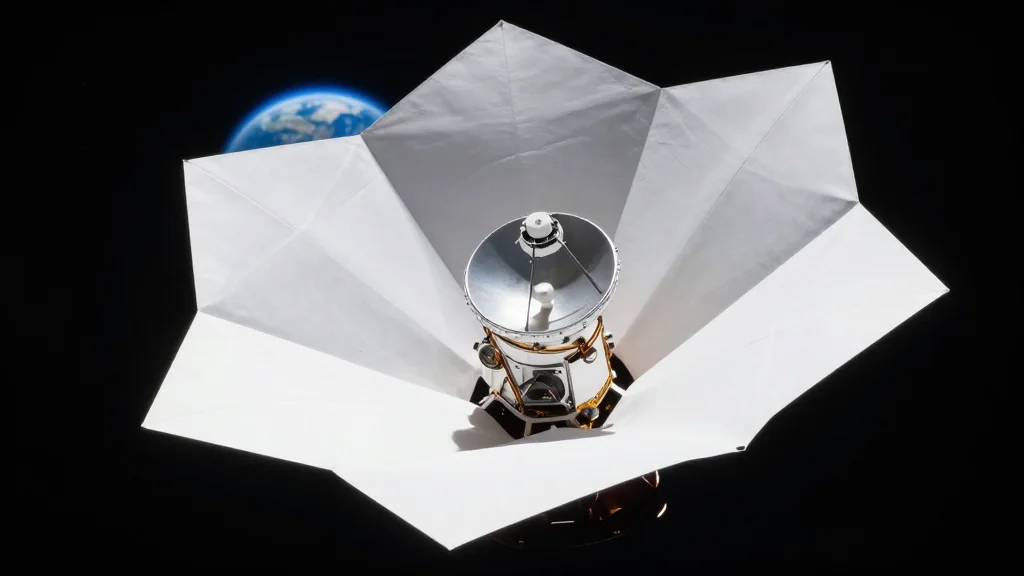
The TWINSTAR Mission Concept: A Pragmatic Path to Finding Earth 2.0
Why It Matters
TWINSTAR offers a realistic, mid‑range solution that bridges the gap between low‑cost probes and multi‑billion‑dollar flagships, accelerating the search for habitable worlds and preserving limited NASA budgets.
Key Takeaways
- •$3‑5 billion budget targets “strategic middle” between probes and flagships
- •4‑meter telescope with 34‑meter starshade reaches 10⁻¹⁰ contrast
- •Origami‑like starshade folds into standard rocket fairings
- •Sun‑Earth L2 orbit provides stable thermal environment
- •JWST‑derived bus cuts development risk and cost
Pulse Analysis
Direct imaging of Earth‑like planets demands suppressing starlight by a factor of ten‑billion, a challenge that has driven most flagship concepts toward massive, costly telescopes. The TWINSTAR mission sidesteps the extreme wavefront stability required by internal coronagraphs by employing an external starshade, a separate spacecraft that blocks starlight before it reaches the telescope. This architectural shift dramatically reduces the precision burden on the primary mirror while still delivering the contrast needed to isolate faint planetary signals, making the science goal of detecting biosignatures more attainable within a modest budget.
The starshade’s engineering is a centerpiece of the concept: a 34‑meter petaled screen that launches in a compact, origami‑like stowage and unfurls in space to form a precise diffraction pattern. By using a JWST‑derived bus and situating the observatory at Sun‑Earth L2, TWINSTAR benefits from proven thermal control, milli‑arcsecond pointing, and a stable thermal environment that enables long exposures. Risk mitigation focuses on a precursor technology demonstration to raise the starshade’s TRL from 5‑6, while the telescope’s detectors inherit TRL 7‑8 from Roman and JWST heritage, keeping overall program risk low.
Strategically, TWINSTAR fills the “strategic middle” identified by the Astro2020 Decadal Survey, offering a pathway to habitable‑world discovery without the $10‑plus billion price tag of a flagship. Its cost‑effective design could attract commercial partnerships and international collaborations, expanding the pool of funding sources. If successful, the mission would not only deliver the first spectral fingerprints of a living world but also establish a reusable architecture for future exoplanet observatories, reshaping the economics of deep‑space astrophysics.
The TWINSTAR mission concept: A pragmatic path to finding Earth 2.0
Comments
Want to join the conversation?
Loading comments...