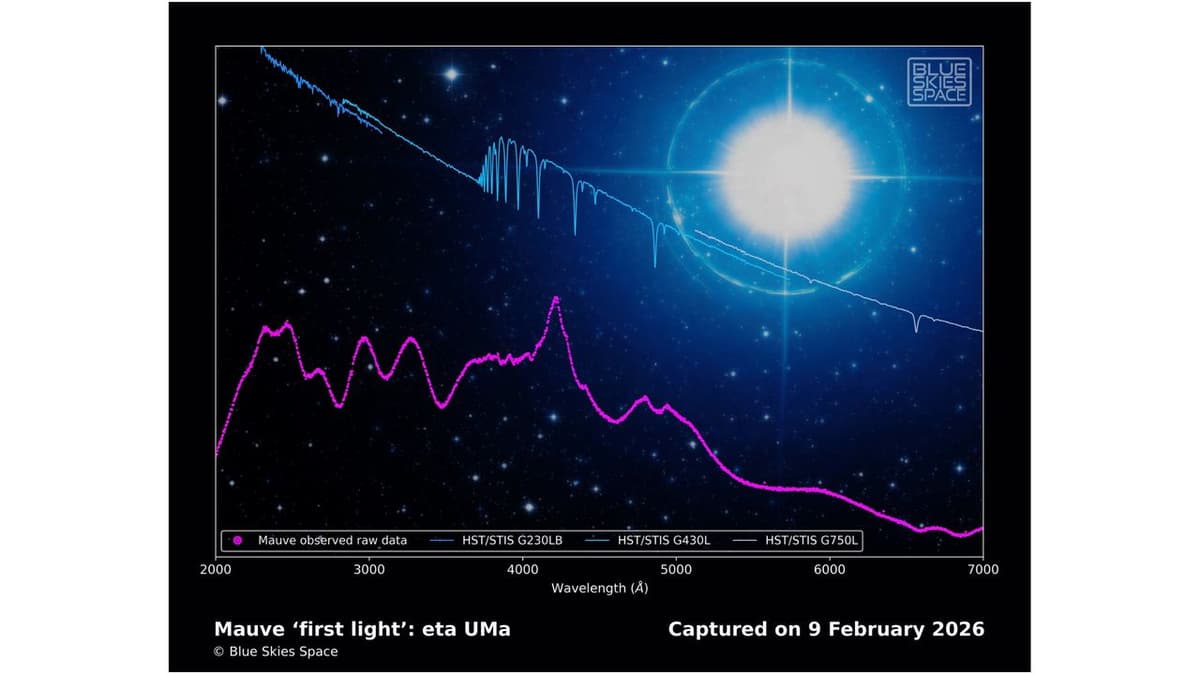
The World's 1st Private Space Telescope Just Spotted Its 1st Star. Here's What It Saw.
•March 3, 2026
0
Why It Matters
Mauve opens a new, cost‑effective avenue for ultraviolet stellar observations, accelerating the search for habitable exoplanets. Its commercial model could reshape how the scientific community accesses space‑based data.
Key Takeaways
- •Mauve is first private space telescope
- •Targets UV emissions to study stellar flares
- •Provides rapid, low‑cost data for exoplanet habitability
- •Blue Skies Space plans follow‑on mission Twinkle
- •Commercial astronomy complements government‑funded flagship missions
Pulse Analysis
The launch of Mauve marks a watershed moment in the commercialization of space science, signaling a shift from exclusive government‑run observatories to market‑driven platforms. By leveraging low‑cost launch services and modular satellite designs, private firms can now field instruments that were once the sole domain of agencies like NASA or ESA. This democratization lowers barriers for universities and smaller research groups, expanding the pool of scientists who can conduct high‑precision ultraviolet observations without competing for scarce Hubble time.
Mauve’s primary strength lies in its ability to capture both visible and ultraviolet spectra of nearby stars, a capability critical for studying stellar flares and their impact on planetary environments. Ultraviolet radiation drives atmospheric chemistry and can strip away atmospheres, directly influencing a planet’s habitability. By continuously monitoring stars such as η Ursa Majoris, Mauve provides real‑time data on flare frequency and intensity, enabling astronomers to refine models of exoplanetary climate stability and prioritize targets for deeper investigation.
Beyond the scientific payoff, Mauve’s commercial subscription model creates a sustainable revenue stream that funds subsequent missions like Twinkle, a dedicated exoplanet‑spectroscopy satellite. The approach also encourages partnerships with international space agencies and paves the way for constellations that could observe radio emissions from lunar orbit. As launch costs continue to fall, the private sector is poised to become a reliable source of niche, high‑value data, complementing flagship missions while accelerating the overall pace of discovery.
The world's 1st private space telescope just spotted its 1st star. Here's what it saw.
0
Comments
Want to join the conversation?
Loading comments...