This 3.2 Gigapixel Time Machine Will Change Everything We Know About the Cosmos
•January 21, 2026
0
Why It Matters
It will transform astrophysics by delivering the most comprehensive, time‑resolved map of the universe, accelerating discoveries in dark energy, planetary defense, and transient phenomena. The open‑access model also democratizes data, spurring innovation across academia and industry.
Key Takeaways
- •3.2‑gigapixel camera captures unprecedented sky detail.
- •Survey images southern sky every few nights for ten years.
- •Generates 60 petabytes, delivering millions of nightly alerts.
- •Enables dark matter mapping and near‑Earth asteroid detection.
- •Open data fosters global collaboration and citizen‑science projects.
Pulse Analysis
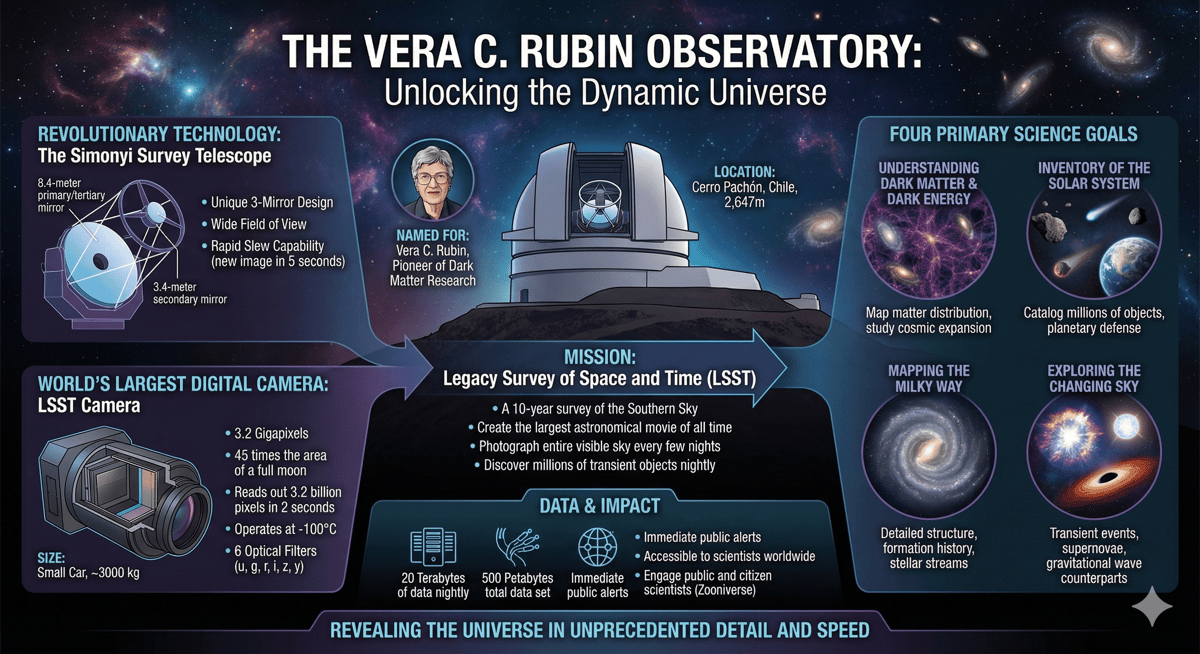
The Rubin Observatory’s technical breakthroughs set a new benchmark for ground‑based astronomy. Its 8.4‑meter monolithic primary, paired with the world’s largest convex secondary mirror, delivers a 3.5° field of view without sacrificing resolution. The LSST Camera’s 3.2‑gigapixel focal plane, cooled to –100 °C, captures six‑filter images in rapid 15‑second exposures, turning the telescope into a high‑speed, wide‑angle eye on the cosmos. Coupled with Cerro Pachón’s pristine, high‑altitude conditions, the system minimizes atmospheric distortion, ensuring data quality comparable to space‑based platforms.
Beyond hardware, Rubin’s real power lies in its data infrastructure. Each night, roughly 20 TB of raw images travel via fiber‑optic links to processing centers where automated pipelines calibrate, stack, and catalog billions of sources. Within 60 seconds, an alert stream flags up to 10 million transient or moving objects, feeding community brokers that prioritize supernovae, gravitational‑wave counterparts, and near‑Earth asteroids for rapid follow‑up. Over ten years, the archive will amass 60 petabytes, supporting four science pillars—dark matter and dark energy, solar‑system census, transient sky, and Milky Way mapping—each poised to answer fundamental cosmological questions.
The observatory’s open‑access philosophy amplifies its scientific return. By releasing calibrated images and catalogs to the global community, Rubin fuels collaborations across universities, private firms, and citizen‑science platforms like Zooniverse. This democratization accelerates algorithm development, machine‑learning applications, and educational outreach, bridging the gap between professional astronomers and the public. In contrast to narrow‑field space telescopes, Rubin acts as a cosmic floodlight, discovering targets that space‑based observatories can later study in detail, creating a synergistic ecosystem that reshapes how humanity explores the universe.
This 3.2 Gigapixel Time Machine Will Change Everything We Know About the Cosmos
0
Comments
Want to join the conversation?
Loading comments...