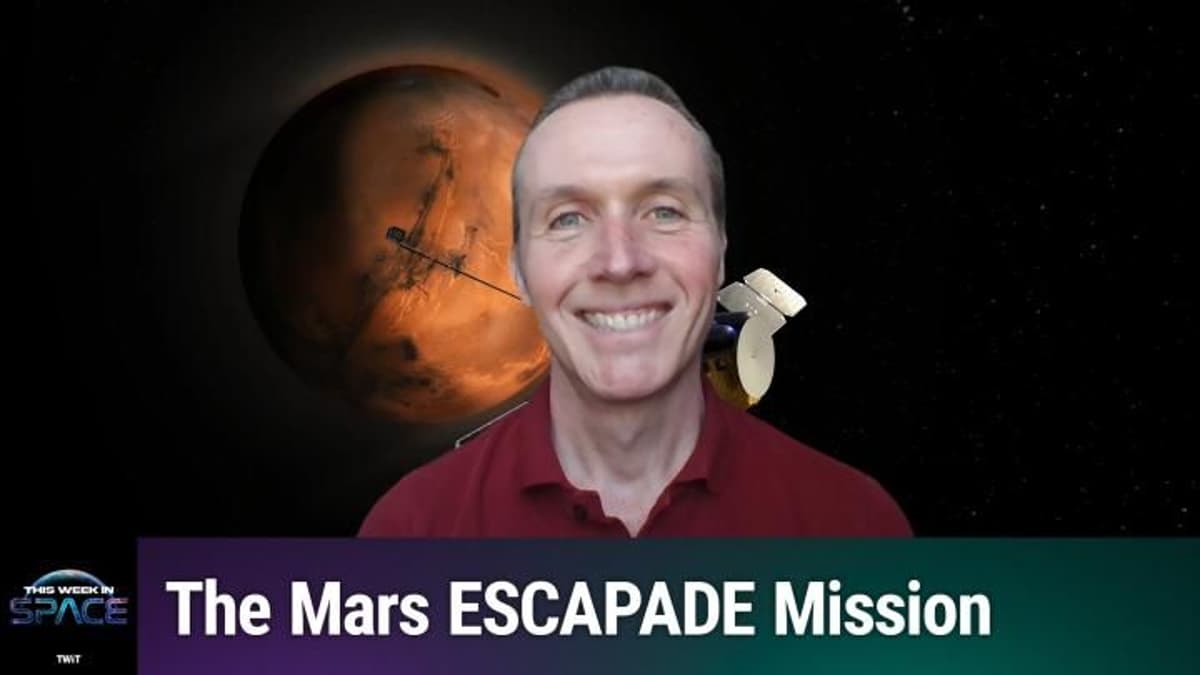
This Week In Space Podcast: Episode 210 — ESCAPADES at Mars
Why It Matters
Understanding atmospheric loss on Mars refines climate models and informs future crewed missions, while ESCAPADE’s budget‑friendly approach showcases a new paradigm for deep‑space science.
Key Takeaways
- •ESCAPADE will launch twin orbiters to study Mars atmospheric loss.
- •Mission built by Rocket Lab, launched on Blue Origin’s New Glenn.
- •Arrival at Mars slated for 2028, offering unprecedented plasma measurements.
- •Budget‑constrained design demonstrates cost‑effective deep‑space exploration.
- •Insights could inform future human missions and climate models of Mars.
Pulse Analysis
Mars ESCAPADE (Escape and Plasma Acceleration and Dynamics Explorers) represents a strategic shift in planetary science, deploying two small satellites to map how solar wind and magnetic fields strip away the Martian atmosphere. By focusing on ion escape processes, the mission promises to fill gaps left by larger orbiters, delivering high‑resolution measurements of plasma flows that dictate the planet’s long‑term habitability prospects. The twin‑orbiter design also enables simultaneous observations, offering a three‑dimensional view of atmospheric loss mechanisms.
The program’s execution underscores a cost‑effective model for deep‑space missions. Rocket Lab, an emerging launch provider, supplied the spacecraft bus, while Blue Origin’s New Glenn rocket delivered the payload, marking one of the first major scientific payloads on the vehicle. With a modest budget compared to flagship missions, ESCAPADE demonstrates that industry partnerships can reduce expenses without compromising scientific return. The launch is slated for early 2025, with a cruise phase that positions the orbiters for Mars arrival in 2028, aligning with NASA’s broader timeline for Mars exploration.
Beyond its immediate goals, ESCAPADE’s findings will ripple across the aerospace sector. Detailed atmospheric loss data improve climate evolution models, aiding planners of future crewed missions such as Artemis III and eventual Mars surface habitats. The mission also complements concurrent efforts like the Psyche asteroid probe’s Mars flyby and SpaceX’s Starship development, collectively advancing our understanding of planetary environments and the engineering pathways needed for sustained human presence beyond Earth.
This Week In Space podcast: Episode 210 — ESCAPADES at Mars
Comments
Want to join the conversation?
Loading comments...