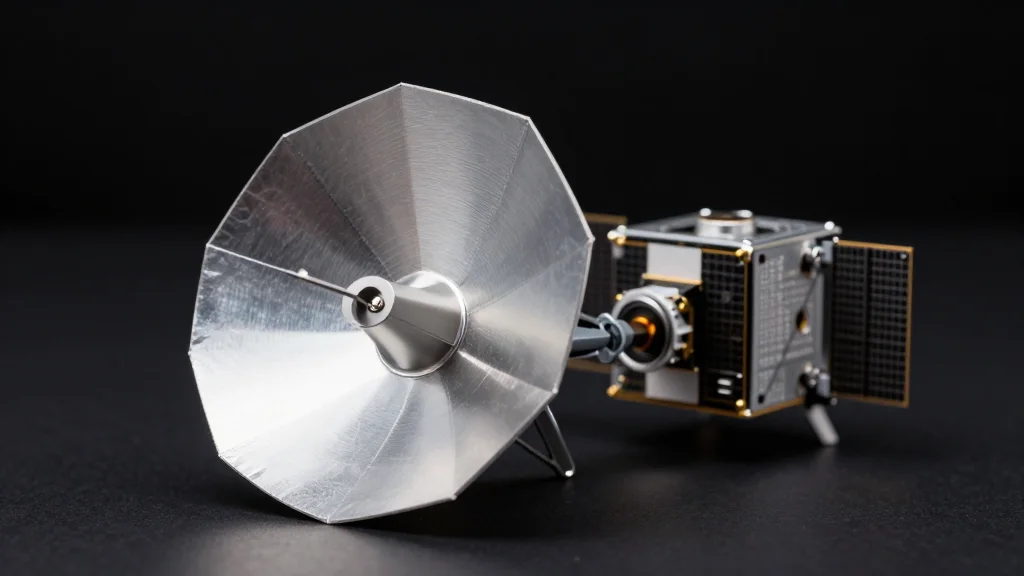
Tiny Satellites Face Big Data Limits: How Foldable Antennas Could Change CubeSat Missions
Why It Matters
The antenna removes a key bottleneck—limited bandwidth—in CubeSat missions, opening commercial and scientific opportunities that previously required larger, costlier platforms. This breakthrough could accelerate low‑cost space‑based internet, disaster monitoring, and deep‑space exploration using miniature satellites.
Key Takeaways
- •Origami‑inspired reflectarray fits 3U CubeSat, weighs 64 g
- •Antenna expands 2.6×, achieving 265 % storage ratio
- •Provides 18 dBic gain at 5.8 GHz, enabling high‑rate links
- •Supports deep‑space and lunar CubeSat communications
- •Demonstrated in anechoic chamber, ready for OrigamiSat‑2 launch 2026
Pulse Analysis
CubeSats have transformed access to space, but their tiny form factor imposes strict limits on antenna size, capping data throughput and restricting mission scope. Traditional high‑gain dishes are too bulky and heavy, forcing operators to accept low‑rate, narrow‑band links that hinder real‑time applications such as Earth observation or inter‑satellite networking. The origami‑inspired reflectarray sidesteps this trade‑off by leveraging a flasher‑origami folding pattern and lightweight shape‑memory booms, allowing a 10 cm × 10 cm × 6 cm stowed package to deploy into a 2.6‑times larger aperture once in orbit. This clever mechanical design, combined with a beam‑tilting primary radiator, yields an 18 dBic gain at 5.8 GHz—comparable to antennas on much larger spacecraft—while staying under 100 g, a critical threshold for 3U CubeSats.
The performance metrics matter beyond the laboratory. An 18 dBic gain translates into data rates that can support high‑definition video, rapid telemetry, and even broadband internet services from low‑Earth orbit platforms. Moreover, the antenna’s circular polarization and beam‑tilting capability improve link reliability in cluttered orbital environments and enable communication with ground stations at higher elevation angles. For missions targeting the Moon or deep‑space destinations, the increased link budget reduces the need for extensive ground infrastructure, making ambitious scientific payloads feasible on a CubeSat budget.
Industry analysts see this technology as a catalyst for a new wave of commercial and governmental CubeSat programs. Space‑based internet providers can now contemplate constellations that deliver higher throughput per satellite, lowering overall constellation size and cost. Disaster‑response agencies will benefit from faster, more reliable downlinks for real‑time imaging, while academic institutions gain a viable path to lunar or interplanetary experiments without the expense of traditional spacecraft. As the design matures and production scales, the foldable reflectarray could become a standard payload component, reshaping the economics and capabilities of small‑satellite missions worldwide.
Tiny satellites face big data limits: How foldable antennas could change CubeSat missions
Comments
Want to join the conversation?
Loading comments...