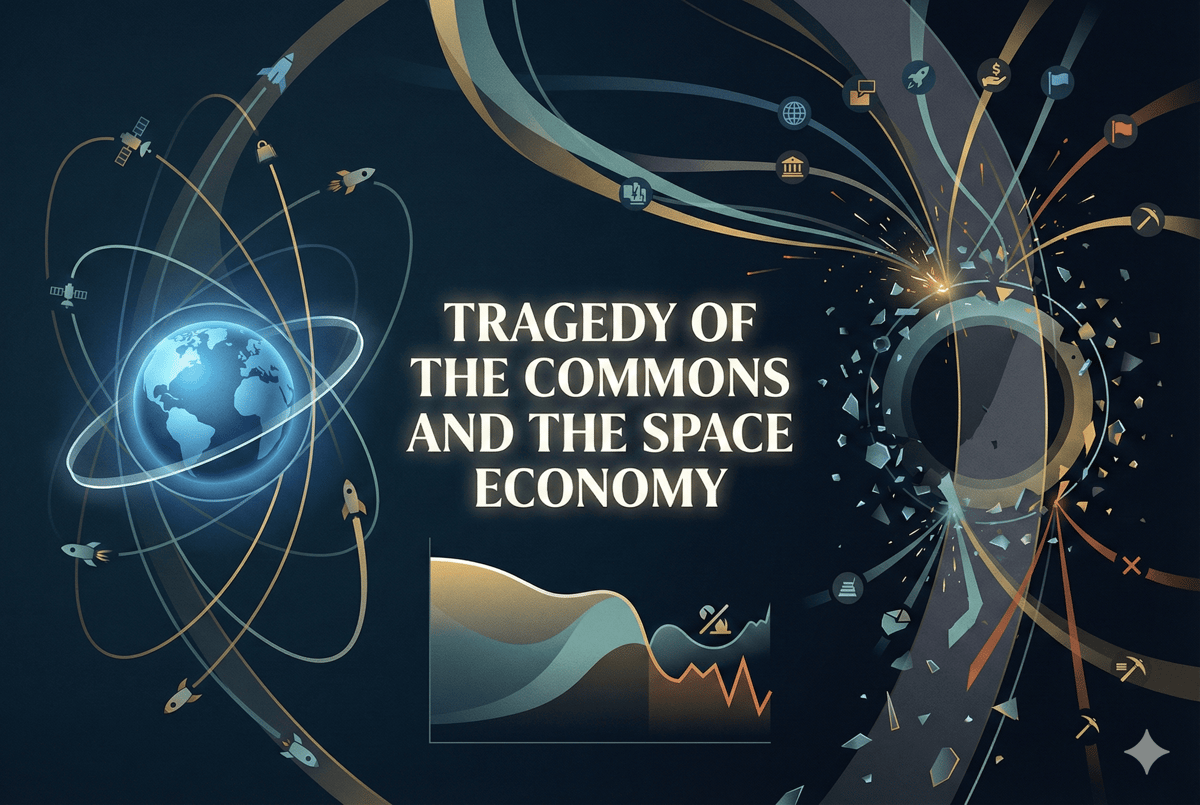
Tragedy of the Commons and the Space Economy
•February 9, 2026
0
Companies Mentioned

Why It Matters
Without effective commons management, orbital congestion and debris could render key orbits unusable, threatening commercial services, scientific research, and future exploration. Robust, multi‑layered governance therefore becomes a strategic imperative for the entire space industry.
Key Takeaways
- •LEO congestion raises collision risk for all operators
- •Spectrum crowding amplifies interference and coordination costs
- •Mega‑constellations boost services but increase externalities
- •Transparent tracking data reduces uncertainty and incentivizes safe behavior
- •Polycentric rules combine national, international, and industry standards
Pulse Analysis
Space has evolved from a frontier for a few nation‑states into a densely populated commons where every launch adds pressure on shared resources. The rapid decline in launch costs and the rise of mega‑constellations have democratized access, but they also multiply collision probabilities in low‑Earth orbit and strain the limited radio‑frequency bands coordinated by the ITU. When operators treat orbital slots and spectrum as private assets, the external costs—debris creation, signal interference, and even light pollution—are diffused across the entire ecosystem, creating a classic tragedy of the commons scenario.
Effective mitigation hinges on governance that internalizes these externalities. National licensing regimes can mandate end‑of‑life disposal, performance bonds, and mandatory data sharing, turning diffuse risks into concrete obligations. International bodies such as the United Nations Office for Outer Space Affairs and the ITU provide the normative framework, while industry consortia develop technical standards for ephemeris formats and autonomous collision avoidance. By layering these mechanisms—global treaties, national regulations, and market‑driven standards—a polycentric system emerges that aligns incentives, improves transparency, and reduces transaction costs for operators of all sizes.
Looking ahead, the sustainability of the space economy depends on proactive commons management. Active debris removal, standardized design‑for‑deorbit practices, and equitable access to orbital resources will become competitive differentiators rather than optional extras. As the threshold for orbital congestion approaches, the cost of inaction will far exceed the investments needed for robust space traffic management and coordinated spectrum allocation. Stakeholders that embrace these governance tools now will secure long‑term operational safety, preserve scientific value, and maintain the economic viability of space‑based services.
Tragedy of the Commons and the Space Economy
0
Comments
Want to join the conversation?
Loading comments...