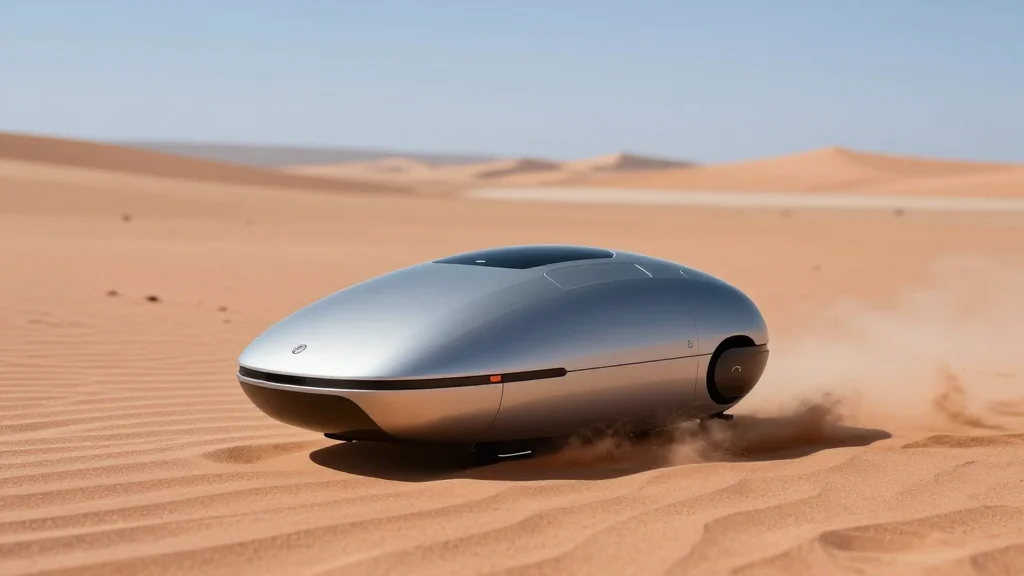
Tumbleweed Mars Testing: Harnessing Wind Energy
Why It Matters
Wind‑powered rovers could slash mission mass and fuel costs, enabling larger sensor swarms for more comprehensive Martian data collection. Successful Earth analog testing de‑risky the technology for upcoming ESA and commercial Mars missions.
Key Takeaways
- •First wind‑driven rover completed day‑one desert test
- •Prototype reaches 35 mph using only wind power
- •Elliptical carbon‑fiber design weighs 8 lb, carries 7 sensors
- •Successful test improves uphill mobility and impact resistance
Pulse Analysis
Wind‑driven mobility addresses one of the biggest constraints on planetary exploration: mass. Traditional rovers rely on batteries and radioisotope power units, adding significant weight and limiting mission duration. By harnessing ambient wind, the Tumbleweed Mars concept eliminates fuel and reduces power‑system complexity, a breakthrough that could lower launch costs and expand payload capacity. The Atacama Desert, with its hyper‑arid climate and diurnal wind cycles mirroring those on Mars, offers an ideal proving ground, allowing engineers to evaluate autonomous behavior under realistic conditions.
The prototype’s elliptical carbon‑fiber frame, weighing just 8 lb (3.5 kg), integrates a camera, microphone, GPS, gamma‑ray spectrometer, magnetometer and environmental sensors. Its ability to achieve 35 mph (57 km/h) solely from wind demonstrates that sufficient kinetic energy can be harvested even in thin atmospheres. Test data showed the rover could climb inclines and absorb impacts better than expected, confirming the design’s resilience on rocky or sandy terrain. The envisioned mission would drop swarms over the Martian north pole, where they would unfurl like parachutes, ride prevailing winds toward the equator, and relay high‑resolution atmospheric and surface measurements.
If scaled, wind‑propelled swarms could transform Mars science by providing continuous, distributed observations at a fraction of the cost of single, heavy rovers. The technology also appeals to commercial entities eyeing resource scouting or infrastructure deployment on the Red Planet. Ongoing collaborations with ESA and Europlanet suggest that the next testing phase will move to simulated Martian pressure chambers, refining control algorithms before a potential flight opportunity in the late 2020s. This momentum signals a shift toward more sustainable, low‑mass exploration architectures.
Tumbleweed Mars Testing: Harnessing Wind Energy
Comments
Want to join the conversation?
Loading comments...