Unidentified Anomalous Phenomena: The Current State of Knowledge and Uncertainty
•January 7, 2026
0
Why It Matters
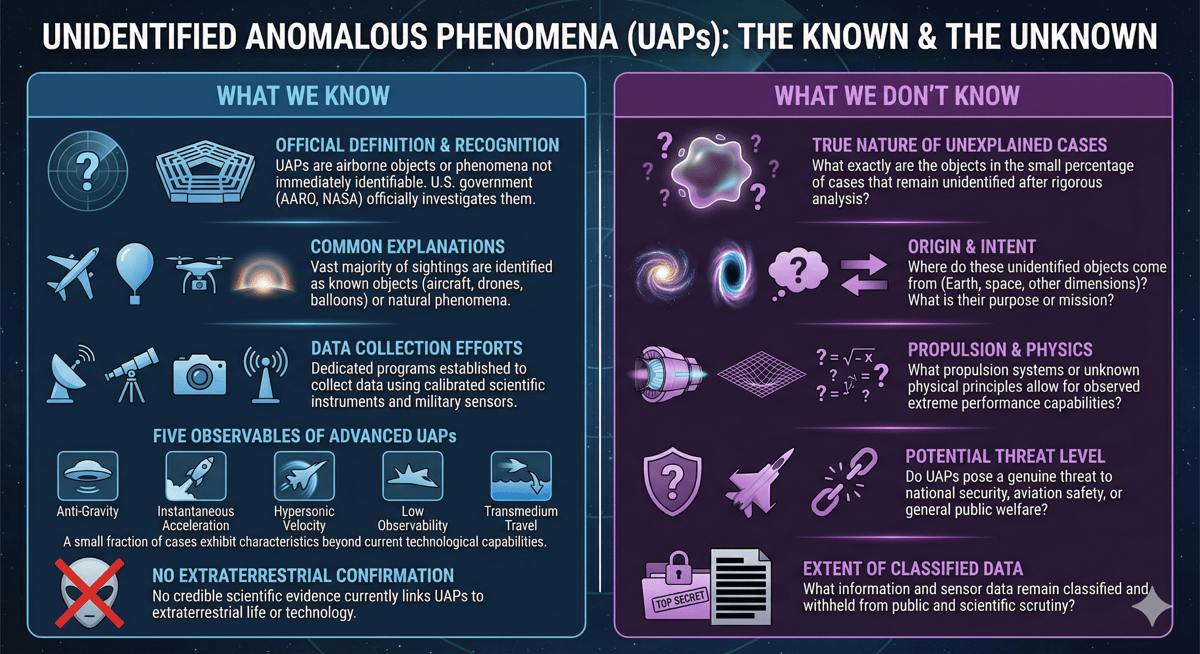
The findings affect aviation safety, national security, and scientific inquiry by exposing data gaps and the possibility of advanced, unacknowledged technologies, prompting calls for greater transparency and systematic data collection.
Key Takeaways
- •Most UAP reports resolve to mundane objects.
- •Data scarcity and sensor errors limit scientific analysis.
- •No verifiable extraterrestrial evidence confirmed.
- •Five observables describe truly anomalous flight characteristics.
- •Classified data hampers independent research and transparency.
Pulse Analysis
The rebranding of UFOs to Unidentified Anomalous Phenomena reflects a deliberate effort to strip away cultural bias and broaden investigative scope. By encompassing air, space, and maritime domains, agencies like the Department of Defense’s All‑domain Anomaly Resolution Office (AARO) and NASA can apply uniform reporting standards, encouraging pilots and sensor operators to submit observations without fear of ridicule. This shift has already yielded a richer dataset, allowing analysts to separate routine clutter—birds, balloons, drones—from genuinely puzzling events.
Despite the larger pool of reports, scientific progress remains hampered by two persistent obstacles: low‑resolution, single‑sensor recordings and the classification of high‑fidelity data. Sensor artifacts, compression glitches, and atmospheric phenomena account for a substantial share of sightings, underscoring the need for calibrated, multi‑modal collection methods. Yet many detailed radar logs and infrared captures stay behind security clearances, limiting peer‑review and slowing hypothesis testing. The resulting evidence gap fuels speculation while preventing rigorous validation of any extraordinary claims.
The handful of cases that exhibit the so‑called Five Observables—anti‑gravity lift, instantaneous acceleration, hypersonic velocity without thermal signatures, low observability, and seamless trans‑medium travel—pose the most compelling challenges. If these outliers represent foreign advanced technology, they could signal a strategic surprise; if they hint at unknown physics, they could reshape aerospace engineering. Emerging solutions include leveraging commercial satellite constellations and AI‑driven anomaly detection to filter known objects and flag true unknowns. Greater transparency, balanced with legitimate security concerns, will be essential for converting mystery into measurable knowledge.
Unidentified Anomalous Phenomena: The Current State of Knowledge and Uncertainty
0
Comments
Want to join the conversation?
Loading comments...