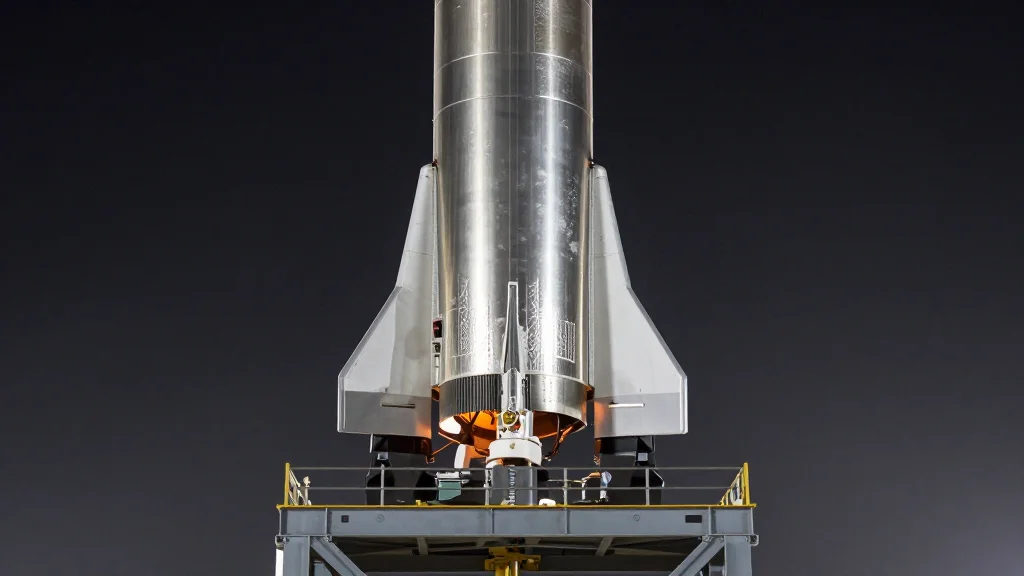
Update on SpaceX Preparations at Boca Chica for Next Starship/Superheavy Test Flight
Companies Mentioned
Why It Matters
Accelerating the test cadence directly influences SpaceX’s ability to certify Starship for crewed Artemis‑3 missions and to demonstrate in‑space refueling, a prerequisite for lunar exploration architectures.
Key Takeaways
- •Superheavy prototype B20 placed on test stand for cryogenic checks.
- •LOX and methane tanks will undergo extreme cold structural validation.
- •July‑August window set for Starship flight 13, two‑month gap.
- •Rapid flight cadence needed for Artemis‑3 crewed Earth‑orbit certification.
- •Refueling demonstration targeted before year‑end, depends on flight 13 success.
Pulse Analysis
SpaceX’s Starship program has entered a pivotal phase as Superheavy booster B20 moves to the Boca Chica cryogenic test stand. This step follows a series of static‑fire and structural assessments that have gradually increased the vehicle’s propellant capacity. By subjecting the LOX and methane tanks, composite over‑wrap pressure vessels, and the intricate network of valves and sensors to near‑absolute‑zero temperatures, engineers aim to confirm that the booster can survive the thermal stresses of a full‑scale launch. Successful validation will clear the path for the next engine‑fire campaign and integrate B20 into the launch stack for flight 13.
The timing of these tests is tightly linked to SpaceX’s broader launch cadence. A July‑August window for the 13th orbital flight represents a dramatic acceleration compared with the seven‑month interval that separated flights 11 and 12. This compressed schedule is designed to compress the development loop, allowing rapid iteration on hardware and software while keeping the overall program on track for a crewed Artemis‑3 Earth‑orbit qualification in 2027. The fast‑track approach also pressures the company to resolve any anomalies quickly, as each test milestone now carries heightened significance for downstream missions.
Beyond NASA’s partnership, the upcoming flight is a linchpin for SpaceX’s commercial lunar ambitions. The company has pledged to execute an in‑space refueling demonstration before the end of 2026, a capability that would enable multiple Starships to launch within weeks and support sustained lunar operations. Flight 13 must therefore achieve key performance metrics, including tank integrity and engine reliability, to validate the refueling architecture. Success would not only reinforce SpaceX’s position as the primary launch provider for Artemis but also open new revenue streams in orbital logistics and deep‑space exploration.
Update on SpaceX preparations at Boca Chica for next Starship/Superheavy test flight
Comments
Want to join the conversation?
Loading comments...