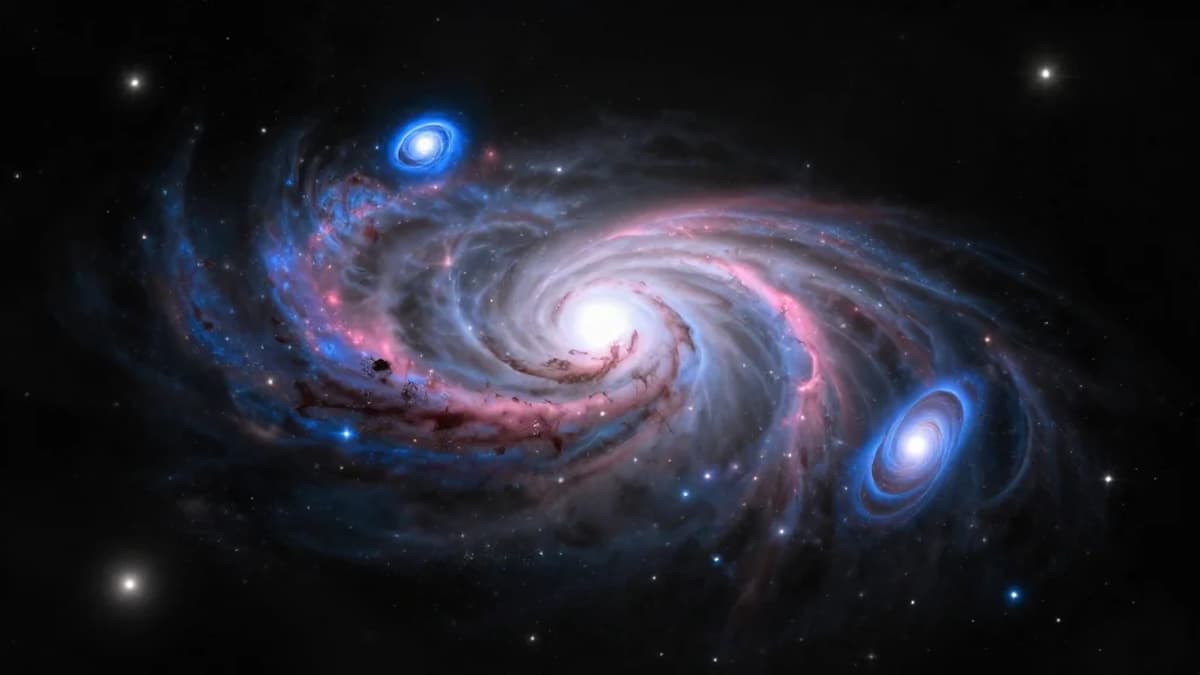
Vast Cluster of Ancient Galaxies Could Rewrite the History of Star Formation
•January 20, 2026
0
Why It Matters
The discovery compels a rethink of early‑universe galaxy assembly rates, reshaping models of cosmic evolution and how we interpret deep‑field observations.
Key Takeaways
- •Record cluster of dusty galaxies at redshift ~6
- •Galaxies forming stars up to 1000× Milky Way rate
- •Discovered via NIKA2 millimeter survey, not JWST
- •Structure challenges early‑universe star‑formation models
- •Dust obscuration hides majority of early star formation
Pulse Analysis
Dust‑enshrouded star formation has long eluded optical and near‑infrared telescopes, leaving a blind spot in our view of the first billion years. While JWST pushes the frontier of high‑redshift galaxy detection, its sensitivity drops where dust re‑emits absorbed energy at longer wavelengths. Millimeter and sub‑millimeter observations, therefore, provide a complementary window that captures the hidden luminosity of massive, dust‑rich systems, revealing a population that could dominate early cosmic star‑formation budgets.
The NIKA2 Cosmological Legacy Survey (N2CLS) leverages the dual‑band 1.2 mm/2 mm camera on the IRAM 30‑meter dish to map large sky areas with unprecedented depth. This capability allowed Lagache’s team to isolate a filamentary overdensity of dusty galaxies at redshift ~6, each radiating intense millimeter fluxes that betray star‑formation rates thousands of times higher than the Milky Way. The structure spans tens of millions of light‑years, making it the most massive, densely packed assembly of its epoch ever recorded, and it was invisible in the deepest Hubble and JWST fields due to extreme dust attenuation.
The implications ripple through theoretical astrophysics. Current semi‑analytic models predict a gradual buildup of stellar mass, yet this discovery suggests that, under certain early‑universe conditions, galaxies can convert gas into stars with far greater efficiency. Revising feedback mechanisms, gas accretion rates, and dust production timelines will be essential to reconcile observations with simulations. Future facilities such as the Atacama Large Millimeter/submillimeter Array upgrades and the proposed Origins Space Telescope will further probe these hidden star factories, refining our picture of how the first luminous structures shaped the cosmos.
Vast cluster of ancient galaxies could rewrite the history of star formation
0
Comments
Want to join the conversation?
Loading comments...