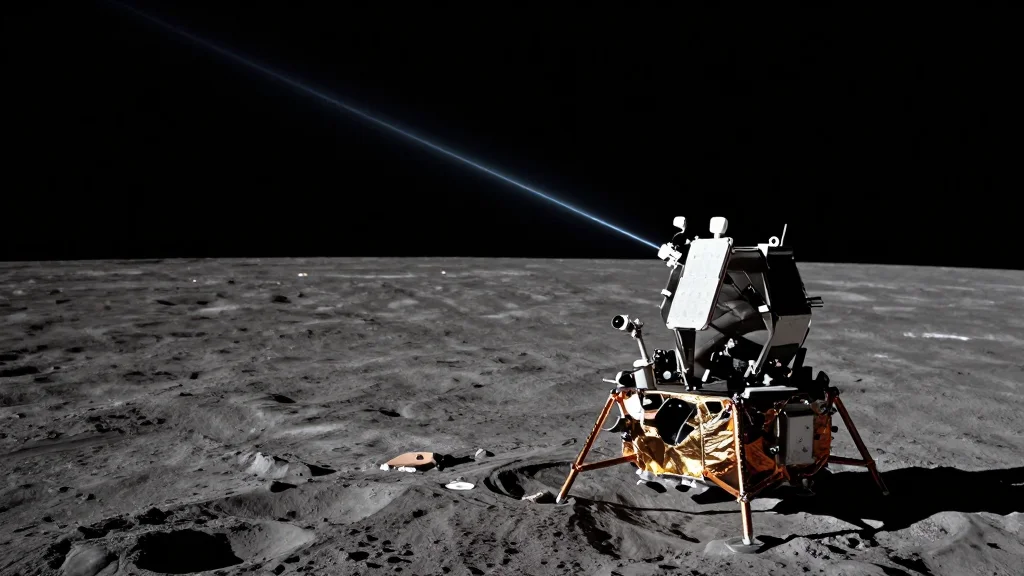
Volta Space Technologies Leverages Government Partnerships and Funding to Develop Laser-Enabled Lunar PV Power Network
Companies Mentioned
Why It Matters
By eliminating the mass and cost of large lunar batteries, LEPTON could reshape mission design and enable continuous operations in harsh environments, accelerating commercial and scientific activity on the Moon and beyond.
Key Takeaways
- •LEPTON aims to beam power from low lunar orbit to surface
- •2028 demo will use Firefly’s Blue Ghost Mission 2 lander
- •Laser power could replace heavy batteries for lunar night operations
- •Technology may support Mars missions and terrestrial disaster power
- •Prior tests demonstrated power transfer up to 880 meters on Earth
Pulse Analysis
The lunar night—lasting up to fourteen Earth days—has long been a bottleneck for sustained surface operations. Conventional solutions rely on massive battery banks or radio‑isotope thermoelectric generators, both of which add significant launch mass and cost. Volta Space’s LEPTON system leverages high‑power lasers in low‑lunar‑orbit to deliver energy via optical wireless power transfer (OWPT) directly to a tuned photovoltaic receiver. By decoupling power generation from the surface, the architecture promises lighter landers, longer mission durations, and access to permanently shadowed regions that were previously off‑limits.
Technically, LEPTON combines a collaboratively pointed laser payload with a high‑efficiency LightPort receiver. The 2028 demonstration aboard Firefly’s Blue Ghost Mission 2 will validate power delivery across hundreds of kilometers, a scale beyond the company’s indoor 200‑meter and outdoor 880‑meter tests. Successful in‑space beaming would allow mission planners to size power budgets around a continuous laser feed rather than finite onboard stores, reducing launch costs and simplifying thermal management. Moreover, the modular nature of the system could support surface‑to‑surface power distribution, linking future lunar habitats or Mars bases to centralized reactors or solar arrays without heavy cabling.
Beyond planetary exploration, LEPTON’s laser‑based power beaming aligns with a broader push toward space‑based solar power and resilient terrestrial energy solutions. Defense agencies are eyeing rapid, non‑contact power delivery for forward operating bases, while humanitarian responders could deploy portable receivers to restore electricity after natural disasters. As private firms and governments race to commercialize orbital power platforms, Volta’s progress may attract further public‑private funding and position it as a key player in the emerging space‑energy ecosystem.
Volta Space Technologies leverages government partnerships and funding to develop laser-enabled lunar PV power network
Comments
Want to join the conversation?
Loading comments...