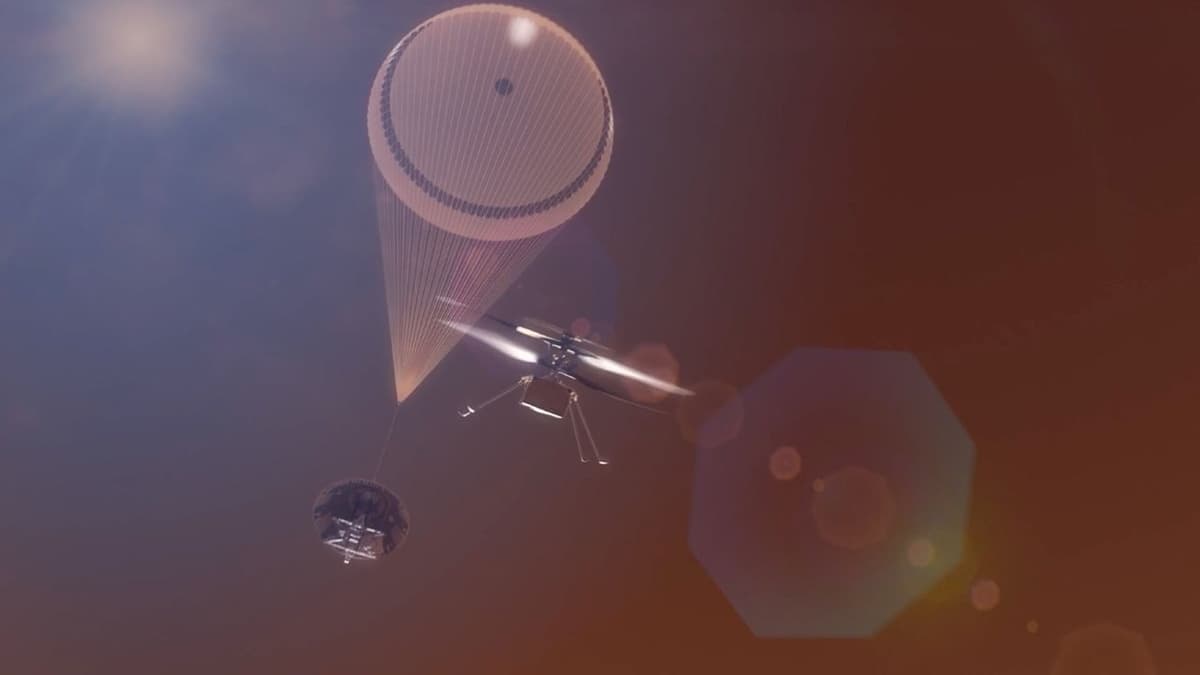
Watch NASA's New Mars Helicopter Rotor Break the Speed of Sound (Video)
Companies Mentioned

NASA
Why It Matters
Increasing lift capacity transforms Mars helicopters from proof‑of‑concept demos into viable science platforms, expanding the scope of planetary exploration beyond rover capabilities.
Key Takeaways
- •Rotor tips reached Mach 1.08 in Mars‑simulated chamber
- •Tests suggest 30% lift increase for future Mars helicopters
- •SkyFall concept will launch three helicopters by Dec 2028
- •Supersonic rotor data integrated into next‑gen design specifications
- •Higher payloads enable science instruments beyond rover reach
Pulse Analysis
The success of Ingenuity demonstrated that powered flight is possible in Mars’ thin, carbon‑dioxide atmosphere, but its limited payload left many scientific opportunities untapped. To move beyond reconnaissance, NASA engineers are engineering rotors that spin fast enough for their tips to break the sound barrier, a feat that dramatically improves lift in low‑density air. By recreating Martian conditions in a high‑tech vacuum chamber, the team could isolate aerodynamic variables and validate designs that were previously only theoretical.
During the recent campaign, 137 tests were run on a three‑blade rotor, gradually increasing RPM until the blade tips surpassed Mach 1.08 without structural damage. A parallel series examined a longer, two‑blade configuration intended for the upcoming SkyFall mission, which plans to deliver three next‑generation helicopters to Mars by December 2028. The longer blades achieved comparable tip speeds at lower RPM, offering a more efficient solution for power‑constrained spacecraft. Data from these experiments are now feeding directly into aerodynamic models and flight‑control algorithms, sharpening performance predictions for future missions.
The implications extend far beyond engineering milestones. A 30% lift improvement means helicopters could transport heavier spectrometers, subsurface drills, or even compact sample‑return modules, reaching terrain that rovers cannot navigate and providing rapid, high‑resolution mapping between orbital passes. This aerial capability could accelerate site selection for future human habitats and commercial ventures, making Mars exploration more flexible and cost‑effective. As NASA prepares for the SkyFall launch, the supersonic rotor breakthrough positions aerial robotics as a cornerstone of next‑decade planetary science.
Watch NASA's new Mars helicopter rotor break the speed of sound (video)
Comments
Want to join the conversation?
Loading comments...