Spacetech News and Headlines
  • All Technology
  • AI
  • Autonomy
  • B2B Growth
  • Big Data
  • BioTech
  • ClimateTech
  • Consumer Tech
  • Crypto
  • Cybersecurity
  • DevOps
  • Digital Marketing
  • Ecommerce
  • EdTech
  • Enterprise
  • FinTech
  • GovTech
  • Hardware
  • HealthTech
  • HRTech
  • LegalTech
  • Nanotech
  • PropTech
  • Quantum
  • Robotics
  • SaaS
  • SpaceTech
AllNewsDealsSocialBlogsVideosPodcastsDigests
NewsDealsSocialBlogsVideosPodcasts
SpacetechNewsWhat Are the Dangers of Moon Dust?
What Are the Dangers of Moon Dust?
SpaceTechAerospace

What Are the Dangers of Moon Dust?

•February 15, 2026
0
New Space Economy
New Space Economy•Feb 15, 2026

Why It Matters

Effective dust mitigation is essential to protect crew health, ensure equipment reliability, and enable long‑duration lunar operations, directly influencing mission success and cost.

Key Takeaways

  • •Moon dust is sharp, abrasive, and electrostatically sticky
  • •Inhalation causes lung irritation and oxidative stress
  • •Dust degrades suits, seals, joints, and filters
  • •Solar panels lose efficiency from dust accumulation
  • •Mitigation needs architecture, suitports, and active cleaning

Pulse Analysis

Lunar regolith forms in a vacuum through relentless micrometeoroid impacts, leaving particles with jagged edges and freshly broken surfaces. Without atmospheric weathering, these grains retain high surface energy, become electrically charged under solar UV, and readily adhere to any material. When inhaled, the angular particles can penetrate deep lung tissue, provoking inflammation and oxidative stress that is especially dangerous in an environment where medical intervention is limited. This combination of physical abrasiveness and chemical reactivity distinguishes moon dust from terrestrial dust and elevates it from a nuisance to a genuine occupational hazard for future explorers.

The engineering ramifications extend across every subsystem of a lunar outpost. EVA suits suffer fabric abrasion, joint torque increase, and seal leakage as dust infiltrates moving parts. Inside habitats, dust loads filters, reduces airflow, and contaminates air‑handling ducts, forcing higher power consumption and more frequent maintenance. Surface assets such as rovers and solar arrays experience traction loss, bearing wear, and significant power degradation due to panel soiling—issues amplified by the lack of wind or rain to naturally clean surfaces. For Artemis missions, which aim for repeated landings and multi‑month stays, these risks compound, threatening both crew safety and mission economics.

Mitigation therefore adopts a layered strategy: architectural zoning separates dirty and clean zones, while suitports keep contaminated garments external to habitats. Advanced coatings—both low‑adhesion and electrostatic‑dissipative—reduce particle attachment on optics, radiators, and solar cells. Active removal technologies, from ultrasonic vibrators to robotic brush‑vacuum hybrids, are being tested to dislodge and capture dust without scratching delicate surfaces. Operational protocols, including controlled airlock cycles and regular filter monitoring, round out the approach. As commercial partners and international agencies converge on a sustained lunar presence, robust dust‑management solutions will be a cornerstone of mission resilience and cost‑effectiveness.

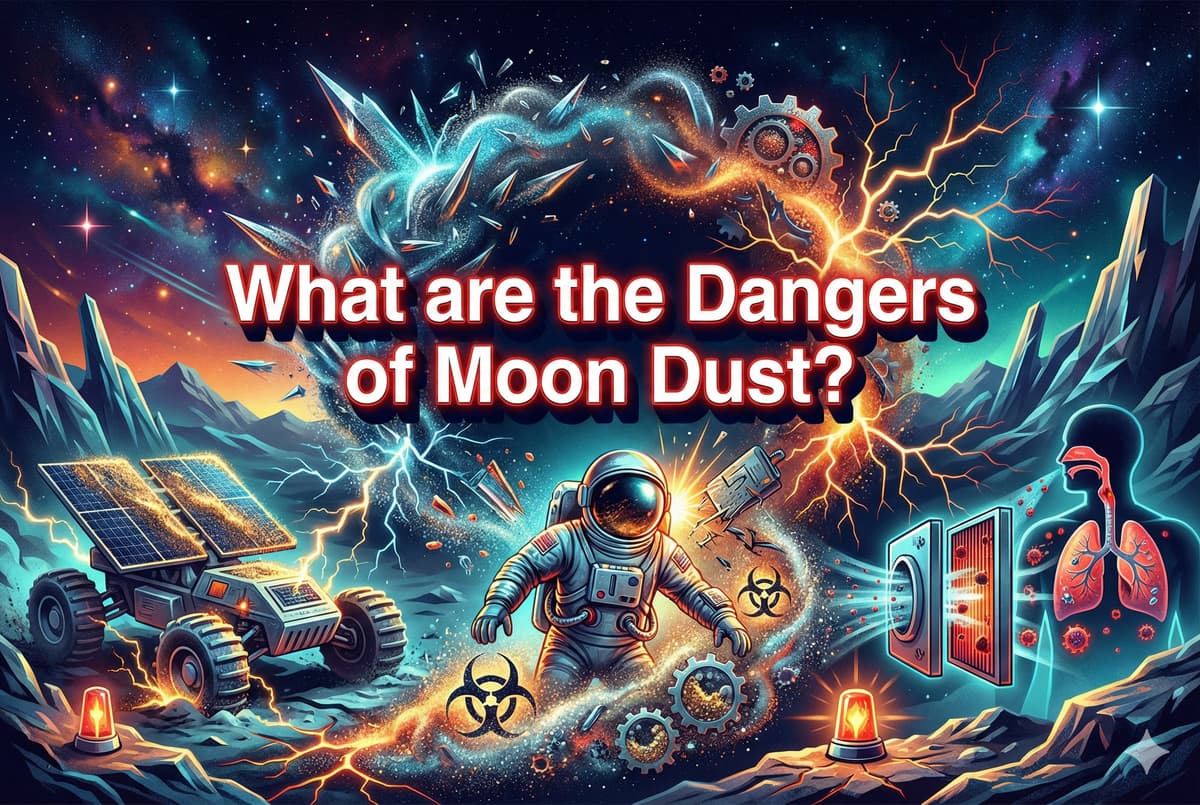
What are the Dangers of Moon Dust?

Key Takeaways

  • Moon dust sticks to almost everything, raising health, equipment, and habitat contamination risks.

  • Sharp, reactive grains can irritate lungs, eyes, and skin and degrade seals, joints, and filters.

  • Managing dust drives design choices for suits, airlocks, landers, power systems, and operations.


What “Moon Dust” Really Is

Moon dust is not like household dust, beach sand, or desert grit. It is a component of the lunar regolith, the loose surface layer created by billions of years of micrometeoroid impacts, larger collisions, and continuous surface gardening. In everyday conversation, “dust” usually refers to the finest portion of regolith, but lunar‑exploration discussions often use the term broadly to include fine powders and small grains that behave like dust once disturbed.

Unlike Earth soils, lunar regolith forms without liquid water, organic matter, or weather‑driven rounding. That absence matters because water and wind tend to smooth particles and coat them with chemically stable films. On the Moon, grains can remain sharp‑edged, angular, and prone to sticking. The dust fraction is also persistent. Once it is kicked up by boots, wheels, tools, or rocket plumes, it can travel, settle into crevices, and be re‑suspended repeatedly.

From a hazard perspective, moon dust becomes dangerous because it combines multiple problem traits in one material: abrasive particle shapes, fine sizes that can be inhaled, surface chemistry that can be reactive, and electrostatic behavior that promotes adhesion and migration. Any one of those traits would be inconvenient; together they drive a multi‑domain risk that spans human health, mechanical reliability, electrical stability, optical performance, thermal control, and long‑duration habitat cleanliness.


Why Lunar Dust Is So Different From Earth Dust

Earth dust is shaped by wind, water, and biology. Moon dust is shaped by impacts, radiation, and vacuum. That difference changes its physical form and its behavior once it contacts human systems.

Angular Grains and Abrasive Surfaces

Impact processes fracture minerals and glasses into jagged pieces. The resulting grains can have sharp edges and points, acting like tiny cutting tools. Abrasion becomes a serious hazard when dust is trapped between moving surfaces such as bearings, zipper tracks, seals, joints, and sliding interfaces. Even where parts are designed for vacuum, abrasive contaminants can accelerate wear, raise friction, and shorten service life.

Fine Particle Sizes and Deep Penetration

The finest fraction of dust can remain suspended longer in enclosed spaces and can enter the respiratory system if controls fail. Particle size also influences how dust behaves in filters, how easily it migrates through fabrics, and how strongly it adheres electrostatically. The smallest particles can deposit deep in the lungs, while somewhat larger particles can irritate the upper airway and eyes.

Reactive Surfaces and “Freshly Broken” Chemistry

On Earth, many mineral surfaces are passivated by oxidation, moisture, and organic films. On the Moon, grain surfaces can be “fresh,” meaning newly fractured and not coated by stable layers. Space weathering adds another twist: micrometeoroid impacts and solar wind can change regolith surfaces, generating glassy agglutinates and nanophase metallic iron that may influence chemical reactivity. The practical hazard is that dust may produce oxidative stress in biological tissues, and it may also interact with oxygen and moisture once brought into a habitat.

Electrostatic Charging and Persistent Adhesion

The lunar surface is exposed to ultraviolet radiation and plasma from the solar wind. Those inputs can charge dust grains and nearby surfaces. Charged dust tends to cling to suits, visors, tools, radiator panels, and optical surfaces. It can also migrate in surprising ways, including lofting and transport near the day‑night boundary, often discussed in relation to horizon‑glow observations reported during Apollo 17.

Electrostatic adhesion is not a minor nuisance. It drives contamination pathways that are hard to eliminate because dust does not simply fall off. Brushing can embed grains deeper into fabric, and wiping can scratch sensitive surfaces.


How Moon Dust Was Experienced During Apollo

Modern risk discussions remain grounded in the most direct evidence available: the Apollo surface missions. The Apollo era provided real operational exposure, real hardware wear, and real habitat contamination. Even though those missions were short compared with planned long‑duration stays, they still revealed that dust management can dominate daily routines and crew comfort.

Habitat Intrusion and Persistent Contamination

Dust followed astronauts back into the lunar module on suits, boots, gloves, and tools. Once inside, it spread to surfaces, floated, and became difficult to remove. In a small cabin, even a small mass of dust can create widespread contamination. The dust odor reported by crews is often described as sharp and unusual, and it became part of the lived experience of returning from extravehicular activity.

Irritation and Performance Effects

Apollo reports described short‑lived irritation consistent with dust exposure, including eye, nose, and throat discomfort. Even mild symptoms matter because surface work demands attention, precision, and stamina. Irritation can reduce comfort and can distract from tasks, especially if repeated day after day in a long campaign.

Hardware Wear and Operational Consequences

Apollo hardware encountered dust‑related wear on suit fabrics, joints, and mechanical interfaces. Dust also reduced traction and impaired visibility on some surfaces. The key lesson was not that missions became impossible, but that dust became a constant adversary. Longer missions, more frequent EVAs, larger vehicles, and permanent habitats would multiply those challenges.


Health Dangers of Moon Dust

Moon dust presents health hazards through inhalation, eye contact, skin exposure, and secondary pathways such as contamination of food, water, and air‑handling equipment. The most important point is that lunar dust is not only a cleanliness problem; it is a potential occupational hazard in an extreme environment where medical support is limited and prevention is more feasible than treatment.

Respiratory Risks

Inhalation is the most discussed health pathway because fine particles can reach sensitive lung regions. In a lunar habitat, inhalation risk depends on how much dust gets inside, how effectively it is captured by filtration, and how often it is re‑suspended by movement, airflow, and cleaning.

Two mechanisms drive respiratory risk:

  1. Physical irritation – Sharp, angular grains can inflame tissue and trigger coughing and discomfort.

  2. Chemical or surface‑driven biological response – Reactive surfaces can cause oxidative stress or inflammation.

Research on lunar samples is limited, so simulants and modified materials are widely used to explore toxicity pathways. Even if toxicity is moderate compared with some Earth industrial dusts, the lunar context amplifies the concern: exposure could be repeated, healthcare is constrained, and a compromised respiratory system can reduce EVA tolerance and overall mission performance.

Eye Hazards

Dust entering helmet visors or becoming airborne in the habitat can scratch the eye, cause redness, tearing, and blurred vision. Optically, dust on visors scatters light, reduces contrast, and creates glare, complicating navigation and tool use.

Skin Hazards

Dust contacting skin at suit interfaces, during suit maintenance, or inside the habitat can cause irritation and abrasion. Fine particles can embed in fabrics and rub against skin, especially where movement is repetitive. Persistent abrasion is an important concern for infection control and comfort.

Secondary Ingestion and Cross‑Contamination

Dust that settles on food packaging, water systems, or preparation surfaces can become an ingestion pathway. While ingestion may be less biologically sensitive than inhalation for some particles, it signals a broader failure of contamination control, which can lead to microbial management issues and equipment reliability problems.

Allergic‑Type Responses and Sensitization Concerns

Apollo‑era accounts include mention of symptoms that resemble allergic irritation. Whether lunar dust can drive classic allergy sensitization is not the main operational question; the operational question is whether repeated exposure could increase symptom severity or persistence, reducing performance over time. With long‑duration exploration, even mild chronic irritation becomes a mission‑design factor.

Why “Dose” and “Duration” Change Everything

A short Apollo stay and a multi‑month Artemis campaign are not comparable. Dose can accumulate, and chronic low‑dose exposure can produce different outcomes than a single high‑dose exposure. Habitats designed for repeated EVAs can gradually accumulate dust in corners, filters, textiles, and ducts. Each EVA cycle becomes an opportunity to import dust and an opportunity to re‑aerosolize it during cleaning or airflow events.

Longer duration also raises the importance of individual variability. Some crew members might experience stronger irritation, and repeated EVA cycles can compound effects. That uncertainty is one reason dust standards, exposure limits, and monitoring approaches are treated as mission‑enabling, not optional.


Engineering Dangers to Spacesuits

Spacesuits are the front line where dust meets exploration. Dust hazards here matter because suit failures threaten EVA capability, and EVA capability is central to surface exploration value.

Abrasion of Fabrics and Outer Layers

Suit outer layers face repeated contact with dust during kneeling, walking, climbing, tool handling, and vehicle operations. Abrasion can thin fabrics, wear seams, and degrade protective layers. Dust can also become embedded, worsening wear patterns over time.

Joint Wear, Torque Increase, and Mobility Loss

Dust infiltration can raise friction in suit joints, increasing the effort needed to bend or rotate them. Higher torque can fatigue astronauts and reduce task endurance. Over long campaigns, increased friction can also accelerate mechanical wear.

Seal Integrity and Leakage Risk

Dust can compromise seals by creating leak paths or preventing proper closure. Even small leakage is dangerous in a pressurized suit. Seal design can mitigate this, but dust makes the problem harder because it is persistent and tends to migrate.

Zippers, Bearings, and Mechanical Fasteners

Fine grains can lodge in zipper tracks and bearing elements. A zipper failure in a dust‑laden environment can prevent suit closure or safe donning/doffing, turning a convenience issue into a safety issue.

Visor and Helmet Contamination

Dust on visors reduces visibility and creates glare. Scratching is an additional hazard because wiping dust can act like sandpaper. Visor coatings and cleaning procedures must account for the abrasive nature of dust and the limited water availability for rinsing.

Thermal Control Degradation

Dust on external surfaces can change absorptivity and emissivity, altering thermal balance. Dust can also interfere with radiators or heat‑exchange components if it accumulates in vents or on panels.


Engineering Dangers to Habitats and Airlocks

Habitats must remain livable, which depends on clean air, reliable seals, stable thermal control, and maintainable interiors. Dust threatens each of those.

Air Quality and Filtration Load

Dust raises filter loading, shortens filter life, and can increase pressure drop across filtration systems, raising power demands for fans and reducing airflow where it is needed. Multi‑stage filtration and careful airflow management become important, and filter replacement can release trapped dust if procedures are not robust.

Ducts, Fans, and Heat Exchangers

Fine particles can accumulate in ducts and on fan blades, altering performance. Heat exchangers can foul, reducing efficiency. In a long‑duration habitat, fouling is a continuous trend that requires routine maintenance, spare parts, and careful monitoring.

Seal Degradation and Leak Paths

Dust can compromise hatches, airlocks, docking interfaces, and pressure seals, especially if seals are repeatedly cycled with contaminated surfaces. Maintaining clean sealing surfaces becomes a daily operational task.

Interior Surface Contamination and Cleaning Burden

Dust that enters a habitat settles into textiles, corners, and equipment crevices. Routine cleaning must remove dust without re‑aerosolizing it. Vacuuming, wiping, and adhesive collection can work, but they consume time, supplies, and filter capacity. The cleaning burden matters because time is a limited resource; increased cleaning competes with scientific work, maintenance, rest, and planning.

Human Factors and Long‑Term Living Conditions

A dusty habitat is not only a health hazard; it is also a morale and performance issue. Persistent irritation, unpleasant odors, and visible grime can degrade comfort. In isolated environments, small irritants can carry outsized psychological weight. Dust management, even when it looks like housekeeping, becomes part of mission resilience.


Dangers to Rovers, Landers, and Surface Mobility

Surface vehicles expand exploration reach, but dust can degrade their reliability and performance.

  • Wheel Wear, Traction Changes, and Mobility Limits – Dust can reduce traction, clog wheel treads, and create a fine layer that behaves differently than compacted regolith.

  • Bearings, Hinges, and Suspension Interfaces – Dust‑driven wear can reduce efficiency, increase power use, and raise failure risk.

  • Sensor and Camera Degradation – Optics and navigation sensors can be blinded or degraded by dust, affecting both crewed and robotic operations.

  • Radiators and Thermal Control Surfaces – Dust accumulation changes thermal properties and reduces heat rejection, limiting operating time.

  • Charging Effects and Electrical Reliability – Charged dust can create unexpected conduction pathways or static discharge events, leading to intermittent faults.


Dangers to Power Systems and Energy Production

Power is the backbone of surface operations; dust hazards here are important because power loss can cascade into life‑support risk and mission interruption.

  • Solar Panel Soiling and Output Loss – Dust reduces light transmission; without wind or rain to clean panels, soiling must be prevented, removed, or accepted as a performance loss.

  • Radiator Soiling and Thermal Constraints – Dust reduces emissivity, limiting heat rejection and potentially forcing derating of electronics and batteries.

  • Battery and Electronics Bay Contamination – Dust that penetrates electronics bays can cause abrasion, thermal insulation in the wrong places, and potential electrical faults. Sealing helps, but seals themselves are challenged by dust.


Dangers to Scientific Instruments and Planetary‑Science Goals

Dust threatens scientific integrity in two ways: it can impair instruments, and it can contaminate samples and sensitive environments.

  • Optical and Spectral Instrument Contamination – Dust on optics scatters light, adds noise, and creates false readings. Cleaning optics on the Moon is difficult because wiping can scratch and rinsing is limited.

  • Sample Contamination and Misleading Measurements – Dust inside a habitat can contaminate samples, tools, and containers, blurring site distinctions and complicating scientific conclusions.

  • Polar Volatiles and Contamination Sensitivity – Dust transport from landings and surface operations could contaminate permanently shadowed regions that may contain water ice and other volatiles, directly affecting measurements.


Dangers From Rocket Plumes and Dust Ejecta

Landings and takeoffs accelerate dust and small particles to high speeds. Those particles can travel far because the Moon lacks a thick atmosphere to slow them.

  • High‑Velocity Particle Impacts – Dust and grit accelerated by plumes can strike nearby hardware, habitats, vehicles, and instruments, causing surface damage.

  • Surface Erosion and Cratering – Plumes erode regolith, excavate material, and create uneven surfaces that complicate navigation and landing safety. Fresh dust exposed by erosion is more reactive and more likely to become airborne later.

  • Contamination Over Large Areas – Ballistic trajectories allow ejecta to spread across wide areas, affecting multi‑asset surface architectures. Prepared landing pads and designated zones are essential mitigation steps.


Electrostatic Dust Transport and the “Sticking Problem”

Electrostatic charging can produce levitation and migration, especially near the terminator where surface potentials change rapidly. Dust sticks, migrates, and can reach surfaces that were expected to stay clean. Adhesion means a dust‑management plan cannot rely on gravity alone or on gentle brushing; it requires a layered approach: prevent dust contact, reduce adhesion with materials and coatings, remove dust without grinding it into surfaces, and limit pathways that bring dust into habitats.


Why Lunar Dust Is a “System of Systems” Risk

Moon‑dust hazards span environmental physics, toxicology, mechanical engineering, electrical engineering, thermal design, operations, and human factors. Small failures can compound:

  • A modest increase in suit dust retention → higher habitat dust loading → shortened filter life → more maintenance → re‑suspension of dust → increased respiratory exposure and seal contamination → more equipment failures → further maintenance, and so on.

Because of these feedback loops, dust mitigation is not just a technology topic; it is a planning and logistics topic that shapes spares, consumables, cleaning schedules, EVA cadence, and surface‑architecture choices.


Current Exploration Context and Why Dust Matters More for Artemis‑Style Campaigns

The near‑term exploration context is shaped by the Artemis program led by NASA with international partners and commercial participants. Compared with Apollo, Artemis points toward repeated missions, longer surface time, more equipment, and a pathway toward sustained presence. That shift increases dust relevance:

  • Repeated EVAs import dust continuously.

  • Robust suits face cumulative wear.

  • Solar arrays lose performance without effective dust removal.

Sustained presence also raises the importance of standard operating procedures, training, and monitoring. Dust becomes an everyday operational reality, not an occasional inconvenience.


Dust Mitigation Strategies and Their Limitations

Mitigation approaches fall into four categories: prevention, containment, removal, and tolerance. No single method solves the problem; each reduces risk in one pathway while leaving others.

Prevention Through Architecture and Zoning

Designating “dirty zones” for suit maintenance, “clean zones” for living, and intermediate transition spaces that trap dust can keep dust out of habitats. Airlocks designed for dust control limit intrusion but require procedures that work under time pressure. Locating landing zones away from habitats and power systems reduces plume‑driven dust, though it adds logistics challenges.

Suitport and External‑Suit Concepts

Suitports keep suits outside the habitat and allow astronauts to enter through a rear hatch, reducing habitat contamination. They add mechanical complexity and new sealing challenges; dust moves to the suit‑habitat interface, where reliable seals are essential.

Materials, Coatings, and Dust‑Resistant Textiles

Dust‑resistant textiles and coatings can reduce adhesion and make cleaning easier. Electrostatic or electric‑field approaches may repel dust, but they must handle power demands, durability, and safety. Coatings can degrade over time and may not survive hundreds of dust‑laden cycles.

Mechanical Removal: Brushes, Wipes, and Vacuuming

Brushing can embed grains into fabrics; wiping can scratch optics; vacuuming can work in habitats but loads filters and can re‑aerosolize fine particles if not well designed. Adhesive collection captures dust without grinding, but adhesives lose tack and create disposal challenges.

Thermal and Vibrational Methods

Heating can reduce adhesion; vibration can shake dust loose. These methods are surface‑specific, may not work on deeply embedded dust, and can introduce fatigue and wear.

Operational Controls and Behavioral Mitigation

Procedures—slow suit doffing, controlled airflow, careful tool handling, dedicated cleaning routines—can reduce dust spread. They are effective but vulnerable to fatigue, schedule pressure, and human error. Designs that reduce procedural dependence are therefore valuable.

Design for Dust Tolerance

Dust‑tolerant bearings, connectors, and sealed mechanisms reduce sensitivity, but tolerance is never unlimited. Wear still accumulates, and maintenance remains necessary.


Health Monitoring and Exposure Management

Dust hazards are managed most effectively when they are measured. Monitoring can include particle counters, filter‑loading metrics, surface‑contamination checks, and medical monitoring for respiratory and ocular symptoms.

Exposure standards for lunar dust are complicated by uncertainty about toxicity, variability among regolith types, and differences between pristine lunar dust and Earth‑contaminated samples. That uncertainty encourages conservative designs, robust filtration, and strong prevention measures that keep exposure as low as practical.

Medical monitoring matters because early symptom detection can guide operational changes. If irritation rises with EVA cadence, schedules and cleaning procedures can be adjusted, preventing larger problems on long missions.


Regional Differences and Why “Dust” Is Not One Uniform Hazard

The Moon is not uniform. Mare regions and highlands differ in composition; polar regolith can be mixed with volatile‑related materials and may behave differently. Grain shape, glass content, and nanophase‑iron fraction vary by location and maturity, affecting toxicity and adhesion.

For mission planners, the practical takeaway is that dust hazards should be evaluated by site, not assumed to be identical everywhere. Sampling, in‑situ measurement, and operational experience will refine risk estimates. Until then, designs must handle a wide range of plausible dust behaviors.


Commercial Activity, Traffic Growth, and the Risk of “Dusty Neighborhoods”

As lunar activity increases, the number of landings and surface operations could rise. More traffic means more plume‑driven dust events and a higher background level of disturbed regolith around shared infrastructure. Coordination among actors becomes important to prevent one activity from degrading another’s systems.

Agreed landing distances, shared mitigation infrastructure (e.g., prepared landing pads), and common contamination‑control practices can reduce mutual interference.


Why Dust Remains a Central Hazard Even With Better Technology

Modern materials, robotics, and filtration reduce risk but do not remove the underlying physics. Dust is produced by the environment and by human activity. It adheres due to charging and texture, migrates into small spaces, abrades, and irritates. A sustained lunar presence increases the number of cycles in which these processes can cause cumulative effects.

The long‑term hazard is not a single dramatic failure event; it is steady degradation: a little more friction, a little more irritation, a little more filter loading, a little more reduced power output. Over time, that steady degradation can become mission‑limiting unless designs and operations are built around dust reality.


Summary

Moon dust is dangerous because it combines fine‑particle behavior, abrasive texture, reactive surface chemistry, and electrostatic adhesion in a vacuum environment that does not naturally clean itself. The most important risks span human health, suit reliability, habitat air quality, power generation, thermal control, optics performance, and mechanical wear. Long‑duration lunar exploration increases exposure duration and the number of dust‑import cycles, making prevention and containment more effective than reliance on cleaning alone.

Effective dust management depends on a layered approach that includes:

  • Surface‑architecture choices and robust airlock or suitport strategies

  • Dust‑resistant materials and coatings

  • Cleaning methods that avoid grinding dust into surfaces

  • High‑quality filtration and operational discipline

Dust hazards also vary by location and activity level, meaning future measurements and experience will refine standards and designs. Even as technology improves, dust remains a defining constraint on sustainable lunar operations.


Appendix: Top 10 Questions Answered in This Article

  1. What makes moon dust hazardous compared with Earth dust?

    Angular, abrasive grains, very fine particles, and strong electrostatic adhesion combine to increase irritation risk and accelerate mechanical wear.

  2. How can moon dust affect astronaut lungs and breathing?

    Fine particles can be inhaled, causing physical irritation and potentially triggering inflammatory responses from reactive surfaces. Repeated exposure on long missions raises concern even if single exposures are brief.

  3. Why does moon dust stick so strongly to spacesuits and equipment?

    UV light and plasma charge the grains; charged grains adhere to charged or insulating surfaces. Mechanical interlocking from grain texture also contributes.

  4. What are the main risks of moon dust to spacesuit performance?

    Abrasion of outer layers, increased joint friction, seal contamination, visor scratching, and degradation of thermal‑control surfaces.

  5. How does moon dust threaten habitat life‑support systems?

    Dust loads filters, fouls fans, ducts, and heat exchangers, and can be re‑aerosolized during cleaning, degrading air quality and increasing consumable use.

  6. Why are solar panels and radiators especially vulnerable to moon dust?

    Dust blocks light on panels and changes emissivity on radiators; there is no wind or rain to clean them, so performance loss accumulates.

  7. What dangers come from rocket plumes interacting with lunar soil?

    Plumes accelerate dust to high speeds, causing high‑velocity impacts on nearby hardware and spreading ejecta over large areas.

  8. Can moon dust interfere with scientific instruments and measurements?

    Yes—dust contaminates optics, scatters light, adds noise, and can contaminate samples, compromising data quality.

  9. What mitigation approaches reduce moon dust risks most effectively?

    Strategies that prevent dust intrusion—robust airlocks, suitports, zoning, dust‑resistant materials, and disciplined procedures—are most effective, complemented by dust‑tolerant hardware design.

  10. Why is moon dust still a major issue for sustained lunar missions?

    Repeated EVAs, vehicle operations, and landings multiply dust disturbance. Cumulative effects—wear, contamination, filter loading—can become mission‑limiting without strong prevention and containment.

Read Original Article
0

Comments

Want to join the conversation?

Loading comments...