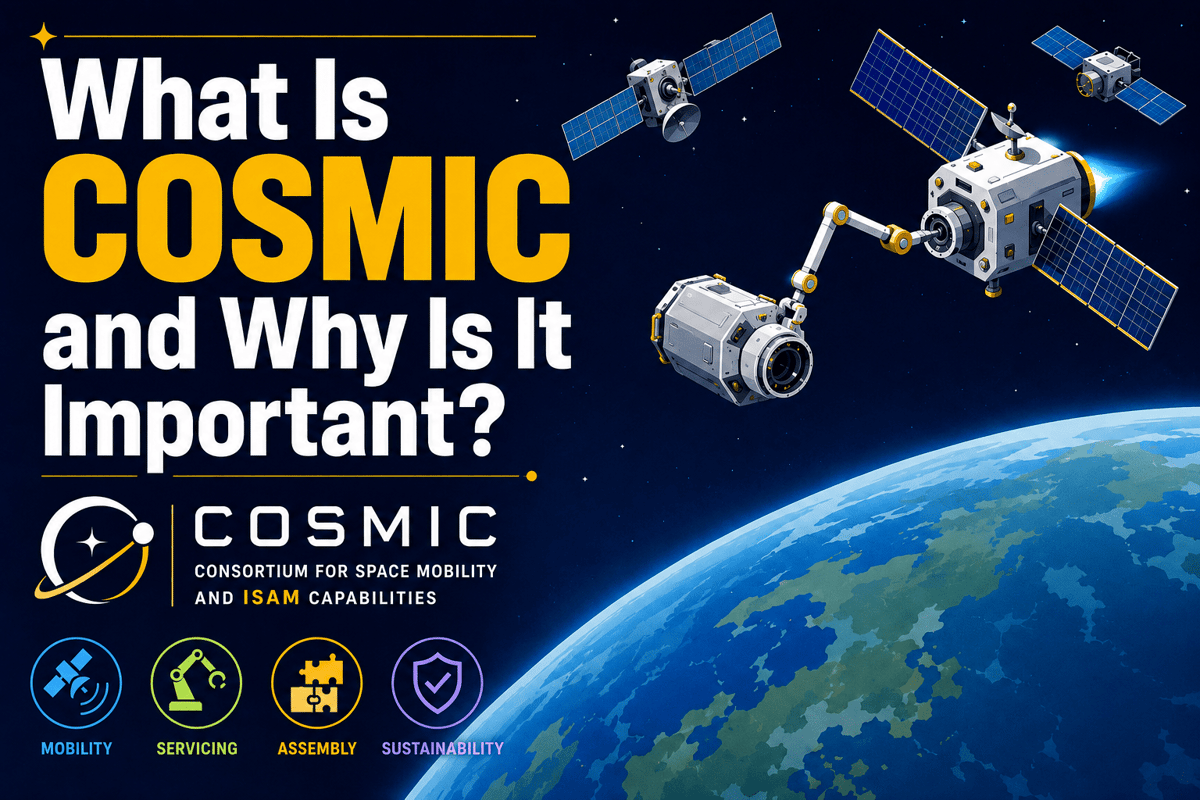
What Is COSMIC and Why Is It Important?
Companies Mentioned
Why It Matters
By enabling refueling, repair and on‑orbit construction, COSMIC can extend satellite lifespans, reduce debris and unlock new mission architectures, creating a multi‑billion‑dollar market for services and hardware.
Key Takeaways
- •COSMIC unites 300+ U.S. organizations around ISAM coordination.
- •ISAM can cut satellite replacement costs and lower orbital debris.
- •Standards, demos, and workforce training are core COSMIC functions.
- •Commercial life‑extension services already proven by Northrop Grumman’s MEV.
- •Market growth hinges on demand, regulation and serviceable spacecraft design.
Pulse Analysis
The emergence of in‑space servicing, assembly and manufacturing marks a fundamental change in how spacecraft are conceived, built and operated. Rather than treating a satellite as a disposable, self‑contained unit, ISAM envisions a modular, serviceable asset that can be refueled, repaired or expanded after launch. COSMIC acts as the connective tissue for this ecosystem, bringing together engineers, policy makers, standards bodies and investors to translate high‑level national strategies into concrete use‑cases, test‑bed requirements and training programs. By fostering shared technical language and non‑binding recommendations, the consortium reduces duplication and accelerates the maturation of critical technologies such as autonomous rendezvous, fluid transfer interfaces and on‑orbit robotics.
Commercial interest in ISAM is already materializing. Northrop Grumman’s Mission Extension Vehicle has demonstrated that life‑extension services can preserve revenue streams for GEO communications operators, while Astroscale’s ADRAS‑J mission proved the feasibility of close‑range inspection of debris. These pilots create data that insurers and financiers can use to price risk, and they give regulators concrete scenarios to shape licensing frameworks. COSMIC’s work on standards—through collaborations with CONFERS and other bodies—helps codify docking ports, refueling couplings and safety protocols, which in turn lowers entry barriers for new service providers and encourages investment in a nascent market projected to reach several billions of dollars within the next decade.
Despite progress, the path to a fully operational ISAM economy remains fraught with challenges. Demand hinges on satellite owners adopting serviceable designs, a classic chicken‑and‑egg problem that requires coordinated incentives and clear cost‑benefit analyses. Regulatory gaps, especially around liability and debris mitigation for on‑orbit manipulation, can stall commercial launches. Moreover, a skilled workforce capable of designing, testing and operating complex robotic systems is still scarce. COSMIC’s workforce development initiatives, including the Capstone Challenge, aim to fill this talent pipeline while fostering cross‑sector collaboration. As international partners pursue similar capabilities, the consortium’s role in aligning U.S. standards with global norms will be pivotal for ensuring safe, interoperable operations in an increasingly crowded orbital environment.
What Is COSMIC and Why Is It Important?
Comments
Want to join the conversation?
Loading comments...