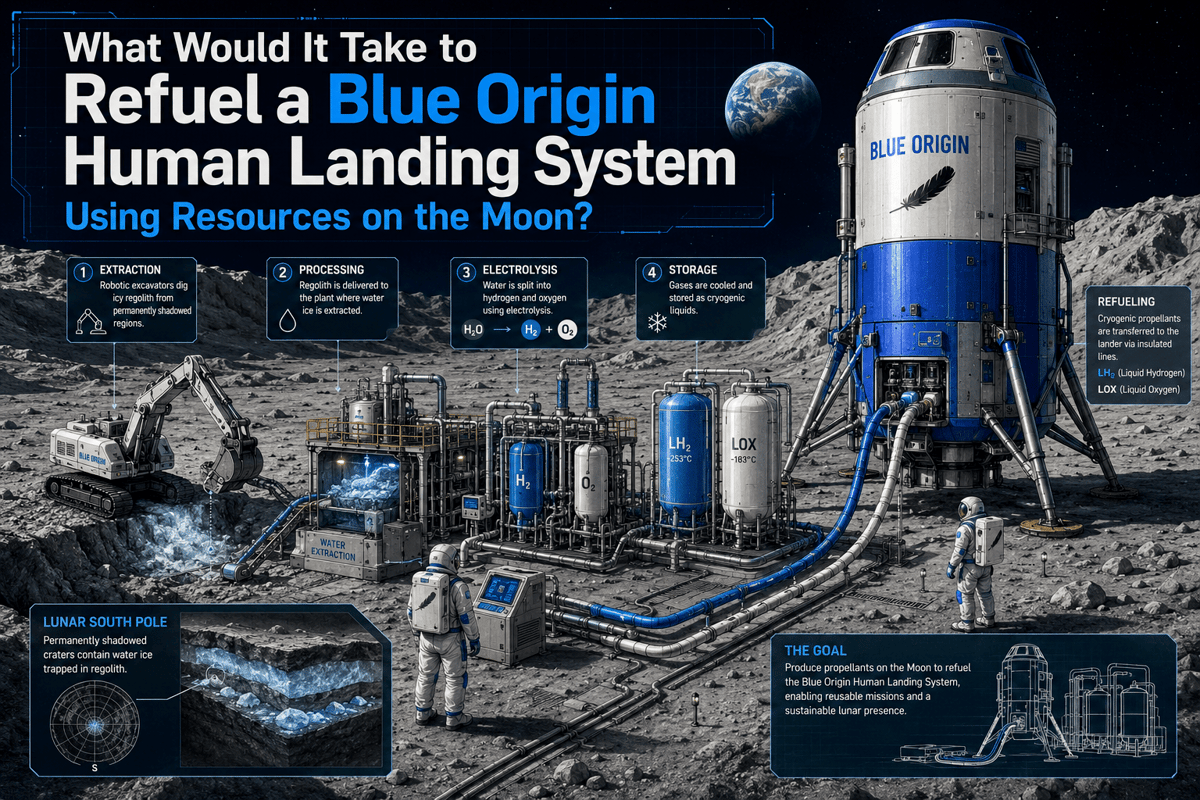
What Would It Take to Refuel a Blue Origin Human Landing System Using Resources on the Moon?
Why It Matters
On‑site refueling could dramatically lower launch costs and make Artemis a sustainable program, while spawning a new lunar‑resource market for mining, power and cryogenic services.
Key Takeaways
- •40‑ton Blue Moon refill needs ~51 t lunar water before losses
- •At 5.6 % ice grade, about 918 t regolith must be mined per refill
- •Energy demand ranges 0.8–2.5 GWh, dominated by ice extraction and electrolysis
- •Surplus oxygen (~11 t) can support life‑support, fuel cells, and surface rovers
Pulse Analysis
The Artemis program’s next milestone is a crewed landing using Blue Origin’s Blue Moon lander, a vehicle that burns liquid oxygen and liquid hydrogen. While early missions will rely on Earth‑launched propellant, long‑term sustainability hinges on in‑situ resource utilization (ISRU). Converting the required 40 metric‑ton propellant load into water reveals a demand of roughly 51 tonnes of lunar ice, a figure that swells to 57‑69 tonnes when realistic process losses are considered. This water‑to‑fuel conversion underscores why hydrogen, not oxygen, drives the mass budget, leaving a sizable surplus of oxygen that can be repurposed for life‑support, fuel‑cell power, or surface mobility.
Extracting that water is the primary technical hurdle. At the measured 5.6 % ice concentration in permanently shadowed regions, nearly a thousand tonnes of regolith must be excavated, filtered, and heated to release the ice. Energy consumption is dominated by ice extraction (up to 1.9 GWh) and electrolysis (≈0.3‑0.4 GWh), with additional loads for hydrogen and oxygen liquefaction. Power architectures therefore combine solar arrays on sun‑lit ridges, energy storage for eclipse periods, and possibly small nuclear generators to sustain a 250‑500 kW average load. Mining rates of 20‑50 t per day translate to campaign durations of three to nine months, compressible to weeks only with megawatt‑scale power and higher‑grade deposits.
From a business perspective, a functional lunar propellant depot would create a multi‑billion‑dollar ecosystem. Companies that master ice detection, robotic excavation, cryogenic processing, and storage could supply not only NASA but also commercial lunar landers, cislunar transport services, and even future Mars‑bound missions. The surplus oxygen by‑product adds revenue streams for life‑support consumables and surface rover fuel. However, uncertainties around ice grade, regolith mechanics, and long‑term cryogenic storage remain risk factors that will shape investment timelines and partnership models. Successful demonstration of a full‑scale ISRU chain could lower launch mass penalties, accelerate Artemis’s sustainable phase, and position early entrants as essential infrastructure providers for the emerging lunar economy.
What Would It Take to Refuel a Blue Origin Human Landing System Using Resources on the Moon?
Comments
Want to join the conversation?
Loading comments...