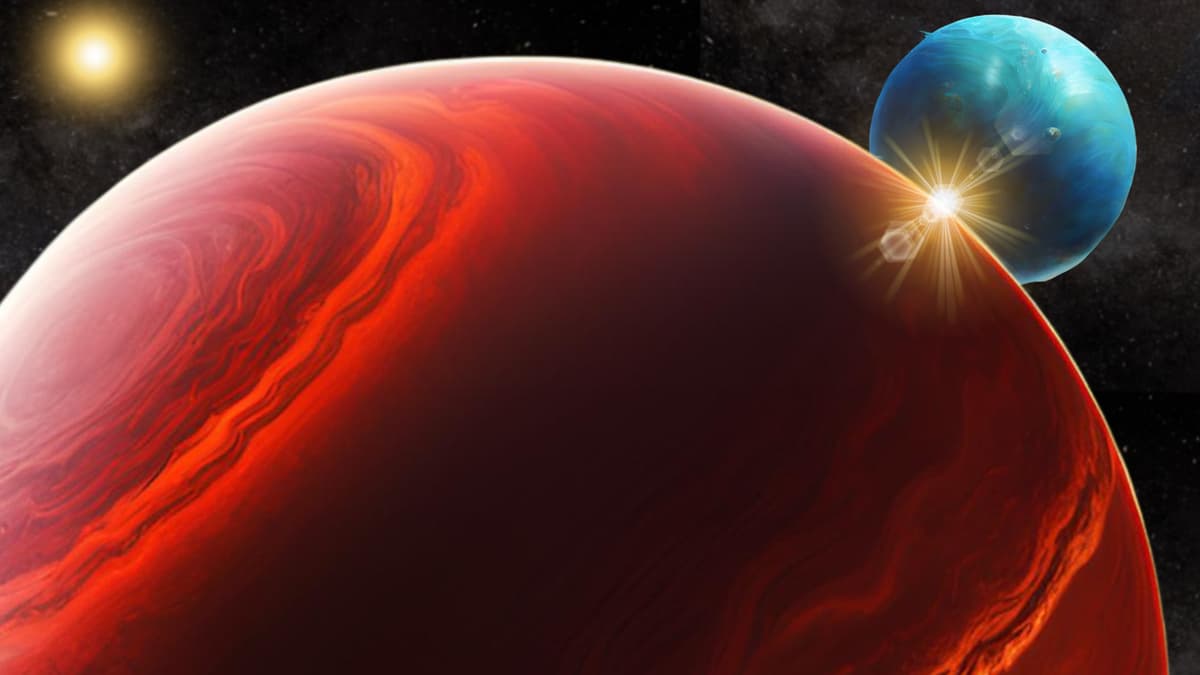
Wobbling Exoplanet Hints at a Hidden Exomoon so Massive It Could Redefine the Word 'Moon' Altogether
•January 22, 2026
0
Companies Mentioned

Canva

Elsevier
Why It Matters
A confirmed super‑massive exomoon would reshape moon classification and provide critical data on satellite formation around distant giants, advancing planetary science.
Key Takeaways
- •Astrometry reveals 9‑month wobble in HD 206893 B
- •Candidate exomoon mass ~0.4 Jupiter (≈9 Neptune masses)
- •Orbit tilted ~60° relative to planet’s orbital plane
- •Largest known moon would dwarf Solar System moons
- •Method opens path for future massive exomoon detections
Pulse Analysis
The hunt for moons beyond our Solar System has long lagged behind the exoplanet boom, largely because traditional techniques such as the transit method struggle to isolate the faint, short‑duration signals a satellite produces. The recent study of the gas‑giant HD 206893 B demonstrates how high‑precision astrometry can overcome those limits. By tracking the planet’s position with the GRAVITY interferometer on the VLT, researchers detected a nine‑month wobble consistent with a massive companion. This approach, which measures tiny shifts in a planet’s sky‑plane coordinates, opens a new observational window for bodies that orbit distant, long‑period planets.
If the inferred companion is confirmed, its estimated mass—about 40 % of Jupiter or nine times that of Neptune—would dwarf every moon known in the Solar System. Such a heavyweight satellite blurs the line between a moon and a low‑mass binary partner, prompting astronomers to revisit the taxonomy of sub‑planetary objects. From a formation standpoint, a moon of this scale suggests a history of capture or a circumplanetary disk massive enough to spawn giant satellites, challenging current models that predict only modest moons around gas giants at wide separations.
The success of astrometric monitoring in this case sets a template for future surveys. Upcoming facilities such as the Extremely Large Telescope and space‑based missions like the Nancy Grace Roman Telescope will deliver even finer positional accuracy, potentially turning the current “tip of the iceberg” into a statistically robust exomoon census. A growing catalog of massive moons would refine estimates of planetary system architectures, inform habitability assessments for moon‑hosted environments, and ultimately reshape how the scientific community defines a moon in the exoplanet era.
Wobbling exoplanet hints at a hidden exomoon so massive it could redefine the word 'moon' altogether
0
Comments
Want to join the conversation?
Loading comments...