Global CAPE Ratios
Key Takeaways
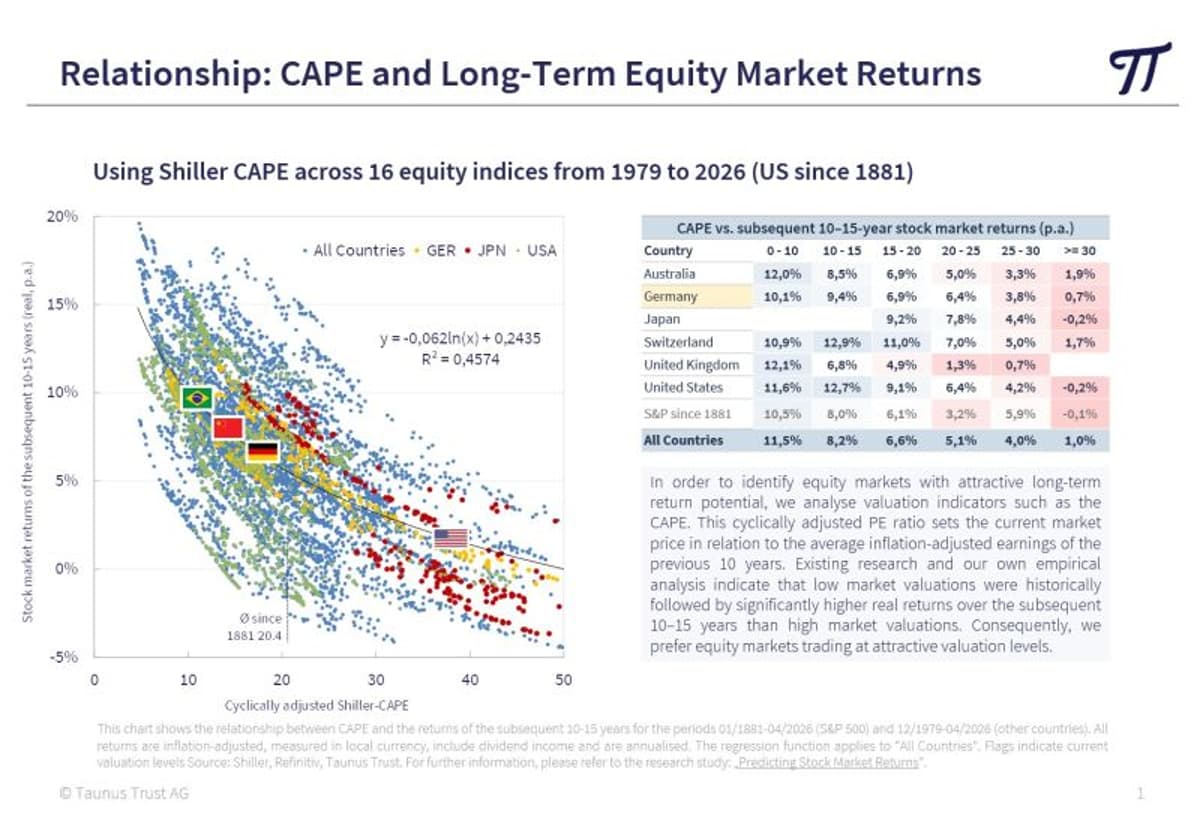
- •Higher CAPE values correlate with lower 10‑15‑year returns
- •US CAPE remains above historical average, implying modest upside
- •Emerging markets show steeper CAPE‑return slope than developed markets
- •Valuation gaps suggest potential rebalancing toward undervalued regions
- •Historical data supports CAPE as a long‑term return indicator
Pulse Analysis
The Cyclically Adjusted Price‑Earnings ratio, popularized by Robert Shiller, adjusts earnings for inflation and business cycles, offering a smoother valuation metric than the raw P/E. By extending the analysis to a global set of equities, the latest Idea Farm chart confirms that the inverse CAPE‑return relationship observed in the United States also applies to Europe, Japan, and a broad swath of emerging markets. This cross‑border consistency strengthens the case for CAPE as a universal barometer of long‑run market expectations, rather than a U.S.-centric quirk.
The scatter plot reveals notable regional nuances. While the United States and Western Europe sit at relatively high CAPE levels—suggesting muted future performance—several emerging economies, such as Brazil and Indonesia, display lower CAPE scores coupled with steeper regression slopes. In practice, this means that a modest dip in valuation could translate into disproportionately higher 10‑15‑year returns for those markets. Investors seeking alpha may therefore look beyond traditional safe‑haven assets and consider reallocating a portion of capital toward undervalued, high‑growth regions that the data flags as potential outperformers.
Despite its appeal, CAPE is not a crystal ball. The metric reflects long‑term averages and can be distorted by structural shifts, such as changes in corporate tax policy or the rise of technology‑driven profit models. Consequently, savvy portfolio managers combine CAPE insights with forward‑looking fundamentals, macroeconomic trends, and sector rotation strategies. By treating CAPE as one piece of a broader analytical framework, investors can better balance the lure of low‑valuation opportunities against the risk of prolonged market cycles, ultimately enhancing risk‑adjusted returns over the next decade.
Global CAPE Ratios
Comments
Want to join the conversation?