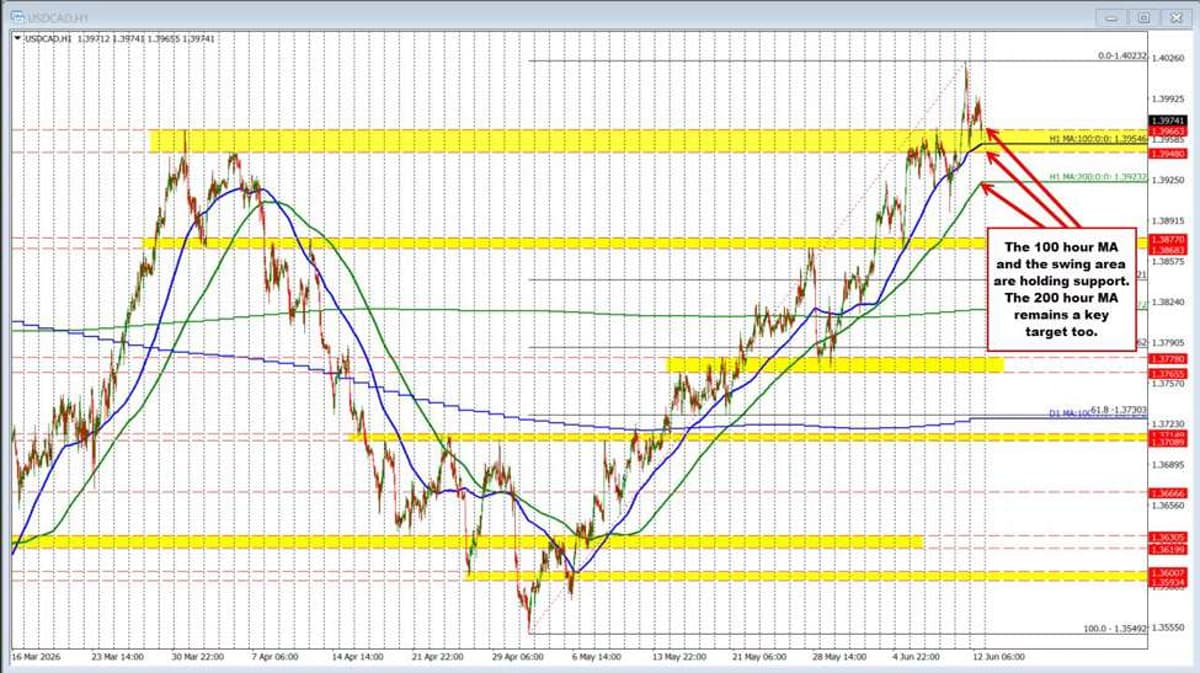
The USDCAD Comes Off the New Highs for the Year but Prior Highs Stall the Fall
Why It Matters
Holding above the identified support keeps the USDCAD’s bullish bias intact, influencing currency traders and hedgers who monitor CAD exposure. Persistent political friction over the USMCA could sustain upward pressure on the pair, affecting cross‑border trade and investment flows.
Key Takeaways
- •USDCAD surged to 1.4023, a 2026 high
- •Pair remains above 200‑hour moving average, indicating bullish trend
- •Support zone 1.3948‑1.3966 crucial for near‑term direction
- •Break below 1.3923 could trigger further downside
- •USMCA tensions may keep pressure on CAD, supporting USDCAD
Pulse Analysis
The Canadian dollar’s recent weakness against the U.S. dollar reflects a broader risk‑off environment and divergent monetary policies. While the Bank of Canada has kept rates steady, the Federal Reserve’s tighter stance continues to attract capital to dollar‑denominated assets. This macro backdrop amplifies technical drivers, such as the USDCAD’s sustained position above its 200‑hour moving average, a classic indicator of long‑term momentum. Traders interpreting these signals often align positions with the prevailing trend, betting on further appreciation of the greenback.
Technical analysts emphasize the importance of the 100‑hour moving average at 1.3955, which now acts as a dynamic support level. The price’s bounce within the March‑April swing range (1.3948‑1.3966) reinforces a short‑term floor, suggesting that buyers retain the upper hand. Should the pair slip below the rising 200‑hour average near 1.3923, it would signal a potential shift, prompting stop‑loss orders and short‑position entries. Conversely, maintaining above these thresholds keeps the upside trajectory viable, with risk‑reward setups favoring long positions.
Beyond charts, geopolitical factors add a layer of uncertainty. Ongoing friction surrounding the United States‑Mexico‑Canada Agreement (USMCA) and former President Trump’s antagonistic rhetoric toward Canada could sustain pressure on the CAD. Any escalation in trade disputes or tariff threats would likely depress Canadian exports, further weakening the currency. Market participants therefore monitor both technical thresholds and policy developments, as the interplay between price action and political risk will shape the USDCAD’s path in the coming months.
The USDCAD comes off the new highs for the year but prior highs stall the fall
Comments
Want to join the conversation?
Loading comments...