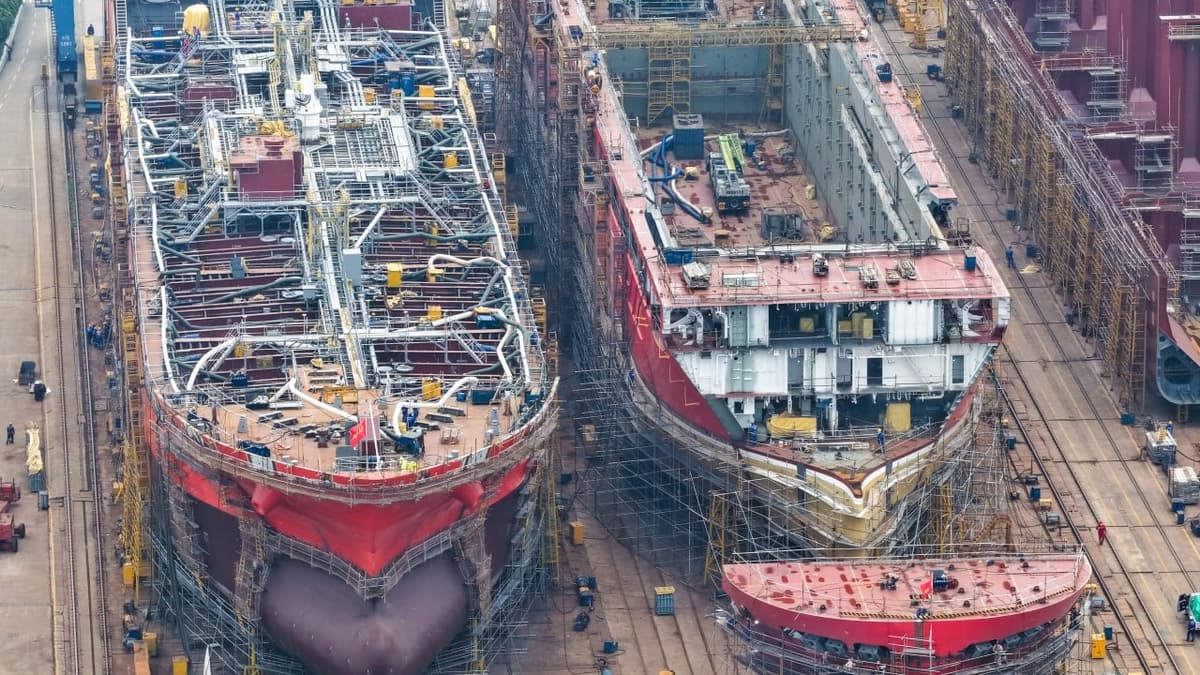
China’s Shipyards Secure Wave of Oil Tanker Orders as Iran War Drives Demand
Why It Matters
The influx of VLCC orders strengthens China’s dominance in shipbuilding while alleviating a critical bottleneck in oil logistics, influencing freight rates and energy supply chains worldwide.
Key Takeaways
- •Chinese yards win $650M VLCC order from Mercuria
- •Advantage Tankers adds two 307k DWT VLCCs, delivery 2028‑2029
- •VLCC charter rates hit $234,700 per day, up 3.4%
- •China captured ~66% of global shipbuilding contracts in 2023
Pulse Analysis
The prolonged blockage of the Strait of Hormuz—handling about 25% of the world’s seaborne oil—has forced shippers to seek larger, more efficient vessels that can avoid the risky Persian Gulf detour. Very large crude carriers, each capable of moving roughly two million barrels per voyage, have become the premium asset, driving charter rates up to $234,700 a day. This environment has sparked a wave of new orders as traders and owners scramble to secure capacity before the market tightens further.
Chinese shipyards are uniquely positioned to meet this surge. With lower labor costs, abundant dry‑dock capacity, and state‑backed financing, they can promise shorter delivery windows than traditional South Korean yards. Recent contracts illustrate the shift: Mercuria’s near‑$650 million agreement for up to four VLCCs and two LR2 product tankers, Advantage Tankers’ two 307,000‑DWT VLCCs slated for 2028‑2029, and Yangzijiang Maritime’s eight‑VLCC first‑time entry. Together, these deals underscore China’s capture of roughly two‑thirds of global new‑build orders in 2023, relegating South Korea to just over 10% of the market.
The ramifications extend beyond shipyards. Tight tanker supply lifts freight rates, boosting earnings for owners but also raising transportation costs for refiners and consumers. Moreover, the concentration of new‑build capacity in China could reshape geopolitical dynamics in maritime logistics, giving Beijing greater leverage over a critical segment of the global energy supply chain. Stakeholders—from commodity traders to policy makers—must monitor how this realignment influences both short‑term market volatility and longer‑term strategic positioning.
China’s shipyards secure wave of oil tanker orders as Iran war drives demand
Comments
Want to join the conversation?
Loading comments...